Visiting Elephant Island

Standard

Adventure in Getting There

After my trip from the Surin Project in Ban Tha Klang to Koh Chang, I’m not certain that I buy into the whole “it’s the journey not the destination” philosophy when actually traveling. On a map, the distance between these two locations is not that far. My mistake was in thinking that there would be an easy route to get between the two. Trusting Ocha’s directions, I boarded the Nakonchai Air bus around 9 PM in Surin. The plan was to take the bus to Rayong and from Rayong it would be easy to catch a bus to Koh Chang. At least that’s what he said.

As we were sitting in the Surin Nakonchai Air bus terminal waiting for the bus, Ocha tells me to make sure that I get off the bus at the main Rayong Bus Terminal on the outskirts of town, not the separate Nakonchai Air terminal. Despite the comfort of my seat, I spent the next 8 hours in spurts of that trance-like sleep where you aren’t fully asleep but aren’t awake either. Having no concept of where the stop for Rayong was along the route factored heavily into that sleepless equation. Turns out, the bus doesn’t actually stop at the main bus terminal in Rayong. So at 5 AM, bleary eyed and confused, I finally ask a songtheaw driver to take me to the main bus station. The driver was not willing to bargain on the fare, insisting on charging me 150 baht (about $5). Based on where Ocha said the main bus station was relative to the Nakhonchai Air terminal, I figured was the price was high, but what is a couple of dollars when you are tired and confused. The driver took me to the terminal located inside the city about 10 blocks away. Upon arrival, I watched him laugh about the con he had just pulled on me. He watched me get my minivan ticket and continued to smirk smugly in my direction. Hopefully he felt the daggers that my look sent him. I also hope that my wish that his actions be returned to him ten-fold was fulfilled.

Feeling hopeless and seeing that my only options were minivans to get to Koh Chang, I purchased my ticket for 200 baht and waited for the 6 AM minivan to leave for Koh Chang. Technically the minivan goes to Trat and from there I needed to take a ferry over to Koh Chang. By the time I got on the minivan, I discovered all the regular seats to be filled and had to settle for the very back, less padded seat. On the upside, for a good portion of the ride I was able to lay down on the seat and rest. After about an hour or two, I really can’t tell you how long it was in my sleep deprived state, my stop apparently came up. My stop turned out to be a small building at a corner on the outskirts of Trat. The driver took my suitcase up to the building for me, said something in Thai to whoever was supposed to be there, and off he went. As I stood alone in the building, I took some solace in the sign to buy a ferry ticket.

After a short time, a man and two women arrived. The man said abruptly, “You wait for more people”. I said ok. Then after a few moments a minivan pulled up. Again the man said abruptly, “You buy ticket.” Quickly, I bought my ticket and got in the minivan. Without waiting for any more passengers, we were off for the 35 km drive to Leam Ngob where the ferry goes to Koh Chang. Arriving at the ferry, I was summarily dropped off. Looking disoriented and weary, a kind man pointed me through a door. I handed my ticket to the woman and wandered up to the ferry that was in dock. Being the only person that was on foot, I wasn’t sure if I should board or not. After a bit of hesitation, I walked up the car ramp and onto the ferry. After staking out a place where I had a great view, I purchased an ice coffee and took a deep breath.

With careful orchestration, cars loaded onto the ferry. Eventually the ferry engines started churning and we departed for Koh Chang. Arriving on the island, the last hurdle was getting to my hotel. The white shared taxis at the meeting point insist on waiting until there are around 12 passengers to make the journey. Again, I was told to wait for more people. I joined another couple in waiting. Two more ferries arrived and still no more passengers. Finally, as though sensing my palpable desperation to get to my hotel, the drivers decided to make a deal with us to pay more than the normal fare instead of waiting. Initially, he said 200 baht. Less than 3 minutes later, while the other couple was debating the offer, the driver said 250 baht for me. Still stinging from the exchange with the driver in Rayong, I challenged him on the change in fare. Agreeing to 200 baht and the other couple agreeing to their offer, we loaded onto the taxi and finally were off. An arduous 16 hours after leaving Ban Tha Klang, I arrived bleary eyed and sleep deprived at my destination, Bailan Bay Resort.

Welcome to Koh Chang!

Welcome to Koh Chang!

Elephant Island

Koh Chang, translated as Elephant Island, is situated off the coast of Thailand, near the Cambodia border. The island is a lush green rainforest rising up out of the turquoise blue water of the Gulf of Thailand, looking like a herd of elephants loitering in a lake. Maybe it’s like finding shapes in clouds in that we see what we want to see.

Elephants are not indigenous to Koh Chang. Koh Chang got its name from the elephant shape of the headland. The elephants that are here have been brought here to cater to the tourists, giving elephant rides and doing trekking. Sarot (the head mahout from the Surin project) has family that moved to Koh Chang to give rides in Ban Kwan Chang on the east side of the island. Never approving of elephant riding, Sarot opted to stay behind in Ban Tha Klang. Going past the elephant riding camps, my heart aches for the elephants and the families that are broken up in the name of the tourist baht.

The second largest island in Thailand, Koh Chang is roughly 30 km long and 14 km wide, its highest point is 744 meters (2,440 feet). Most of the central part of the island is virgin rainforest, leaving the inhabited areas to the coast. Wanting to be further away from the main tourist areas, I chose Bailan Bay as my destination. Bailan Bay Resort is a quaint resort about halfway down the western side of the island. The individual bungalows cling to the hillside on the sharp 100 meter (328 feet) descent to the water. In a land of several resort hotels, Bailan Bay Resort is somewhere in between the fancy and the cheap.

At the end of the path of uneven step-stones, tucked away behind a pair of mangrove trees and nestled into the hillside is bungalow #20. A sea-view room with a fan, it is about 20 feet from the water at high tide. The side of the bungalow facing the water is graced with two large windows and the small wood porch ensures an ample view of the bay. The bungalow is typical of most Thai bungalow architecture; a wood structure housing a single room with a thatched roof. The attached bathroom is almost like a concrete after thought.
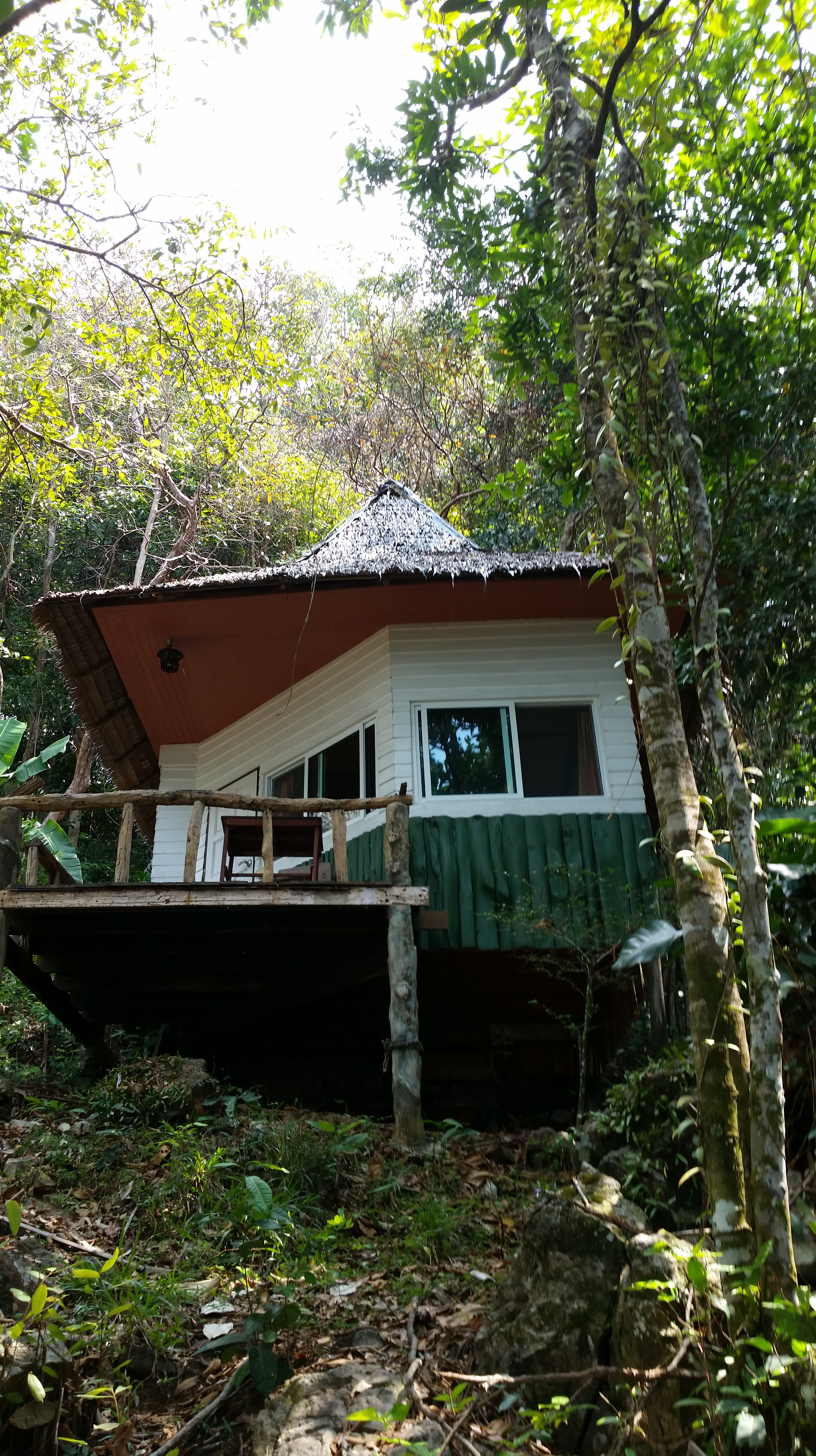
Bailan Bay Resort Bungalow #20

Bailan Bay Resort Bungalow #20

My bungalow is as far from the reception and restaurant as possible. To get to my bungalow I follow a cement walkway running parallel to the hill, then down a steep flight of 52 stairs with varying rise and run. The cement is textured like tree bark to as though to blend in with the natural surroundings. At night, the path to the room is illuminated by lanterns attached to poles. Where the lanterns have been broken, they are replaced by light bulbs protected by plastic bottles attached to trees. The lights lend an almost fairy tale like quality to the walk.

What Bailan Bay Resort lacks in upscale amenities and maintenance, was made up for by its location. Taking the easy route of cutting around a mangrove tree, across the beach of the neighboring property, through the property up to the main road, and a short walk down the main road, I was at the small gathering of shops and restaurants that could be called Bailan Bay Village. I don’t think the village technically has a name. The best part was the distinct lack of tourist crowds found in the other coastal towns and beaches.

The Rough Life

Visiting Koh Change is like being in a postcard for a week. The verdant greens, the aqua and turquoise blue water, the clear skies. Mangroves dot the shore to help keep the island from eroding into the water. Vines drip from the trees as they reach toward the sky seeking the sun. The gentle waves of the Gulf of Thailand gently lap at the shore. Stump tailed macaques playing in the trees adding their chatter to the sounds of geckos chirping.

Every day I made it a point to take a swim in the bath-like clear blue water. Even on the day that it rained, only the top couple of inches of water were cold, the lower layer feeling as though it was still being warmed by some geothermal source. Among the rocks lining the bottom of the bay, I saw many fishes darting for cover as I passed by. Though not as vibrant as some areas that I have had the opportunity to snorkel, I got to see quite a variety of yellow and black, all black, blue, brown, big and little fishes. Black eels lay on the bottom like large cucumbers. As the water became deeper, I swam through fields of sea weed. The tree-like plants ebbing and flowing in the tide, giving the water a yellowish cast. Eventually the water became deep enough that I could no longer see the rocks, despite how clear the water was.
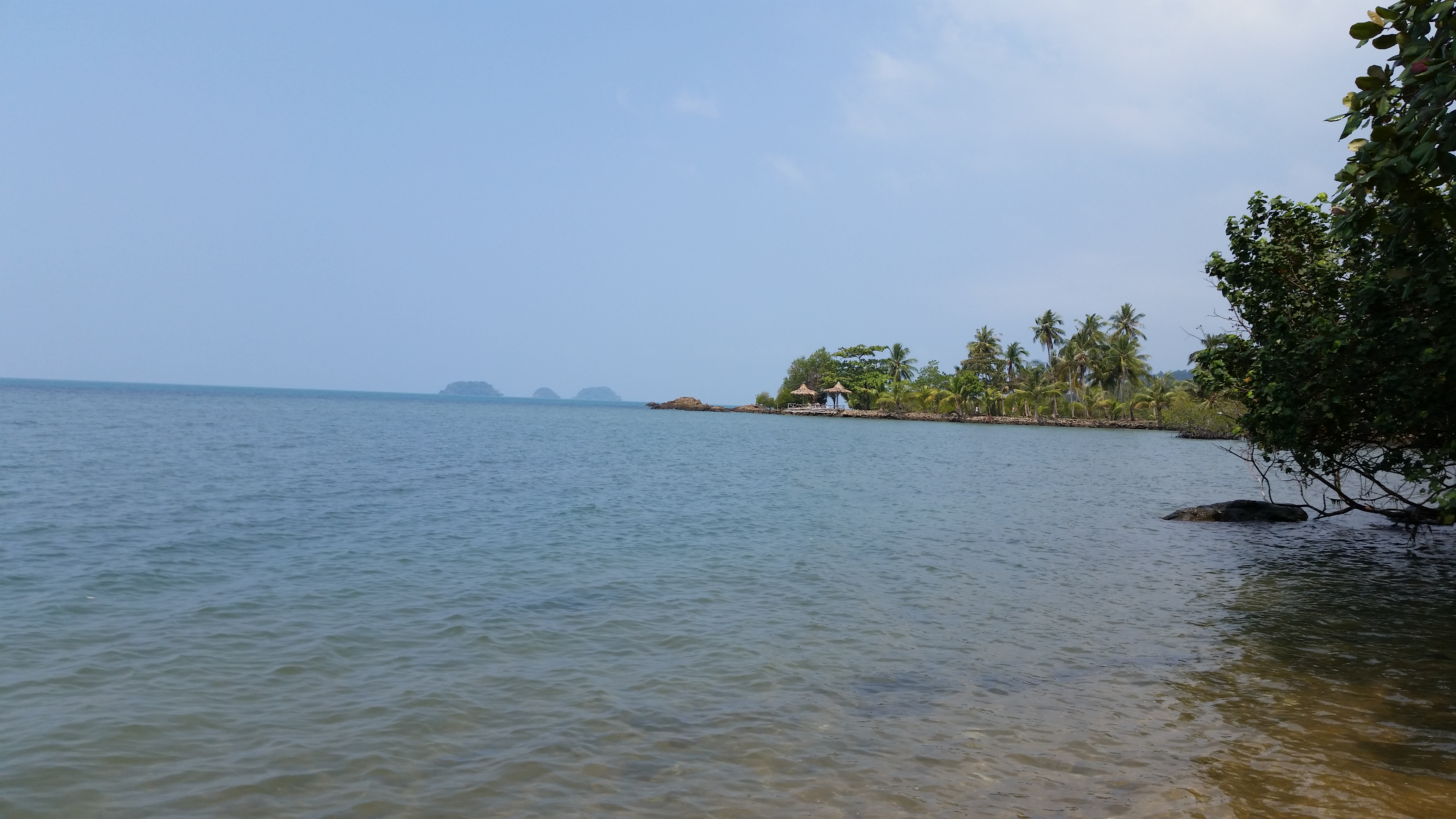
Bailan Bay

Bailan Bay

The changing tides were evident in the bay. At high tide, the water covered the many rocks and most of the beach. At mid-tide swimming became a bit of a challenge weaving around the rocks. At low tide, the water recedes almost all the way out of the shallow bay. The rocks and sand exposed like an alien landscape. The ground offering burbles and pops as the water gave way to the air.

Rounding out each day was watching the golden sun dip below the horizon, its last rays turning the water shades of oranges, pinks and purples. The sun growing large and red as it moved closer to the water. Sitting on the beach, the peacefulness and beauty was perfect.

Seeing the Island

My attention span doesn’t lend itself to spending multiple days on a beach doing nothing. So after a few days of decompression and hoping to make this blur of a trip slow down, I headed out to see the island. Heading to the little village just over from the resort, I rented a motorbike, put some gas in it and off I went.

Driving on Koh Chang’s roller coaster roads was a thrill at times. The yellow “steep slope” sign, displaying a truck over a 30-60-90 triangle representing the slope, didn’t seem to do the steepness justice. Going down several of the hills, my toes were pressed firmly against the front of the motorbike foot area to keep me on the seat. Conversely, going up the hills, occasionally it felt as though I might slip right off the back causing me to grasp the handlebars as tightly as possible. The ups and downs are punctuated by sharply twisting turns. One particular hairpin turn between Bailan Bay and Lonely Beach has a double hairpin turn. A sign at the top informs drivers heading down the hill to give opposing traffic the right of way, since it is pretty much impossible to stay in the lane and make the curve.

Double hairpin turn on a steep hill

Double hairpin turn on a steep hill

Loving the freedom and feel of riding a motorbike, I have been known to go long distances. To get the feel of the motorbike and hoping for less steep hills and sharp curves, I headed about 10 km south to the southwest point of the island. Or, at least to the point where the road seemed to end. Turning around, I zipped my way north 25 km along the coast, up and down hills, around curves, feeling more comfortable with the motorbike. Along the way I stopped at overlooks, the tops of hills, to see a gathering of cute but really evil macaques, and to visit a shrine or two. Proceeding down the east coast, I found much flatter roads as I rolled through groves of coconut, lychee and rubber trees. Occasionally the fruity floral scent of plumeria blooms would catch my nose. 25 km later, I reached the end of the road at the southeastern point of the island. By the time I returned to my hotel, I had managed to ride about 100 km, all on an island. I wouldn’t have thought it possible to ride that far on an island, yet, I somehow managed to do it.

Driving 100 km requires several liters of gasoline. Gasoline “stations” on the island typically consist of several recycled Hong Thong (a whiskey drink) or liter soda bottles filled with gasoline on some type of stand or table with a sign that usually had “gasoline” spelled correctly. The typical cost was about 40 baht ($1.30) for about 750 mL. Coincidentally, the color of 91 octane gasoline and Hong Thong are about the same color. I don’t recommend confusing the two.

Gasoline stand on Koh Chang

Gasoline stand on Koh Chang

Stump tailed macaques are indigenous to Koh Chang. Macaques may be cute to look at, they are generally quite mean. At one point, as I came around a corner, a bevy of tourists were gathered gawking and photographing a gaggle of stump tailed macaques putting on a show by the side of the road. I stopped for a picture or two as well; however, I didn’t stay long. As I was looking eye to eye with a macaque, I got the sense he was working through the options of pouncing on me or not. I made the decision for him and sped away.

Within the virgin rain forest on Koh Chang are several waterfalls. At 20 meters, Klong Plu Waterfall is the tallest waterfall on the island and is easily accessible from the main road on the west side of the island. Listed as one of the “Top 16 Things to do on Koh Chang” on Trip Advisor, even in dry season, I opted to pay the 200 baht fee for foreigners and hiked to the waterfall. After paying 10 baht to park my motorbike at the insistence of the friendly locals to park outside the gate, I discovered free parking just inside the gate.

The trail leads through the rain forest to the waterfall. Having had some rain the two days prior, the ground and trees were moist and everything was lush green. At the end of the trail, the area opens out into a vista with a terrific view of the cascading waterfall. As a popular spot to visit, I was not alone. Many tourists and Thai were wading or swimming in the water, jumping off the rock face into the deep swimming hole at the base of the waterfall. Escaping some of the tourists by scrambling over the rocks, I was able to get a closer and more peaceful view. And as the Trip Advisor review indicated, even in February it was worth the time to go visit.
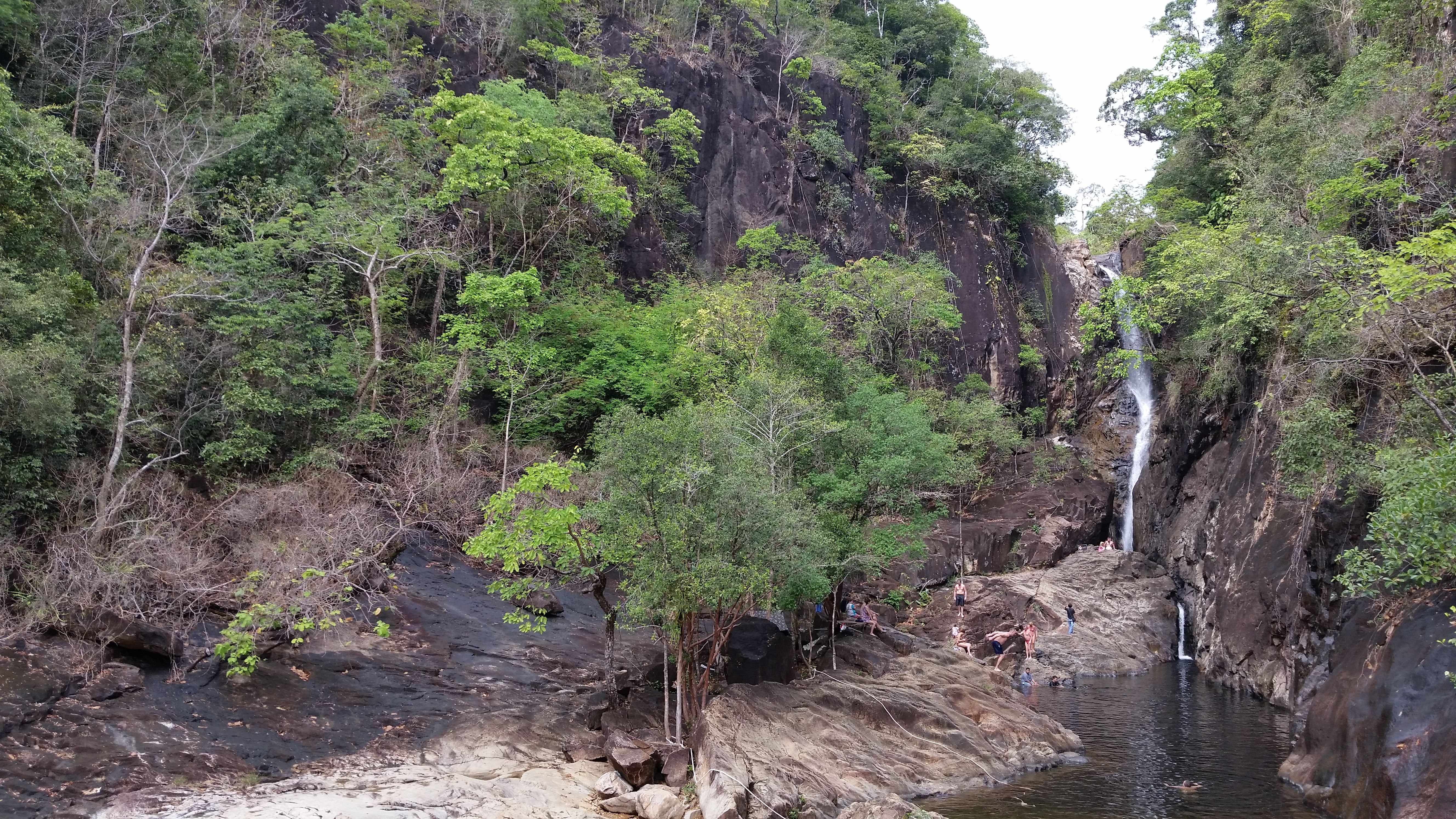
Klong Plu Waterfall

Klong Plu Waterfall

Kai Bae View Point is purported to be the most spectacular spot to view the sunset on the island and at every tourist shop you can find postcards taken at this spot. On a cloudy day it is a nice view. On a clear day it is an absolutely gorgeous view. The first time I stopped at the view point, it was overcast. Two days later the weather was clear and sunny. Despite gut wrenching cramps from food poisoning, I ventured around the double hairpin curve to go to the view point. Looking out over the turquoise and aqua water glistening in the sun and the smaller green islands, I was reminded of how beautiful the place the island is and how fortunate I am to get to take these adventures.

The postcard shot from the Kai Bae Viewpoint

The postcard shot from the Kai Bae Viewpoint

For those of you that have been following my tales since the beginning, you might recount my first experience driving a motorbike on a Thai island and the resulting “Phuket tattoo” (burn) from a small mishap that I had. In the past almost exactly 7 years, my motorbike skills have improved dramatically. Probably helps that I only use automatic motorbikes at this point. Three days of riding on the steep roller coaster hills with their hairpin turns and no mishaps to report. Phew.

Heading Home

The trip leaving Koh Chang for Bangkok was much less harrowing than the trip getting to Koh Chang. Svuarnabhumi (prounounced: soo-wan-a-poom) Bus Company offers a trip from Koh Chang island directly to the Svuarnabhumi airport for 600 baht ($20). Staying at the resort farthest down the coast, I was the first to be picked up by the minivan on the morning of my departure. We made our way back up the coast, stopping at several resorts along the way until the van was filled with other tourists starting their journey onward. From there, they gave us white tickets and took us to the center point ferry. Dropping us off with our luggage, we were herded onto the waiting ferry and directed to go ahead and leave our bags gathered along the side with the cars, and head upstairs.

Weather beaten and rusty from the salt water and sun from the hundreds of trips back and forth, the ferry churned through the water, leaving Koh Chang behind and heading for the mainland. The weather was beautiful, giving me one last fill of turquoise water and lush green island. Taking a few more pictures, I said goodbye to Koh Chang. Arriving at the dock on the mainland, I watched in awe at the skill of the ferry pilot in bringing the ferry into dock. With incredible precision and timing he swung the ferry around and docked it seamlessly.

Centerpoint Ferry Dock on the mainland

Centerpoint Ferry Dock on the mainland

Gathering our luggage and watching the finely orchestrated dance of cars being directed off the ferry, we made our way to a shuttle bus. This bus took us the length of the pier. Unloading and gathering bags one more time, we transferred to the big bus to go to Bangkok. I managed to snag a window seat. Lena, a nurse from Sweden, asked to sit by me. Much to the probable chagrin of the passengers around us, Lena and I hit it off splendidly. We talked pretty much the entire 7 hour bus ride, including the stop for food that the bus makes half way to Bangkok.

As though breaking my computer and camera on this trip weren’t enough, I managed to finish the trip with a flourish. Arriving in Svuarnabhumi airport, I said my goodbyes to Lena and went to 7-11 to get some juice and yogurt for the morning. As I went to pay for my purchase, I discovered that my change purse was not to be found in my bag. Filled with panic, I paid for my purchase with other money that I had, scurried out of the shop to the nearest place I could and dumped the contents of my bag on the floor to make sure I didn’t just miss it. For some reason, when something is misplaced I think it is human nature to check in even the most unlikeliest of places. I checked my backpack, which I hadn’t opened on the bus or since being in the airport, and my bag a third and fourth time. No luck.

Rushing down to the bus counter, I asked if the bus was still there. No, it had already left to go over to the main bus terminal for cleaning. Pearl, a Thai woman who happened to be standing there, was a wonderful help. She made phone calls for me and wrote out my situation in Thai to make it easier for me to communicate with the people at the main bus terminal. Anxious and hopeful, I got on the shuttle to the bus terminal. I kept telling myself “jai yen yen” (which means to keep a cool heart and not get excited) but I wasn’t listening very well. They pointed me to the bus and despite it already being swept and half mopped, they still let me look under and around my seat. No luck.

While upsetting and annoying, nothing that was in the change purse is irreplaceable. I’m grateful that I still had my passport and I had money to travel. Arriving at my hotel, I called and cancelled my credit card that was in the purse and when I return home, I will get a new drivers license. These are the events that make a journey and adventure.

Return to the Elephants

Standard

Back Again

This trip to the Surin Project is my fourth since 2013. On every visit, it is always heartwarming to see my mahout (the people that care for the elephants) and elephant friends. The first person from the project to greet me is Nana, the driver. Because I usually meet the volunteer group arriving from Bangkok at the Buriram bus station, I am typically there waiting when he arrives. His warm smile and cheerful Sawad dee krabp (hello) never fail to bring a smile to my face. Next is Sarot, the main Thai coordinator of the project, when we arrive in Ban Tha Klang at the Elephant Study Center. This time I was able to show him the final version of the tattoo that was fresh and healing the last time I was there. He rubbed it with his wrist and said “good luck, good luck.” My tattoo is that of a Kui (pronounced: goui) symbol he drew on one of my previous trips representing the eight directions we can go in life so that you never lose your way.

For the first time since participating in the project, I stayed in a different house. The project rents houses from the mahouts for the volunteers to stay in. Typically it is two volunteers to a house (or more if there are couples). Because I have a history of disturbing other volunteers with my snoring, Wills arranged for me to have my own place in Dao’s house. Even though Dao is no longer on the project due to health reasons, we still rent his house. Having the change was nice even though I was a bit farther from the Volunteer Meeting Point. Outside my window was Sai Faa’s shelter. Hearing the sounds of an elephant eating, sugar cane swishing against her legs, and the occasional belly rumble is such a calming and happy sound.

The first chance to see the rest of the mahouts, and meet the new ones, is at the welcoming ceremony. Every week of the Surin Project begins with a ceremony performed by the local shaman. The ceremony is part Buddhist and part Kui, which follow a more animistic practice. Pan always seems to be the first mahout to arrive, and I am always greeted with “MJ, MJ”. At least this week I was sitting next to a second week volunteer, so was not the brunt of Pan throwing star gooseberry leaves at me like the last time.

The purpose of the welcoming ceremony is to bring us together for the week as a family and wish us projection and health while we are there. One of the concepts I really enjoy about the welcoming ceremony is the idea of bringing your spirit back to you. As animists, the Kui believe that occasionally your spirit may wander off. Throwing star gooseberry leaves is a ritual to bring your spirit back to you.

With only 12 elephants on the project, the number of volunteers is limited to 12. In the past, the largest group I had been part of was 9. This week we had 12 volunteers. Seeing the growth in popularity of this project is awesome. Of all the Elephant Nature Foundation projects that I have participated in, I believe in the Surin Project purpose and mission of “working to improve the living conditions of captive Asian elephants” the most. For more on the Surin Project see my post: Why Volunteer at the Surin Project or visit www.suringproject.org. Sadly, this trip also marks the last time that Kirsty and Wills will be there as the project coordinators. I will be sad to see them leave; however, their legacy will last in the solid foundation they have established for the project to continue to expand and grow.

Who’s New and Who’s Gone

Each visit to the Surin Project starts with a roll call of elephants and their mahouts. For one reason or another, sometimes elephants are taken off the project. While it is sad to see some of them go, at least they are replaced with other elephants. Two elephants, Jaeb and Sai Faa, left the project since my last visit. Both left because the mahouts had health reasons. Replacing those two elephants are Nuua Tong and Manow.

The cutest addition to the project, bringing the number of elephants back up to the 12 (technically 13) that can be supported on the project are baby Anda and her mom Kaem Sen. Baby Anda is about 4 months old and as cute as ever. Watching a baby elephant trying to figure out how to use their trunk and eat the sugar cane is adorable. Sometimes Kaem Sen gets a little anxious when Anda is running around or when volunteers get a little too close. When she does, she begins slapping her trunk in an attempt to try to get little Anda under control.

Typically when an elephant leaves the project, the knowledge that their life has changed is sad and generally fleeting as the elephant is out of sight, out of mind. Staying at Sai Faa’s mahout’s house, her new existence caused me a bit of heartache. Dao, Sai Faa’s mahout, had to leave the project for health reasons that wouldn’t allow him to participate in the walks and other required work. Sai Faa, his elephant, has been returned to a life of giving back-breaking elephant rides during the day and being on chain the rest of the time. Her saddle is on a shelf just outside my door by the stairs. The missing saddle during the day is a subtle reminder of the change in her daily existence. When she is not out giving rides to the hordes of tourists that visit the Elephant Study Center, she is on chain in her shelter. On the Surin Project, elephants are only allowed to be chained by one chain. Dao is now chaining Sai Faa with two chains. She has a chain on her back leg to keep her in her shelter and a chain between her two front feet. The chain between her two front feet allows her to take steps of only about 3 feet, which at 5’3” is my typical stride length when I walk. Sometimes when I saw Dao, I just wanted to ask him “why?”

Sai Faa on two chains in her shelter

Sai Faa on two chains in her shelter

On the project, the mahouts are under contract to not carry or use a bull hook. A bull hook is a 2 foot long stick with a sharp metal hook on the end. The mahouts in the center are Kui, the local tribe. As animists, the Kui believe that spirits inhabit the bull hook and carrying the bull hook gives them protection from injury. The hook is used to control the elephant, usually not intended to pierce the elephant’s skin, although on occasion mahouts will use it in that manner. Dao has also returned to carrying a bull hook. Seeing him guiding Sai Faa by the ear using the edge of the hook is not a happy sight. When giving her a hello from the stairs while Dao was putting away her saddle one day, it was hard to not think that the small wound on her head isn’t from a bull hook.

Project Life

The main “work” volunteers perform on the project is giving the elephants opportunities to be off chain and interacting as elephants would in the wild. These opportunities are in the form of walks through the forest, watching them eating and playing in the water in the enclosure and walking to the river for baths.

Every day involves at least one walk in the forest, sometimes two. The first day of the project, the volunteers typically go through part of the forest where the poo paper factory and elephant graveyard are located. Having been on that part of the walk multiple times, Sarot took me to hang out with the elephants as they ate while waiting for the rest of the volunteers. Sitting and watching the elephants munch their way through piles of sugar cane and take care of some itches by rubbing against trees is fantastic. This time was also a chance to refine my sling shot skills in practice for the Mahout Olympics at the end of the week, and also because it is fun. Thong Di lent me his sling shot and set up a couple of sugar cane stalks to hit. Even I was impressed by the fact that I actually hit the stalks several times with some accuracy.

One of the changes on the project this time was the opportunity to go into the enclosure during enclosure time to observe the elephants more closely. On prior visits, the volunteers were restricted to trying to see the elephants from the platform that looks out over the enclosure pond. Often the elephants hang out in the enclosure behind the stands of trees, hidden from view from the platform. Getting to go into the enclosure allows the volunteers to observe the elephants more closely.

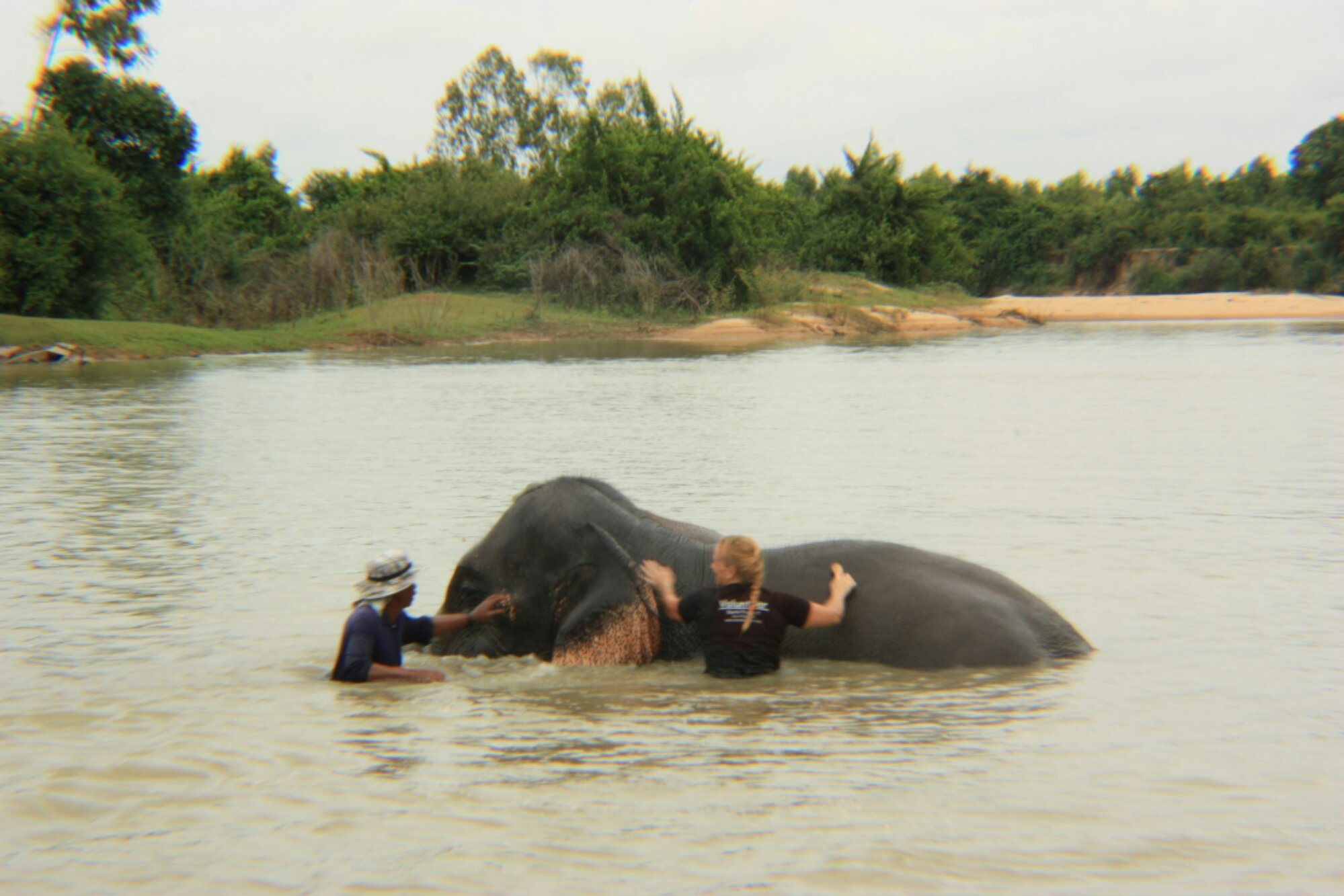
No matter how many times I do it, bathing an elephant never gets old. Feeling their massive body so close, looking them eye to eye, and scrubbing them from head to tail fill me with joy. Luckily we have two opportunities during the week to bathe the elephants. Wednesday I washed Warrin. Pi Pong, Pan’s dad who was taking care of Warrin that day, is very succinct and business like in his work, unlike Pan who tends to live up to his Roman-mythology based name. After washing Warrin, I headed over to help with Fah Sai. At some point during the bath, Thong Di will give Fah Sai the command to take water in her trunk and blow it out while he aims her trunk at a generally unsuspecting volunteer. After dousing Alexia, Thong Di turned Fah Sai’s trunk on me. Even though I know I will lose a water fight with an elephant, it doesn’t stop me from splashing Thong Di after he has Fah Sai spray me. We go back and forth saying “mahout apnam (shower)” and “volunteer apnam”, laughing uncontrollably in the process and getting out of the river soaking wet.

Bathing Warrin in the river

Bathing Warrin in the river

Friday I got to bathe Tangmo, which was a wonderful reward for me after the week of interacting with Krow. Tangmo is one of the smaller elephants on the project and is much more mobile in the water. For some reason Krow likes to completely douse himself when bathing Tangmo even though he always says that the water is “yen mak mak” (very cold). So with a “MJ… neung, song, sam (1, 2, 3)” both Krow and I dunked ourselves underwater. Sometimes I think they do these things to see if the volunteers will play along. Most the times I participate because I think it is fun and helps create friendships with the mahouts.

Occasionally we do actual physical work. Every day we have morning chores of picking up the dried sugar cane from the shelters, cleaning the enclosure area and cutting the sugar cane for the elephants. The volunteers are divided into teams and rotate jobs each day. With 12 volunteers the work is done in about 15 minutes, except for the shelter team which goes on a long tractor ride to spread the sugar cane in a field to be used as mulch for young sugar cane. This trip I only had one opportunity to cut sugar cane, which is probably my favorite task as I get to use a machete. Sugar cane cutting this time was a little frustrating as the machete they gave me to use was about as sharp as a butter knife.

One of the days that my team was cleaning the enclosure, we got to meet Lin Daa. Lin Daa was in the enclosure when we arrived and her mahout quickly gathered her so we could clean. On the way out, I had forgot my water bottle and went back into the enclosure to get it. As I was coming out, Lin Daa was coming back in. Turns out Lin Daa belongs to Krow’s parents and is one of the few elephants not on the project that takes advantage of the opportunity to use the enclosure. After the standard conversation of “what’s your name”, “where are you from” and a little astonishment that I can speak just a little bit of slow Thai, Krow’s dad explained to me that Lin Daa is pregnant and that he is 50. Krow’s mom emphatically in loud slow Thai explained that they are Krow’s parents and emphasized again that they are both 50.

Friday the volunteers actually help the mahouts with some project that is needed for the elephants. This week one job was building a poo bin, which is a bin where elephant poo is stored before it is either used to make paper or turned into fertilizer. The other job was going with Sarot and a team of mahouts to cut down poles. Working together we cut as many 3” diameter eucalyptus trees as were needed until we were told that we had enough. My job was to go with Pi Pong to cut trees using a saw. Again, he had a very swift and business-like manner to his work, walking from eucalyptus stand to eucalyptus stand finding just the right ones to cut. He was patient with my sawing skills and gave a bit of direction when to cut slower. No one is really sure what project Sarot has in mind for these poles.

Working with Pi Pong to cut down eucalyptus trees

Working with Pi Pong to cut down eucalyptus trees

Special Moments

The Surin Project is really working to emphasize a more hands-off, just hang back and watch, approach. Occasionally, having the discipline to not go up and touch the elephants and take pictures can be a Herculean feat. Especially when Sarot is encouraging volunteers to come up to the elephants and have their picture taken. Sometimes the temptation is overwhelming and the spirit is weak. Perhaps it is because both elephants and massage therapists use touch to heal or just because elephants are such beautiful creatures, whatever the reason, I sometimes find the desire to touch the elephants overwhelming. On one of our walks when we were hanging out with Fah Sai and Euang Luang in the forest, Sarot was encouraging volunteers to get in and hug Euang Luang’s trunk as a photo opportunity. I couldn’t resist and got in there for my hug. Mid-hug she gave a deep gentle belly rumble, which to me is one of the most comforting sounds that I know.

Sitting back and watching the elephants results in some pretty awesome experiences as well. During one of the enclosure times, we all stood or sat at the sala (a small simple shelter with a platform and a roof) and just watched Kaem Sen and Anda. Singhat, Kaem Sen and Anda’s mahout, is so beautiful and gentle in how he interacts with Anda. Watching the love and the start of the bonding between elephant and mahout is so special. He would get down to Anda’s height and just let her be in contact with him as she explored her environment. At 4 months old, she is just starting to get used to figuring out how to eat, often attempting to copy what mom is doing. Sugar cane is an obstacle she just hasn’t quite mastered and her attempts to do so are comical and adorable. After a bit of struggling, Singhat gives her an Anda-sized piece of sugar cane that she happily eats.

Watching the mahouts grow and change the longer they are on the project is a benefit of volunteering several times. Seeing the change in Krow, Tangmo’s mahout, this time was precious. The moments where he puts his head against Tangmo or kisses her are just beautiful, truly emphasizing the bond a mahout has with his elephant. In the wild, elephants form family groups and several elephants will take on the role of Auntie to the babies. Tangmo is starting to play this role for Anda. While we were watching Kaem Sen and Anda in the enclosure, Krow brought Tangmo over to be with them and also give Anda an opportunity to continue to grow more comfortable with his presence. Seeing Krow put his head against Anda’s belly and kiss her was precious.

Krow giving Tangmo some love

Krow giving Tangmo some love

A major highlight of the week at the Surin Project is the Mahout Olympics. Volunteers and mahouts are divided into teams to play a series of games. My team was Alexia, Boon Ma, Nana, Suwat and myself. The first event is the slingshot challenge. Five bottles are set up and each person gets five stones. For each bottle that is knocked down, the team gets 3 points. Even after a week of practicing with a sling shot, I was only able to knock down 2 bottles. Fortunately, Nana and Boon Ma are extremely talented with a sling shot. The second event is knuckle bones. Knuckle bones is where you take 10 stone-like seeds, place them in the palm of your hand, toss them in the air, catch as many as you can on the back of your hand, toss those stones in the air and catch as many as you can in your hand using a downward motion. I managed to catch two stones. Nana helped us greatly in this event by catching all 10 stones. The third event was the poo ball catch. Each team member has three chances to use a rake to fling a (dry) poo ball at their teammate that is holding a bucket. The poo ball must be caught in the bucket without the catcher leaving their designated circle. I think we managed to get 2 out of 12 in the bucket. Final event was the 3-legged race. With our ankles bound very securely together, Nana and I started and Boon Ma and Alexia took over, obtaining us a second place finish. Unfortunately, all that left us in a tie for last place.

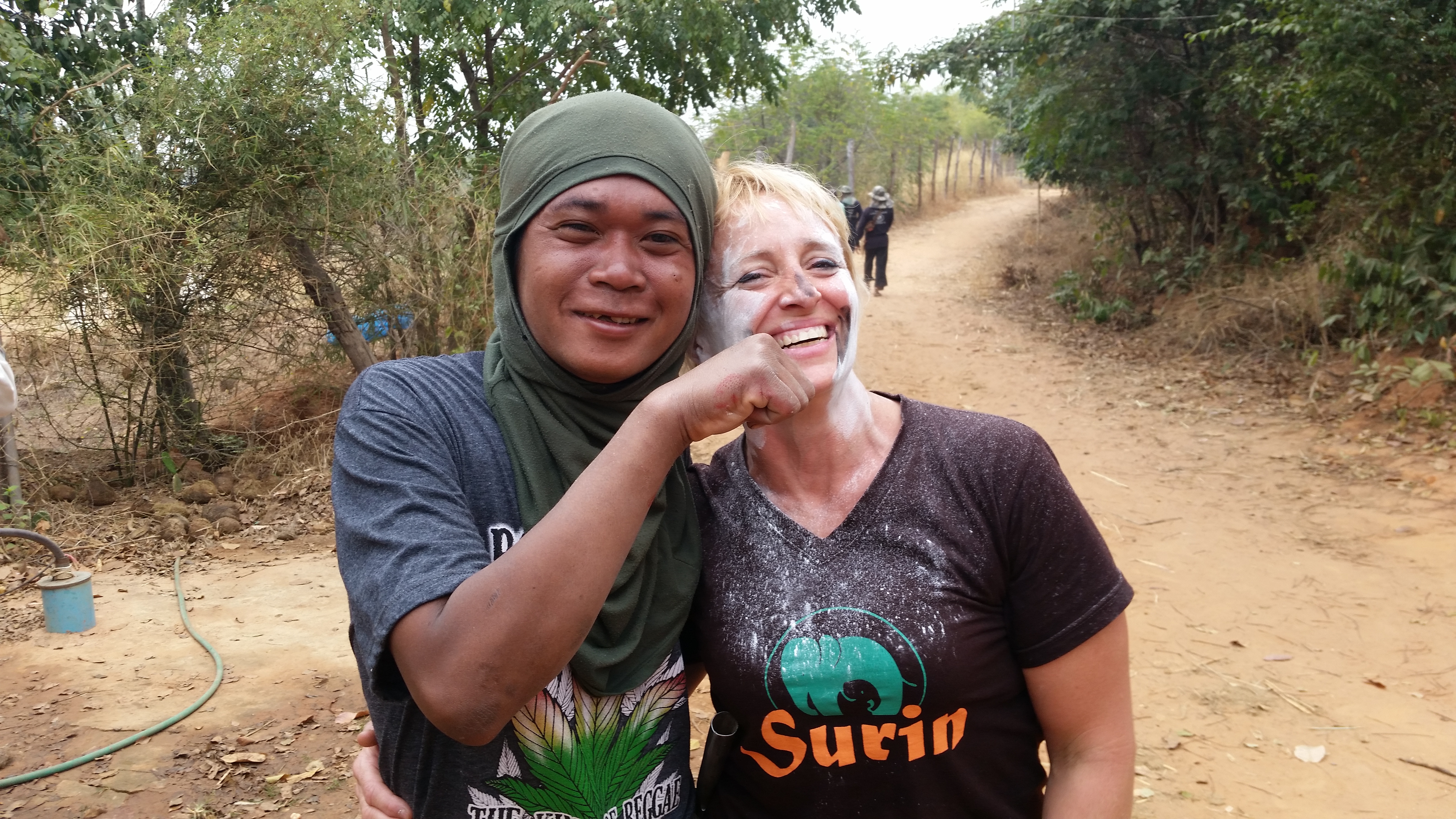
The last place was determined through a match of teams performing Rock-Paper-Scissors. My team went 3-1 in the tie breaker, declaring us the last place team. Our “prize” for last place was a bit of embarrassment and a lot of laughter. After our team picture, we had to perform the Barbeque Chicken song. Only part of us knew the actions that go with the song, but we gave it our best shot. Next, all the other participants had the opportunity to generously cover our faces with baby powder. Krow gave me extra special treatment by using soot to draw lines down my cheeks to my chin, across my eyebrows and on my nose. Once we were sufficiently white faced, we officially closed the Mahout Olympics by performing the Chang song. Again, we did our best to both sing and do the motions for the song. The last part of the embarrassment was the walk back to my house, passing by the extremely friendly shop owner, who got terrific joy at seeing my face covered in white.

Krow and I after the Mahout Olympics

Krow and I after the Mahout Olympics

Not all of the special moments this week were particularly happy. One less-than-happy moment was the spider eviction that I had to perform one night. I am fine with geckos chirping and running amok, especially since they eat mosquitoes. Even the rhino beetle that performed a nightly fly-by of my mosquito netting sounding like a helicopter landing didn’t really bother me, even not knowing where it landed. What bothered me was the night I went to plug in my phone to charge and the rather hefty spider that plopped down on my computer and scurried in the general direction of my bed. It’s possible that I let out a girlish squeak or maybe it was the commotion of me jumping out of my room, switching on every possible light switch on the porch in an attempt to find the broom and then frantically attempting to fling the spider out of my room, that brought Dao’s wife Ruak up to check on me. When she arrived I had successfully evicted the spider. To answer her quizzical look and question if I was ok, I used the international hand gesture of wiggling fingers to explain there had been a spider in my room.

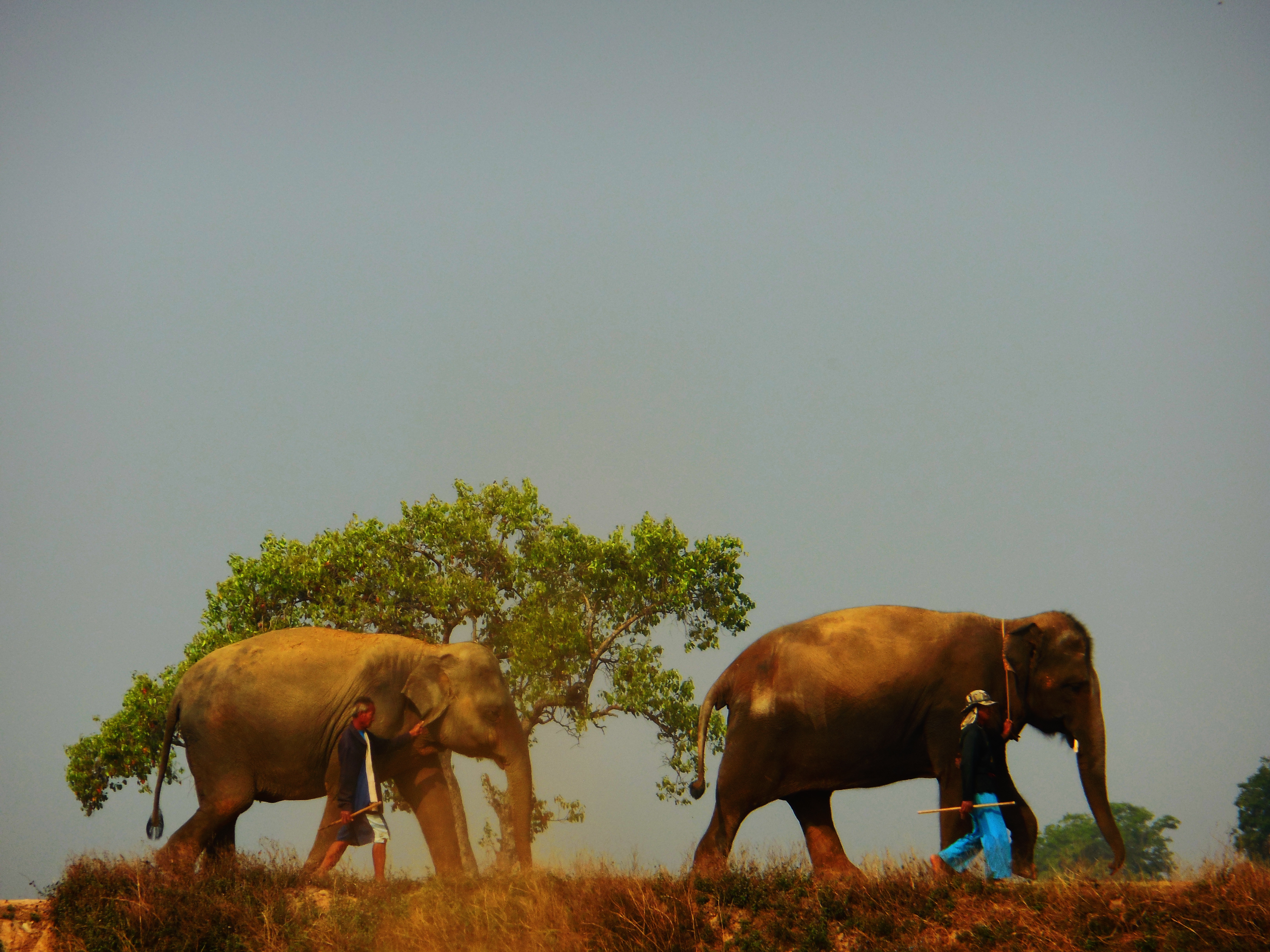
The other less-than-happy moment was the moment that my camera lens jammed on our second walk to the river. One of the other volunteers that is particularly handy with a camera and I had ventured into a rice paddy to get a really cool shot of the elephants as they were walking. As the fields were dry and the angle of the shot was against the berm between rice paddies, a cloud of dust struck my camera. Sadly, attempts to get it un-jammed have been futile. I’m hoping that possibly when I return home, or maybe even while I am on Koh Chang for my last week, that it will be possible to have it repaired. In the meantime, I am grateful that the camera on my Samsung Galaxy phone is almost as good as my regular camera.

Elephants walking to the river

Elephants walking to the river (the shot that killed my camera)

Love is in the Air

One of the crazy moments of the week was when dozens of brides and grooms descended on the Elephant Study Center to participate in a mass ceremony of getting married on an elephant on Valentine’s Day. The sheer number of people at the center was overwhelming, bordering on insane. The main ceremony platform is located just down from our meeting point. Throughout the week we watched the progress of the platform being transformed with the ceremonial trappings.

Finally on the big day it became a zoo of humans, cars and elephants. Participants and their families started arriving in droves around 8:30 am, just as we were returning from our morning chores. Parking anywhere they felt there was space made it impossible for us to return the truck and tractor to their places, eventually just giving up and parking them among the cars. Elephants were gathered in the field behind the ceremony platform, all decked out in ornate cloths under their saddles and some wore headdresses of flowers. The mahouts all had the same bright red shirt. Trucks from the center had been decorated with flowers and bunting to participate in the elephant parade, also adding to the chaos.

Having that much chaos is stressful for the elephants, both our project elephants and the elephants that are waiting to carry the newlyweds around the center in a parade. Fortunately the event went off without any tragedy. Kaem Sen and Anda’s enclosure is the closest enclosure to the ceremonial platform. Kaem Sen is on chain while Anda is allowed to run back and forth. Kaem Sen was clearly anxious about the fact that people kept coming up the closure and wanting to touch her baby. Thankfully we avoided the bulk of the commotion by going on our morning walk through the forest.

As a government sponsored elephant, sometimes the elephants on the project are required to participate in certain events such as this. To refuse to participate would result in the mahout losing their government salary for the week and potentially even losing their place at the Elephant Study Center. Fah Sai was requested to participate. So on Saturday she was dressed up like the other elephants, ornate cloth and basket on her back, and Thong Di had to carry a bull hook for the morning. On our walk in the forest, Nong Neun was particularly vocal about the fact that Fah Sai wasn’t there as part of their friend group. Hearing her trumpets calling to Fah Sai echoing through the trees was a testament to the friendships that can be formed between the elephants.

Why Volunteer at the Surin Project

Standard

Plight of the Elephants

In Thailand, approximately 1,000 elephants remain in the wild, placing the Asian elephant on the endangered species list. Unfortunately, the approximately 3,000 captive elephants are considered livestock, similar to cattle, and are not protected as an endangered species. Captive elephants have a mahout (care taker) that forms a bond with the elephant. Often this bond is a life long relationship.

When young (about 3 years old), the mahout seeks to break the elephant’s wild spirit. Often the breaking process is through negative feedback involving beating with a hook (a foot long rod with a sharp metal book on the end) until the elephant displays the desired behavior. Once broken, if the elephant is destined for life in the tourism industry, they face further training to perform feats that are not a natural part of an elephant’s behavior such as playing soccer (football) or basketball, throwing darts at objects, painting or standing on their front legs. Again, this training is through negative feedback.

In 1989, logging was banned in Thailand. Elephants that once provided essential manpower were suddenly unemployed and their mahouts found themselves without a viable income source to feed their elephants and their families. Many mahouts turned to a life of street begging with their elephants or using their elephants in the tourism industry for trekking or circus shows. Ultimately, mahouts went from a standing of significant status to being on the lowest rung of the ladder.

Street begging elephants faced long days on the streets without access to proper nutrition or water as tourists paid to feed an elephant a bunch of bananas. In 2012, street begging was finally banned in all of the major cities in Thailand. And only a few years ago did authorities start enforcing the ban by fining mahouts using their elephants for begging

Trekking elephants and elephants used for giving rides at tourist locations face back breaking work carrying a heavy saddle (30-50 kilos/56-110 lbs) plus the weight of the tourists which can be another 70 to 120 kilos (150 to 265 lbs) or more, depending on the number of riders. The saddle is often ill fitting as they are a “one size fits all” design, held on with ropes that if tied wrong can constrict movements of the elephant’s legs and their ability to breathe. The elephant wears the saddle the entire working day. Despite the massive size of an elephant, their spine is not designed to bear this type of weight.

Life at the Elephant Study Project

Despite its research sounding name, the Elephant Study Project is basically a relocation option for formerly street begging and otherwise unemployed elephants and their mahouts. The center is located in Baan Tha Klan in the Surin province. Set on 2,000 acres of land, the center is home to anywhere between 150 and 200 elephants and their families. The government provides an income of 8,000 baht ($230) a month for families and elephants living at the center. Often mahouts have to turn to another source of additional income to take care of their families. One option is to perform in the circus that is held twice a day or to offer elephant rides around the center.

Many of the elephants at the center are “on chain” the entire day, either because their mahout is working elsewhere or because they have no place to roam. “On chain” means bound to a stake by a heavy chain allowing the elephant a very small area to move in, typically a radius of only about 6 or 8 feet. Some elephants also have a chain binding their front feet together allowing them very little movement. Another method of being “on chain” is a chain around their neck attaching them to a tree or post of a shelter.

Elephants “on chain” tend to develop stereotypical behaviors, akin to a bored human drumming their fingers or taping their foot. Some elephants sway, some move their head in circles, others rock back and forth. Most elephants at the center display some type of stereotypical behavior. Walking around the center it was heart wrenching to see these beautiful creatures facing this reality on a daily basis.

Why Volunteer?

The Surin Project was started by the Elephant Nature Foundation as a way to provide elephants a better existence and to demonstrate that tourists are interested in seeing elephants acting as they would in the wild. Volunteers pay about $400 a week to be part of the project. This money covers project expenses for the volunteers and to pay the mahouts salaries.

The project currently has funding to support 12 elephants. The mahouts on the project are paid an additional 8,000 baht salary to participate in the program. While these elephants still spend a large portion of their time on chain, the project ensures that they get at least 4 hours a day off chain to go for walks, for swims in the river or for roaming in the enclosure built with the support of the Surin Project. Mahouts are not allowed to use hooks or any sharp objects to control their elephant.

Besides directly supporting the mahouts, the project helps the community and village as a whole. Volunteer lodging is homes that are rented from study center families. The women take care of the houses daily to ensure the bathroom is kept clean and the refrigerator is stocked with an endless supply of water, and will do laundry if needed. Many of the meals the volunteers have are taken at local restaurants.

For more information, see the Surin Project website at: www.surinproject.org

Swiftly Passing Week in Chiang Mai

Standard

Hello Again

Chiang Mai is changing. Sometimes change is good and at the same time bad. Immediately noticeable is the increased cost of taxis from the airport into town, the uniformed drivers and their new cars and the increased number of cars in general on the roads. I know my perception of whether the change is good or bad. Really I wanted to know what the Thai think about it. Both people I asked said that it is good for the economy and bad for the culture. Long, the woman I met at one of the Body Pump classes I attended, summed it up saying that there are so many more Westerners and Asians, in Chiang Mai that she felt came here for what it was and have made it what they want to be. She is saddened by the changes.

In an effort to avoid the touristy and changing old town, and to give me something new to write about, I decided this time to stay somewhere new. The fact that CM Blue House, the guesthouse that has been my home in Chiang Mai for the past 5 years, recently closed also aided that decision. So I opted to stay at Inspire House, just a short distance from Sunshine Massage School.

Inspire House is actually not very inspiring. From the funky stale smell in my room to the tears in the fabric of the sofas in the lobby, it just didn’t make a very good impression on me. Perhaps a fresh coat of paint and a good cleaning of the mold in the bathroom would do it wonders. (To be fair, the fight against mold is a tough one in this climate.) After a day or so, what it lacks in aesthetics was more than compensated for by the luxury of daily housekeeping, two bottles of water a day and a primo location for me. Although lacking strong English speaking skills, the staff was kind and helpful. They helped me get a motorbike the evening I arrived, even though I thought I had arrived too late in the evening to rent one.

Daily Routines

My propensity for making Chiang Mai my home was definitely enhanced by being outside of the old town. During the day I took my massage class. In the evening I worked out, ran errands and went and had dinner. Having such a routine existence made the days fly by.

Having taken several days off of actually working out, the lengthy walks through both Svuarnabhumi and Don Muang Airports on Thursday and Sunday notwithstanding, I needed to go do some exercise. Fitness Thailand offers classes in the evening and Monday and Wednesday were Body Pump class. The instructors are pretty good at leading the class in some combination of Thai and English. Enough English that it wasn’t hard to follow along at all. Also helps that I have been doing Body Pump classes at home so knew the general pattern and moves.

Wednesday evening I arrived at Fitness Thailand running a little behind due to unexpected traffic and a slight navigational issue. When I went to pay I discovered that I didn’t have my wallet with me. No money and no ATM card. Pleading my case to the receptionist, she let me take the class on the promise that I would come back and pay. So after class, I jumped on the motorbike, zoomed back to Inspire House, had a slight moment of panic when my wallet wasn’t where I thought it might be, found my wallet hiding in my backpack, grabbed my wallet, and zoomed back to Fitness Thailand. Times like this are when I am extremely happy to have a motorbike to get around and am generally familiar with Chiang Mai roads.

My inner mermaid was starting to get cranky about not getting in the water, so Tuesday, Thursday and Friday I opted for swimming. Eco Resort, a common location for many Sunshine Massage School students, has a beautiful 25 meter pool. Generally the pool is not crowded, making it fairly easy to swim laps. Sophie, one of the students in my class, was staying there and was at the pool on Tuesday and Thursday. Both days she made the comment that I never stop after watching me jump in the water and swim around 1000 meters each night. The clean, lightly chlorinated, cool water was a welcomed way to end my days.

The most important errand of the week was getting my computer repaired. Upon Lek’s recommendation, I took my computer to the second floor of Panthip Plaza where I found Chiang Mai Notebook Repair. Presenting my computer to them and explaining the tragic incident that had befallen it, I looked at them hopefully and asked if it could be fixed. To my great relief, they said yes. The price for the repair would be 800 baht or about $27. The relief of having my computer fixed and not having to type on my phone washed over me like a wave. The prospect at having to find an alternative or paying a large amount had been weighing on me.

No trip to Chiang Mai is complete without going to the Sunday Night Walking Street (unless you are not there on a Sunday). Walking street is a market that materializes every Sunday evening covering several blocks running right through the middle of the old town. Walking is a relative term, as the number of people squeezing their way between stalls makes a turtle seem like a speed racer. Armed with a list but lacking the desire to do much shopping, I did my best to plod my way down the street and back up. Eventually I gave up and headed back to Inspire House, the realization that I would be forced to do more shopping at the Night Bazaar at some point during the week.

The Night Bazaar is probably my least favorite place to go in Chiang Mai. Pretty much I view it as a feeding grounds for vendors as they ply tourists for their money. Probably doesn’t help that I don’t like to bargain for what I want to purchase, yet know that I have to as the prices the vendors give are inflated to catch the unsuspecting and inexperienced tourist unaware. Tuesday night, after eating dinner and meeting a new friend, we decided in solidarity to head to the Night Bazaar. Generally I was successful in getting several of the remaining items on my list, most specifically the massage tools that I have only ever found here.

Learning Something New

My general motto is to never stop learning. So this year I returned to Sunshine Massage School to take Thai Massage Using the Feet. Our class was the largest I have had there, 20 massage therapists from all over the Europe with a couple people from America and Turkey. Almost everyone in the class was a practicing massage practitioner with several years of experience. Having that much experience in the class was so beneficial as each of us brought a wealth of skills and perspective to the new techniques we were learning.

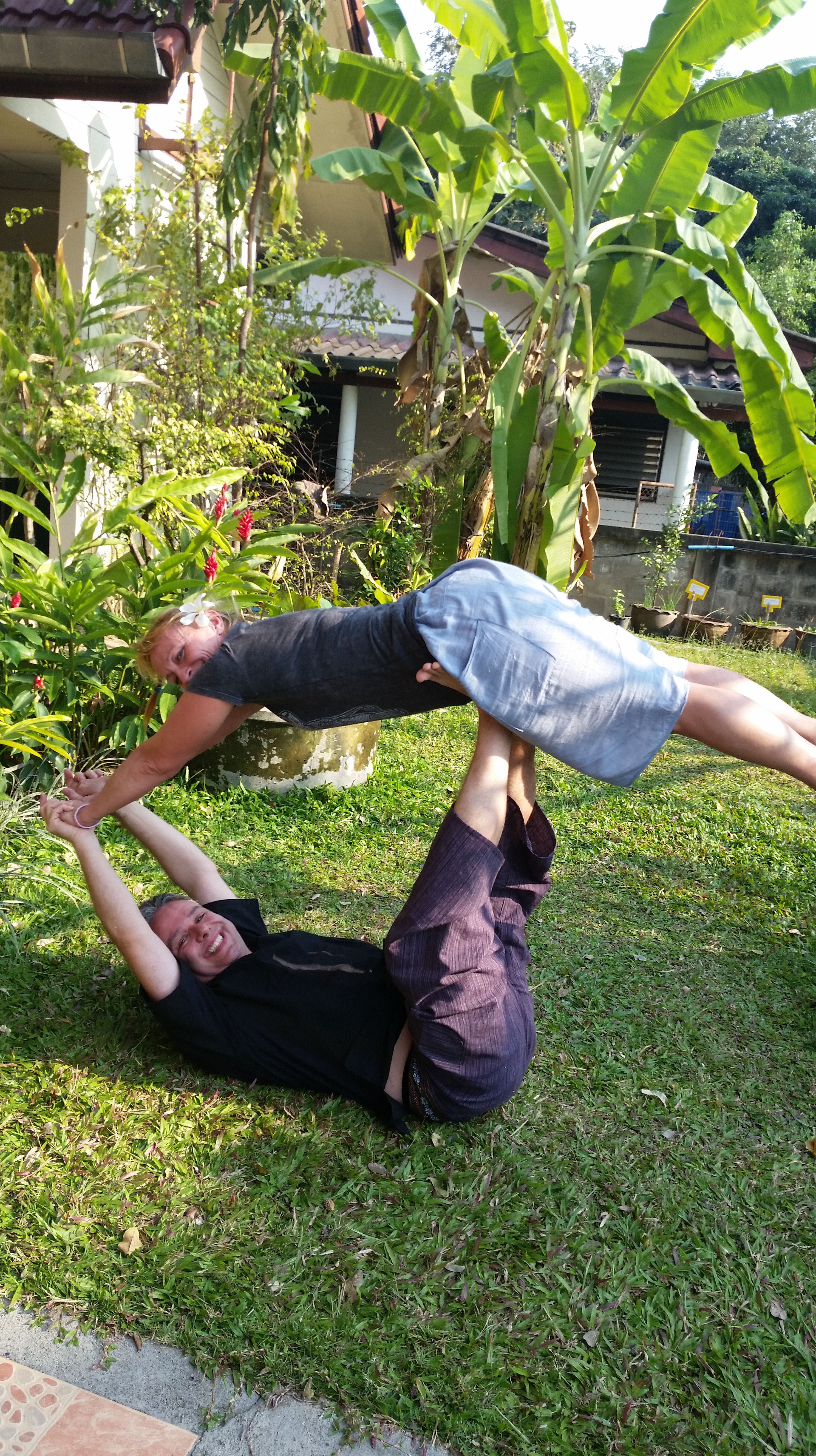
The week of learning passed very quickly. When learning massage, it is important to work with as many different body types as possible. On Thursday I had the opportunity to work with Rogier. Rogier does a form of acro-yoga massage. As the name suggests, acro means in the air. The short term for acro-yoga massage is “flying”. Toward the end of our session, Rogier did some of this type of work. The experience was truly incredible. To be suspended in the air and moved through different positions requires a certain amount of trust and release of control. The most loving and tender part of the time was the ending where he returned to the ground surrounded in a hug. As he was doing this part and I looked around, almost the whole class was watching. Several people commented on how incredible it was to watch. And while I’m sure it looked incredible, it felt even more incredible to experience this type of work.

Flying with Rogier

Flying with Rogier

The People You Meet

One of the most beautiful aspects of traveling is the people that you meet and connect with along the way. People come into our lives at specific times and for specific reasons. And even though your paths may briefly cross, sometimes that person can have a profound effect, like a stone being thrown into a pond changes the water with the ripples it creates.

My normal haunt for dinner is the Chiang Mai Gate market. True, it’s not very adventurous to eat at the same place every night; however, it is a lot like cooking your own food every night, just without the effort. Tuesday night at the market was crowded, with all of the tables filled. At one of the tables was an individual dining solo. Not being particularly shy and knowing it is generally a custom in a lot of countries to share a table with strangers, I asked him if could join him at the table. He said I could so long as I didn’t mind sitting among the trash. As I watched him try to eat his pad thai, I finally couldn’t take it any longer and gave him a lesson on the proper way to eat the noodle dish gracefully. Mike, an American turned Canadian, and I talked for a very long time about a broad array of topics interspersed with moments of very cerebral humor. The capricious amount of witty banter was much appreciated. It was the start of a very interesting friendship that grew over the next few days.

Wednesday night we met again for dinner. When eating at the street vendors it is custom to order your food, eat and then pay before you leave. Mike is just one of those people where conversation comes easily. We were so engrossed at the end of dinner that both of us said our goodbyes and went our separate ways. Fortunately I was taking the long way around the outside moat road looking for a gas station, when I realized that I left without paying for my dinner. Taking the next turnaround I zipped back to the night market and paid for my dinner amongst a profuse amount of apologies. The vendor laughed when I apologized and said she forgot too.

Massage class is a petri dish for meeting and connecting with people. The advantage is that everyone is there for a common purpose and has the fact that we are body workers in common. Having 20 people in class made it difficult to really connect with the group as a whole. Even by the last day there were a couple people whose names I didn’t even know. At the same time, it was possible to establish some very strong connections with people. Justine, a cheerful and kind woman from the UK, and I hit it off almost immediately. Sophie and Melody were also quick connections. The deepest connection I had was with Rogier, a wonderful and kind man from Holland. A testament to when the timing is right; we didn’t actually connect until we worked together Thursday afternoon, yet that connection had the most profound impact on my week.

Just as important as meeting new people is seeing old friends. Many of my friends from Elephant Nature Park have moved away from Chiang Mai. Lek and Chai are the two friends that I have seen most consistently over my travels. Even though we don’t talk as regularly as we used to, we are still friends and still make a special effort to see each other.

Friday night Lek and I were able to meet. She picked a meeting location that she knew I could find, just down from where I used to stay. I parked my motorbike, grabbed my helmet and jumped on the back of her cute orange, almost vintage looking, motorbike. First stop was dinner at a small place on Sirphon Road (the north inside moat road). I took one look at the menu which was entirely in Thai and told her to order for us. We had tom yum goon, fried fish with garlic, and vegetables. We spent dinner catching up and talking about the fact that we have known each other for 5 years already.

After dinner, Lek felt like going to Zoe in Yellow, a bar that is popular for farang (foreigners) and for dancing. A friend of hers was there and invited us to join them at the table they were at. In retrospect, ordering the bucket of mojito for Lek and I might not have been the best move. Somehow by the end of the night, we did manage to drink the whole thing. In the process we ended up actually dancing for awhile. I haven’t danced like that in a long time. Was really nice to relax and enjoy spending time with a very dear friend. At the end of the night, which was about 1 AM, Lek drove me to my motorbike. From there she followed me all the way back to Inspire House just to make sure I made it ok.

Lek and I sharing a bucket of mojito at Zoe in Yellow

Lek and I sharing a bucket of mojito at Zoe in Yellow

Chai travels for his work, which is driving a van for tourists. Most often he is in Chiang Rai. In the blur that was my week, I forgot to contact him and let him know that I was in Chiang Mai, just in case he was able to meet me. Friday morning Chai saw the post of Lek and I on Facebook. Turns out he was in Chiang Mai for the night. Unfortunately for me, he had to work almost all day on Saturday. The beauty of my Thai friends is the lengths they will go to in an effort to see me.

Typically I am ok with Thai time. When it comes to travel arrangements and Thai time, I struggle somewhat. Chai offered to pick me up at Inspire House and take me to the bus station so that I could see him for a few minutes. Saturday happened to be the day that the Chiang Mai Flower Festival parade was happening, making traffic a nightmare. The trip that would normally take maybe 5-10 minutes ended up taking him about 30 minutes. As the time grew nearer for me to catch my bus he finally said that it might be better for us to meet at the bus station instead. Arriving at the bus station at 6:05 for my 6:15 bus, I checked in my luggage and anxiously waited for Chai to arrive. Not having been to the bus station in a long time he didn’t realize that Nakonchai Air now has its own terminal in the bus station complex. Mere moments (6:11) before I needed to be on the bus he made it there to say hello. It was good to see him and I felt guilty that we didn’t get to spend more than those few brief moments.

Even More Ruins

At the end of a very full and very quick week, it was time for me to head south to Buriram. The bus ride from Chiang Mai to Buriram is a 12-hour overnight trip. Fortunately the buses Nakhonchai Air uses are very comfortable, especially the VIP seats at the front. For $24, the VIP seats are worth it as they almost fully recline. Part of the bus experience in Thailand is the sometimes too loud Thai music and then short movie. Fortunately with the overnight trip, about 3 hours in they turn the tv off so everyone can sleep. Until then I made a valiant attempt to drown out the noise using my iPod.

Ever since I have come to the Surin Project, I have wanted to make a trip down to the Prasat Hin Khao Phanom Rung ruins. Generally my travel plans have prevented this from happening, so this time I made a special effort to get there. Prasat Hin Khao Phanom Rung is a former Khmer temple that was part of the Khmer empire that extended from Angkor Wat in Cambodia deep into Thailand in the 9th to 11th centuries. The temple is also the best example of Khmer architecture in Thailand.

The ruins are located a mere 70 kilometers or so from Buriram. The options for getting there are to take a bus to a small town and then a motorbike taxi from there, hiring a taxi from Buriram or renting a motorbike. As is my way, I opted for the motorbike. When I went to rent a motorbike from the place I was staying, you would have thought that I suddenly sprouted a third eye the way the woman looked at me. After emphatically suggesting the taxi approach and me emphatically insisting on motorbike, she helped me locate a place to rent a motorbike that included a helmet. Jintana Resort, where I am staying, has a motorbike to rent but no helmet. In Thailand, helmets are compulsory even if this law isn’t always particularly enforced for Thai. For farang (foreigners) the law is almost always enforced. Not to mention the safety factor.

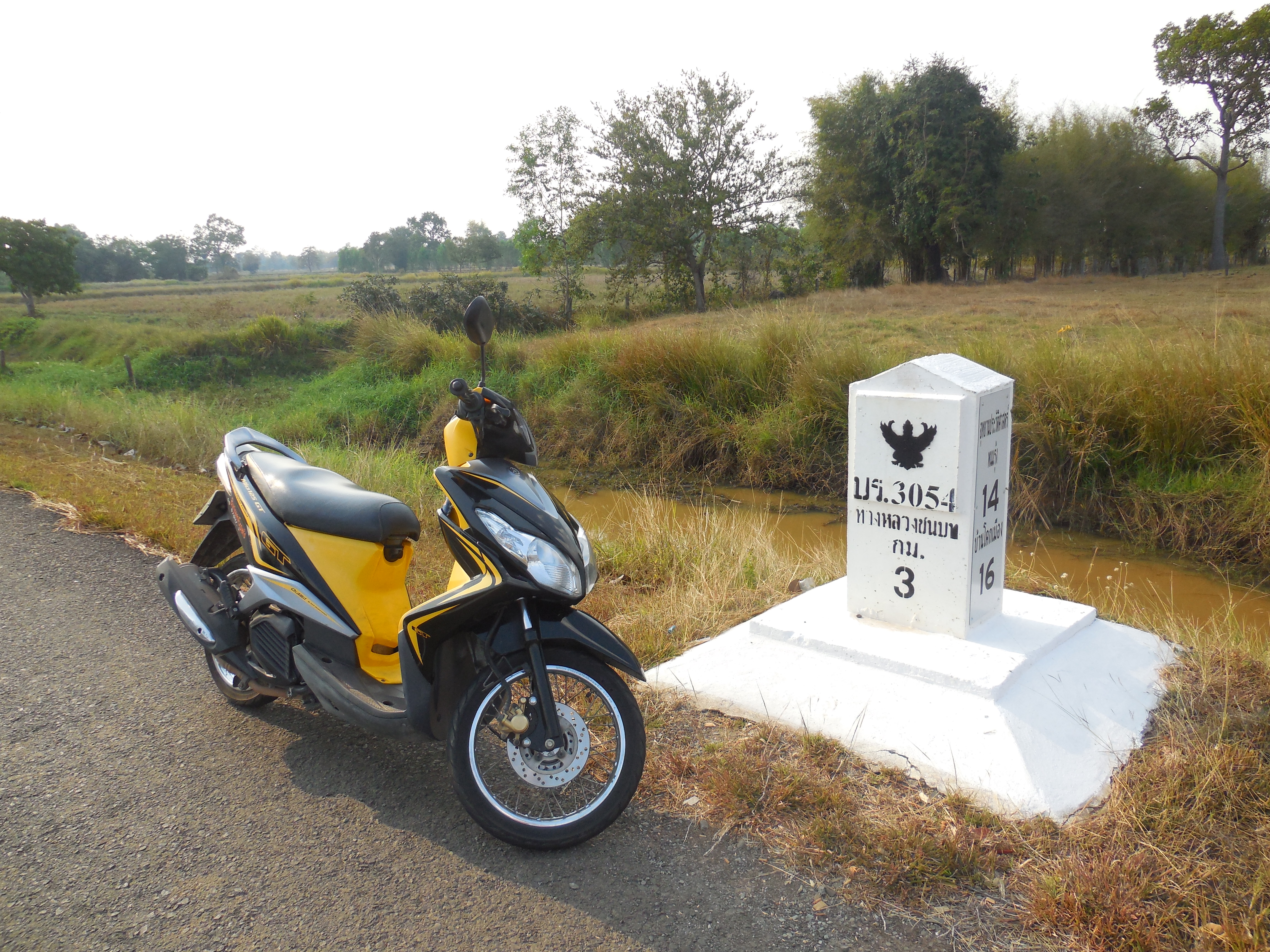
Armed with a not-to-scale map and a practice of holistic navigation, I jumped on my yellow and black motorbike that I immediately nicknamed Bumble Bee Jr. (after the transformer) and headed off. For those unfamiliar with the concept of holistic navigation, it is the practice of heading off in what you assume to be the right direction and hope for signs that you made the right choice. Occasionally this method has resulted in some interesting adventures to places I didn’t expect. This time, according to the blue tourist attraction signs, it worked out pretty well.

Bumble Bee Jr. on the road

Bumble Bee Jr. on the road

Zooming down the road on a motorbike through the sun bleached plains, sometimes strange and interesting sights briefly catch your attention: cows grazing on the side of the road; dogs lying in the sun; motorbikes coming at you on the wrong side of the road; cars coming at you passing another car on a bridge where the road narrows, a large concrete Buddha being constructed on what I’m assuming is the site of a future wat (temple); tourist attraction signs for Thai Silk Village; large fiberglass crane statues marking the entrance to a bird sanctuary; the Thai Cowboy Hat Factory. (Who knew there was a Thai Cowboy Hat Factory?!) The most interesting phenomenon was the waves of cool air fighting with the hot midday sun. Even though the fields looked dry and brown, enough water must have been present to create a swamp cooler effect.

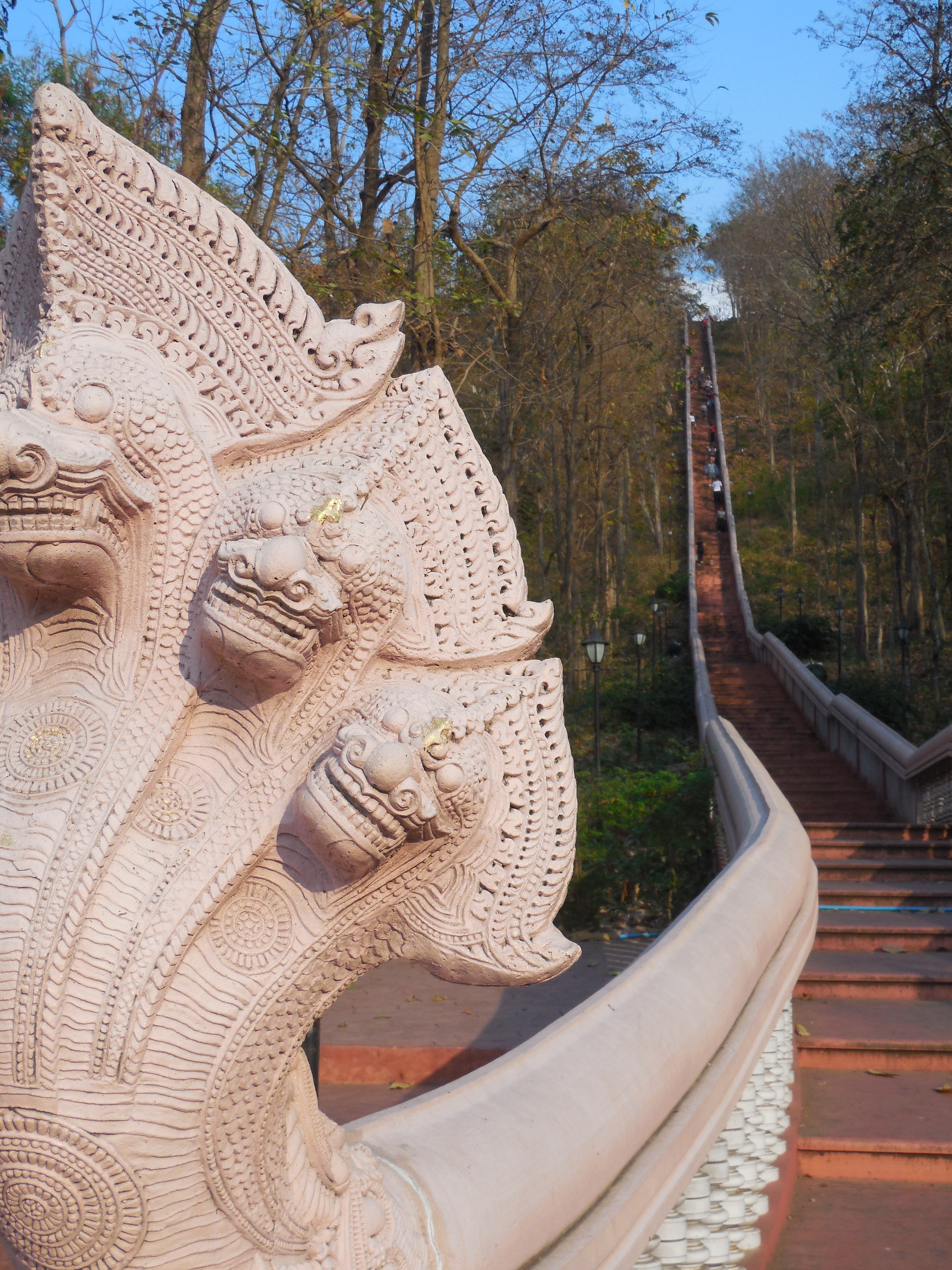
Prasat Hin Khao Phanom Rung is situated at the top of a dormant volcano. “The approach to the temple is pretty dramatic [when approached from the east]”. Unfortunately I read that part in my guide book after parking at the west entrance. To get the full effect I opted to climb down to the eastern entrance and then come back up to the main prang (temple building). The guide book was definitely correct. The approach is symbolic of the journey to the heavenly palace of the gods. The 200-meter-long avenue is paved in large stones leads to several flights of stairs leading sharply up the mountain. Along the way are bridges adorned with 5-headed naga (serpent) balustrades and the feet of what were once guardian sculptures protecting the path.

Approach to Prasat Hin Phanom Rung from the east

Approach to Prasat Hin Phanom Rung from the east

While definitely not on the scale of Angkor Wat, the architecture that has been immaculately restored is impressive. The Khmer practiced Hinduism. The Buddha statues typical of Thai religious buildings are replaced with Shiva lingam, the sacred symbol of Hindu worship. The ornate carvings that adorn the inside and outside of the prang depict Hindu creation myths. The use of primarily stone in the construction has allowed these building to persist for centuries.

Next stop on my tour was Prasat Muang Tam, located about 8 km down the other side of the hill. While not as impressive as Prasat Hin Khao Rung, the ruins are still fantastically preserved. One of the features of Khmer or Hindu architecture is the symmetry of the buildings where the doorways between galleries and the inner buildings all are in alignment, creating an endless path that diminishes into the horizon.

Doorways at Prasat Muang Tam

Doorways at Prasat Muang Tam

Again reaching my fill of ruins, I began the journey back toward Buriram. Relying on my holistic navigation and the desire to see a bit of potentially different countryside, I continued in what would be a loop back to Buriram. Doubting my sense of navigation at one junction in a small town, I opted to actually ask which direction to go to get to Buriram. Again, you would have thought a third eye suddenly materialized on my head as I told the gentleman that I asked that I was going by motorbike. He kindly pointed me in the right direction (which is the direction I would have taken) and after a typical chat of “where are you from, “what is your name” and “how long are you visiting Thailand”, I was back on the road.

About 10 km outside of Buriram, I came across the Khao Kradong Volcano Forest Park. In no real rush to get back to Buriram and needing a break from the motorbike seat, I stopped for a visit. The steep 101 step staircase lead to a very large gold seated Buddha keeping watch over the plains. The view from the top was impressive and dramatic as far as how quickly the dormant volcanoes rise from the flat plains. After a short tour of the few buildings situated around the Buddha statue, I made the much easier climb back down the mountain and back on my motorbike.

Staircase at Khao Kradong Vocano Forest Park

Staircase at Khao Kradong Vocano Forest Park

Another Journey Begins

Standard

It all seems such a blur so far. 11 Days into the trip and I am just now starting to write my travel tales. Perhaps that is a sign of enjoying my time.

Trip number 11 to Thailand started in its usual way. One difference was the direct Denver to Tokyo flight. Otherwise, the arrival in Bangkok at almost midnight, welcomed by heat and humidity, the trip to Floral Shire Resort, the room on the second floor, was all the same. The restaurants on the way to the hotel were once again full of people, a contrast to the last time I was here and the curfew was in effect.

The other distinct difference was knocking my computer off the table in the morning when grabbing for my phone to silence the rather loud alarm, made even louder by the tile floor and concrete walls. Much like bread landing butter side down, the computer landed on the side where the power cord is plugged in. The result, the DC connector was jammed into the computer and could no longer be connected to a power supply. Apparently I needed to have something interesting at the start of the trip.

Wats in Ruin

Needing to spend a day between my arrival and when it would be best for me to visit my Thai family, I opted to visit Sukhothai. In 1238 the Sukhothai kingdom was founded, the seat of power being as what could now be considered the second capital of Thailand during the 13th and 14th century. The old town is now a historical site with the remains of wats (temples) and chedis covering several square kilometers. The third king of the Sukhothai kingdom had the most profound effect on the history by laying the foundation of a unique Thai identity by establishing Theravada Buddhism as the common religion and introducing the forerunner of the modern Thai alphabet. Just a little history…

Getting to Sukhothai was even more hassle free than I could have asked for. Last trip I had attempted without much success at finding the free shuttle between Svuarnbhumi Airport (the international airport) and Don Muang Airport (the domestic airport). Finding the correct desk (located on floor 2 at gate 3) this time, I showed them my flight reservation they stamped the paper and I boarded the bus. Most my time on the bus was spent reading with an occasional glance at the humid haze enshrouded city and the traffic. An hour later I was at Don Muang Airport with plenty of time to kill before checking in for my flight to Phitsanulok, about 58 km southeast of Sukhothai.

Aging Don Muang Airport is such a contrast to the newer Svuarnabhumi Airport. The opening of one of my favorite books, Long Dark Tea Time of the Soul, is “It can hardly be a coincidence that no language has ever come up with the phrase ‘as pretty as an airport’.” Don Muang Airport is a case in point. The dingy fluorescent light emphasizing the aging carpet and 1960’s tile floor. The crazy and unique thing about Don Muang Airport is the fact that there is a golf course situated between the two runways. Led me to wonder if the planes ever are hit by golf balls that are shanked off the course.

Initially my biggest concern lay in getting from Phitsanulok to Sukhothai. In my mind I knew I needed to find transportation from the airport to the correct bus station then finding the correct bus from Phitsanulok to Sukhothai. Entering the baggage claim area, my eye was drawn to the bright yellow uniform of the Nok Air agent holding the sign offering a transfer to Sukhothai from Phistanulok. Taking the easy approach, I hopped a ride in a pleasant air conditioned minivan. Turned out to be a very auspicious choice as the van dropped me off on the exact soi (alley) where my guesthouse was located. This arrangement was totally by chance, but a happy coincidence

Immediately after checking into my room, I rented a motorbike and was on my way to the old town, about 14 km from the new town. The first few meters were used to successfully get my motorbike skills up to date, all without incident. After that I was zipping through the Thai countryside in the late afternoon sun.

In 2011 I had visited Sukhothai with my friends Lek, Lauren and Fern. The trip had an incredibly frenzied pace due to a late start to drive to Sukhothai (about an hour) and the need to have Lauren and Fern back to the Phitsanulok Airport in time for their flight. Our time at the ruins was spent running up and looking and taking pictures, running back to the car, zipping to the next wat ruin, running up and looking and taking pictures. This visit took on a much more leisurely pace. Probably should have considered taking the audio tour, as that might have made viewing the ruins a little more interesting.

Arriving in late afternoon about 4:30, I stayed until well after dusk. Watching the light change as the sun was casting its last bit of light on the ruins was stunning. Especially seeing the evening star positioned just over the shoulder of the enormous Buddha at Wat Mahathat in the fading blue sky touched with strands of orange and pink over the distant hills.

Buddha at Wat Mahathat at Sunset

Buddha at Wat Mahathat at Sunset

More Ruins

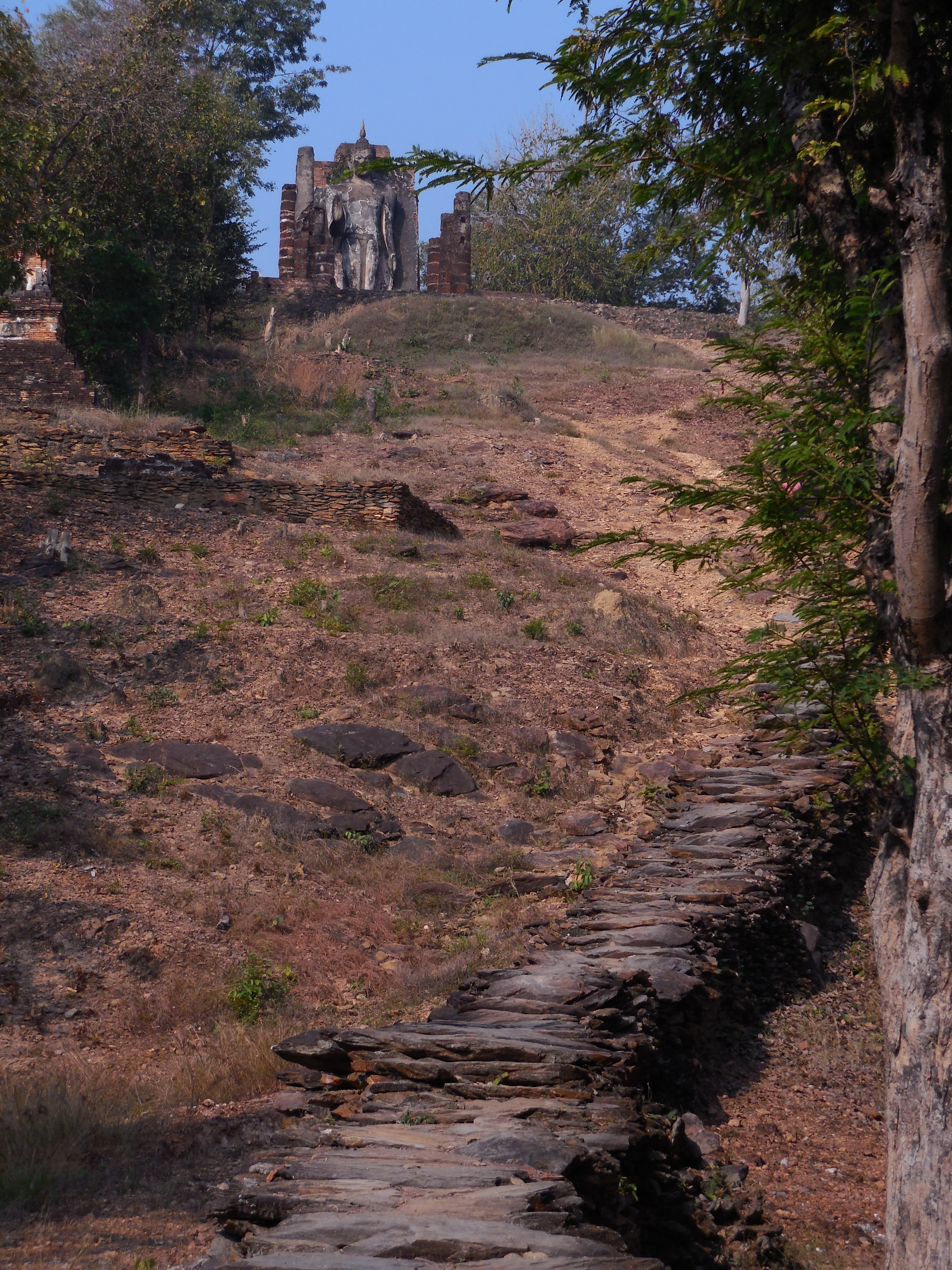
Having already spent several hours at the central zone, I opted to visit the west zone located about 5 km west of the main gate. The main feature of the west zone is a very large standing Buddha at the hilltop temple of Wat Saphan Hin, which means “stone bridge”. The hilltop temple is reached via a steep 200-meter long path of stone slabs. Fairly uneven stone slabs at that. The view enjoyed by the standing Buddha was worth the climb.

Path up to the hilltop Buddha

Path up to the hilltop Buddha

Opted to continue further into the west zone to ensure I got my whole value out of the 120 baht (about $4) entrance fee. Some of the ruins I just looked at from my motorbike and took the occasional picture. On the ones with a more interesting description, I hiked up a few more uneven stone paths in the hopes that there might be more Buddha images and something interesting to see. Unfortunately most of the Buddha images from this zone have been moved to the museum in the central zone, leaving it to your imagination to picture what the temple looked like.
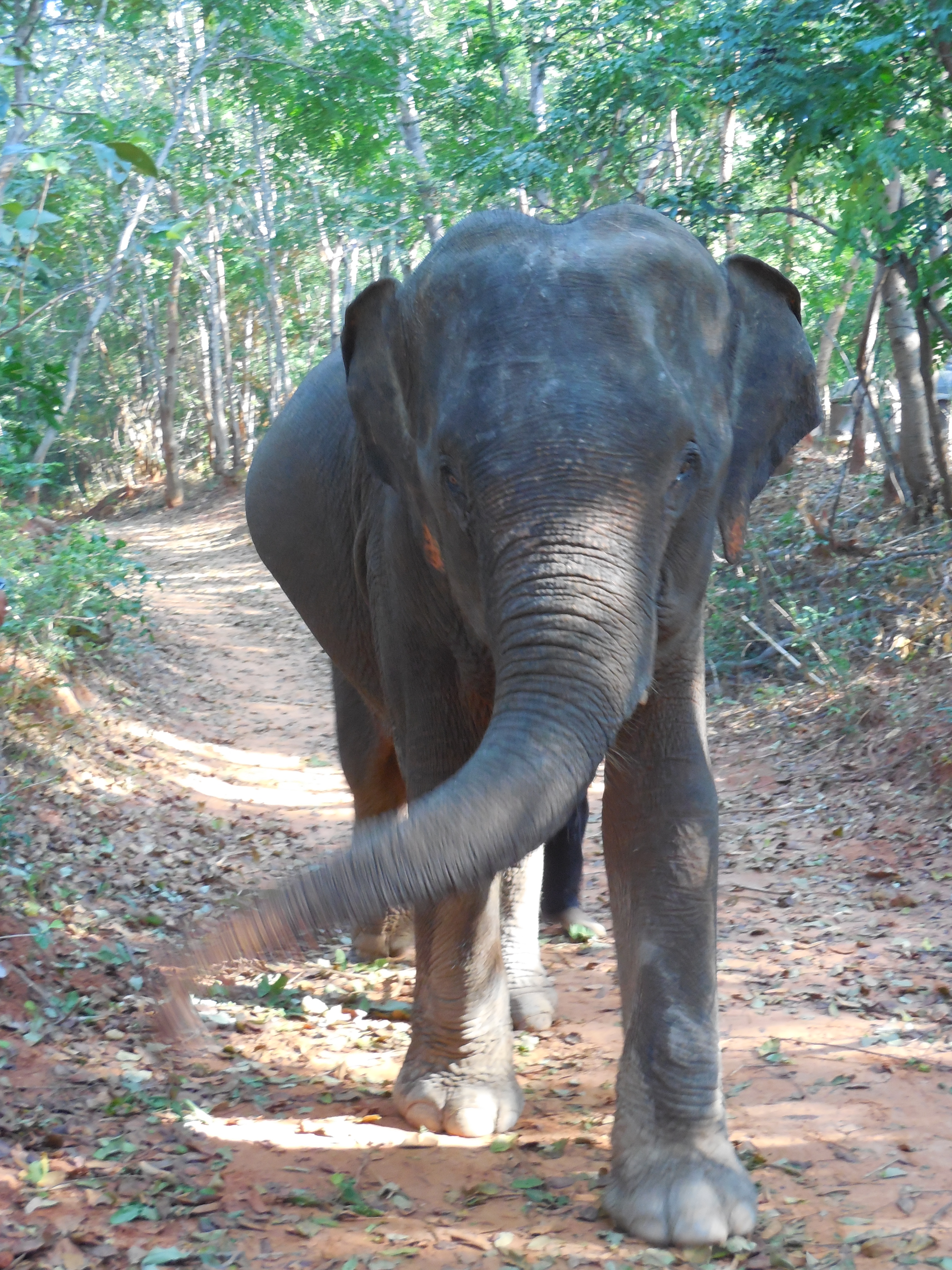
To be honest, I can only look at so many piles of rocks that were once wats and chedis before I lose interest. Upon reaching that point, I turned my motorbike around and headed back toward the new town. Not to mention hunger was setting in. With time to spare after eating I opted to get a massage to work out all the kinks in my muscles from about 3 days of traveling.

Buses make the 45-60 minute trip from Sukhothai to Phitsanulok about every hour. What I did not know is that there are options of buses to take. Failing to figure this out, I ended up on the slow government bus that seemed to stop almost everywhere stretching out the ride to almost 90 minutes. Getting close to Phitsanulok, the bus became more crowded. Fortunately no one really opts to sit by the farang (foreigner) unless there is no other spot to sit.

Time in Tapan Hin

Next stop on the trip was Tapan Hin, about an hour south of Phitsanulok in the Pichit province. Every trip that I can make it to Tapan Hin to visit my family, I do. I go out of my way to get there and they go out of their way to make sure that I am happy. Mostly that care and love on their part is demonstrated through their worry. They worry that I’m hungry, that I’m sick, that I can’t eat something, that I’m bored. And it is hard to convince them otherwise. I really am ok just being with them. I know the worry about me being sick part is justified, as the last two times I was there I got sick. And there was the whole ant attack thing the last trip.

The whole family greats me with warm smiles and the sensation that I belong as part of them. Nun (my little sister) and her boyfriend Not were home from University. The few days I spent with them was Nun’s chance to really practice her English. Nat had to work both days that I was there proctoring a district test, so Nun was left in charge of translating for me. Translating is a trying task and I am grateful for her being there.
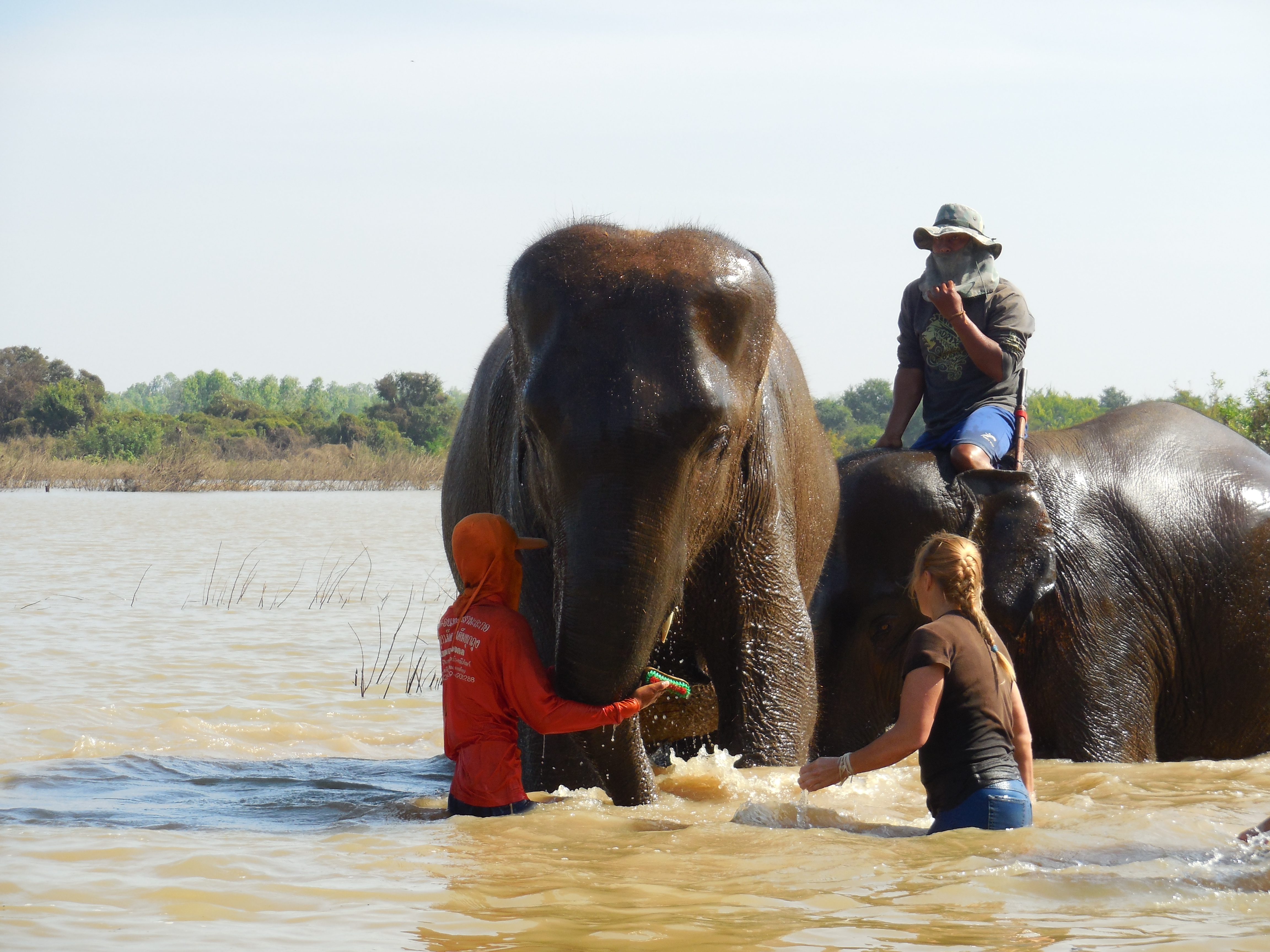
Something is to be said for technology aiding communication. My conversations were greatly enhanced with the help of the Google Translate app downloaded to my phone. While Google Translate isn’t perfect and sometimes can be quite interesting in its translations, it was good enough. Instead of rudimentary conversation, I was able to share more complex thoughts. And using the app was much faster than trying to find individual words in my English-Thai dictionary.
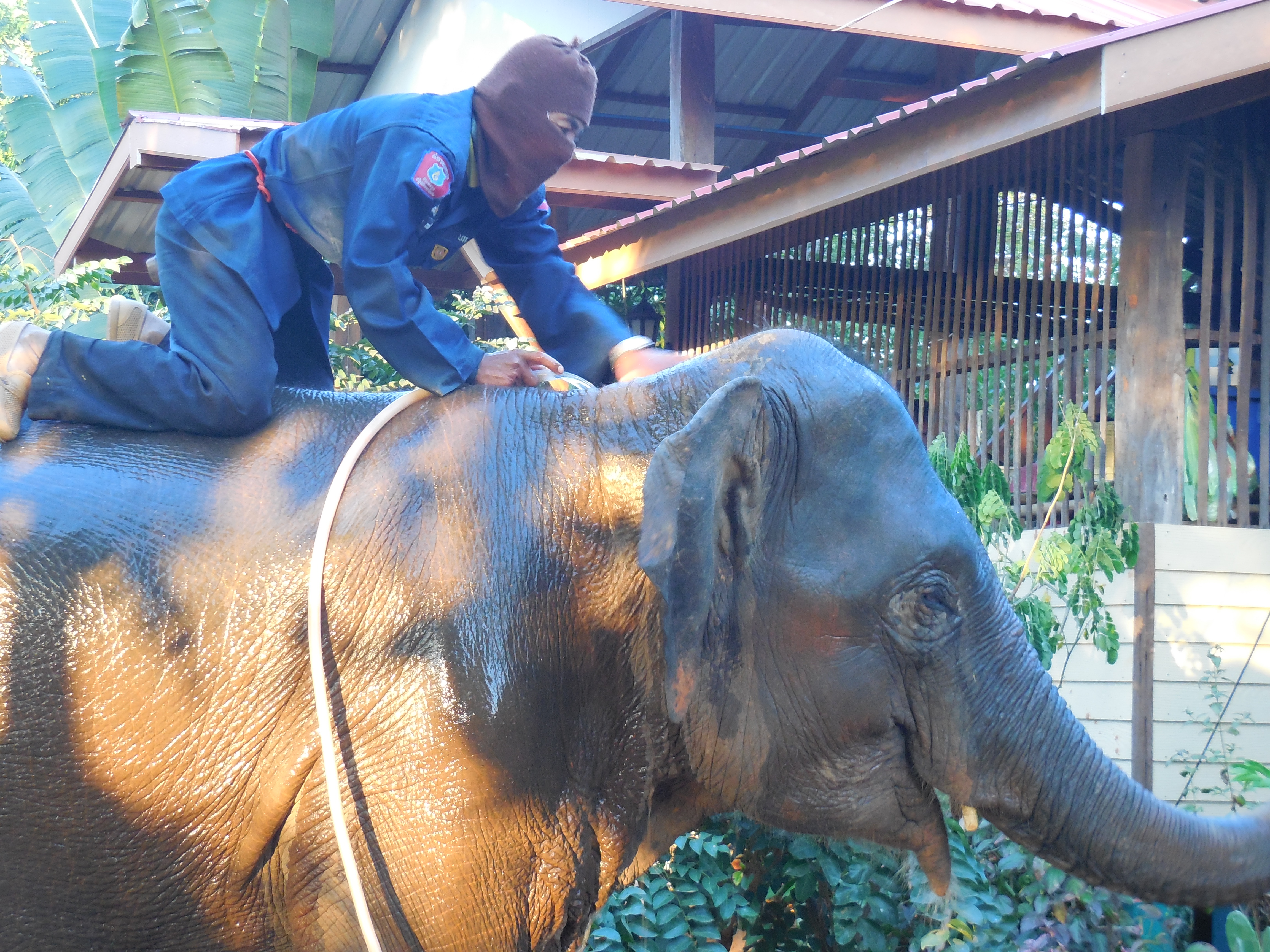
I still believe that any farang left on their own in Thailand will lose weight. Any farang that is with a Thai family will gain weight. The entire morning was spent eating. First breakfast. Then one of the many neighbors or family showed up with fried bananas. Then dad went and bought fried potato balls, fried taro balls, fried balls with mung beans in them, fried donut like things with carmalized sugar on them, pomello and papaya. I think I spent all morning eating. And consequently, was not hungry at lunch time when Dad was supposed to take me for pad thai.

Thinking that I was completely bored, Fern (one of the neighbors) was enlisted to take Nun, Not and me to see some temples. The first temple we went to was in Tapan Hin, the extremely large Buddha rising above the temple walls looking out over the town. Here we made an offering of a candle, flowers and rubbing gold leaf on the Buddha. After a few pictures, we headed over to the train station to pick up my friend Mai. She was getting ready to go back to the University where she teaches and had a little time to spend with us. It was great to see Mai. Last time I saw Mai was almost 3 years ago.

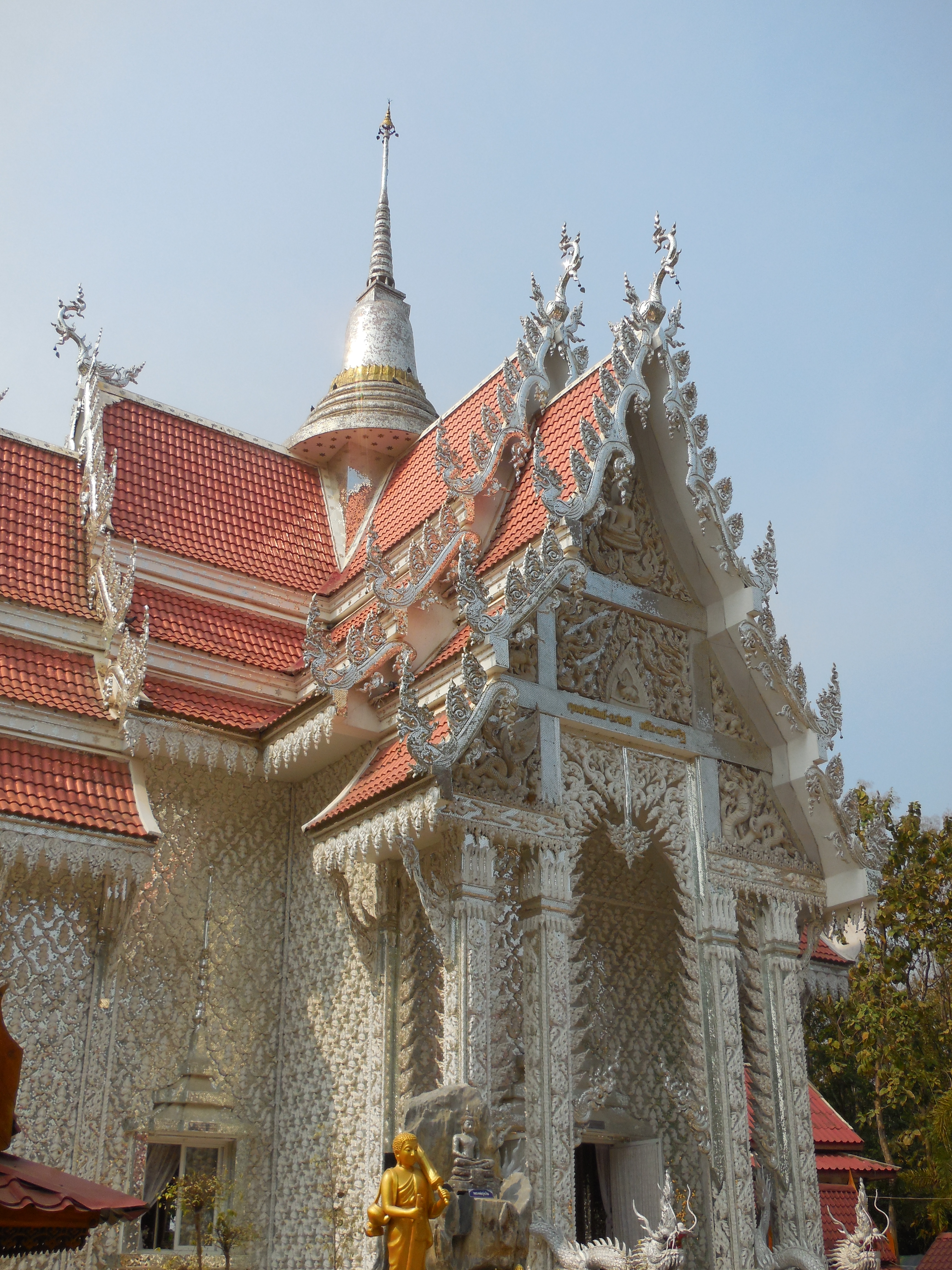
The next temple we visited was Wat Mai Kahm Wan, located about half way between Tapan Hin and Pichit. The main bot (temple building) was an awesome spectacle. Covered almost entirely in silver mirrors it glistened in the bright sun. Even the inside is covered in silver mirrors, reflecting the gold of the Buddha statues. The next shrine was dedicated to yakkha, the Black Buddha. Yakkha is a mara (basically a demon), typically portrayed as eating the moon. The tale goes that each month he eats the moon but because he is unable to digest food, the moon reappears every 28 days. At the shrine, the incense and the offering candles are black instead of the typical gold.

The main temple building at Wat Mai Kahm Wan

The main temple building at Wat Mai Kahm Wan

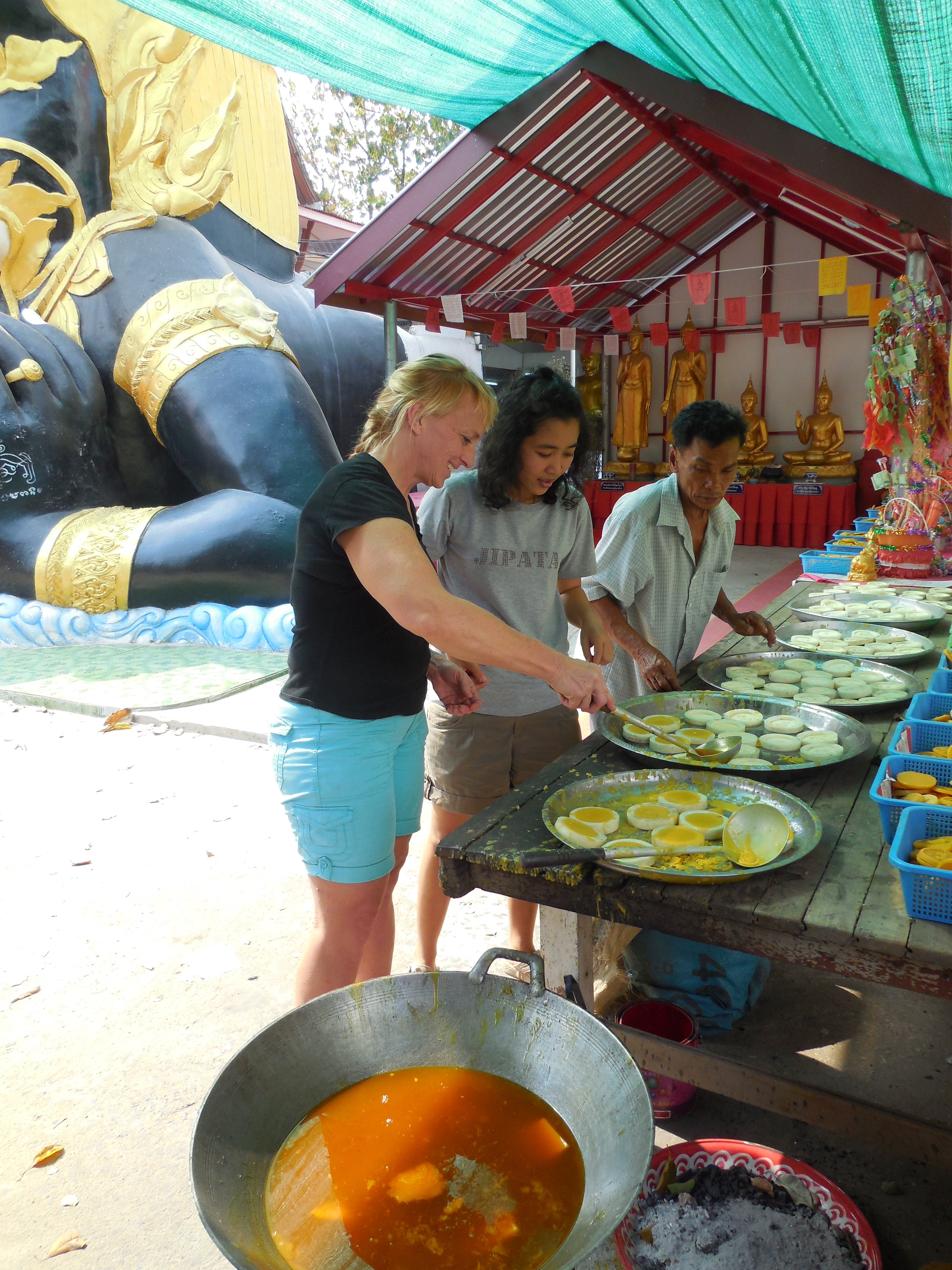
While pausing to look at the shrine and the wax offerings next to the shrine, an elderly man came up and showed us what to do to make a wax token. First, you take a piece of wax and put it in the large pot of melted wax. From there, you find the mould for corresponding to your Chinese zodiac year (I am the year of the dog), take a ladle of wax and pour it into the mould. Lastly, you take one of the already made wax tokens and offer it to the Buddha corresponding to your Chinese zodiac year.

Making wax tokens with Mai

Making wax tokens with Mai

The last building at the wat that we visited was unique. A different elderly man urged us to go in for a monk’s blessing. The entrance of the building is as though you are walking into the mouth of yakkha. There you pray to the first Buddha, then move over to where the monk is sitting for the blessing. The first thing the monk does is give you a blessing bracelet. Because monks cannot had anything to or take anything from a female, he drops them in our hands for us to put on. Unlike other temples where the blessing bracelet is a multi-strand string, this temple’s bracelets are more like a true bracelet made of pink and white braided cord with a wooden bead. After the blessing, one more prayer to another Buddha and exit out of a different door than you came in.

Mugata…Yum!

The last several trips to Thailand I have been invited to go to eat mugata. Literally pork pan, the food is cooked at the table with a heated metal plate in the center with a trough of broth for cooking the vegetables. The communal cooking is fun and brings the group together. When Nat told me we were having mugata for dinner, I was super happy. Not just because I was looking forward to eating it but because I was hoping that I would have the opportunity to have it on this trip.

Nat was home when we returned from our temple tour, so Nat, Gao, Nun, Not, Name and I all piled in the car and headed off to shop for the ingredients for mugata. First stop was Tesco-Lotus to get the pork and some of the meats that were better to get there instead of the fresh market. Next was the fresh market. Nat and I mostly just walked around and talked while everyone else did the shopping. We decided we are much better at carrying things instead of buying things. One final stop at Big C for items that apparently were not at either of the other two stops.

Preparation commenced the minute we got home. Nat gave me a knife and a cutting board. Then it was decided that perhaps a better task for me would be to take the small sausages out of their casings. A simple task with less possibility of cutting myself, and probably much easier to explain what needed to be done. So pork was cut into pieces and seasoned, vegetables were prepared, sausages and faux crab unwrapped. Dad set to getting the pans ready to cook, one electric and one over the fire.

Mugata is one of those meals where you are constantly eating bite by bite. Everyone puts meat on the cooking plate and vegetables are added to the broth to cook. When the food is ready, which was demonstrated to me what was done and what was not done several times, you dip it in the green or the red (or a combination of the two) sauces and eat it. Repeat this process over and over again until you are beyond full. At which point, everyone will still encourage you to eat more.

Boat Festival

After dinner we headed into Pichit for a festival that was taking place. I still have no idea the name of the festival or exactly what it is commemorating. Pichit is the home of the long boat races held every year around Buddhist lent. For this festival, large boat structures are constructed in the river and covered in lights so they look like they are alit with fire. The temple is a swarm of people, taking on the atmosphere of a carnival with lights and vendors. Traffic approaching the temple was a nightmare and fortunately Nat grew up close to there so knew his way around the small sois.

First stop is the lottery. Like a carnival game, you buy tickets then go to the large pool of water and fish out as many small containers as you have tickets using a net attached to a long pole. Inside the little containers are numbers. When you have your allotted number of containers, you proceed to the table where workers open them, and like reading tea leaves, determine what you have won. Everyone hopes for the big prizes. I won a collection of plastic baskets, a multi-purpose can/bottle/I don’t know what opener, a bar of soap and a package of laundry soap. I kept the soap and laundry soap and left the rest for the family.

The crowd was so large it was impossible to see the performances and the only pictures I was able to get were the ones where I hold my camera as high as possible, aim it at where I think it will take a picture and then see how it turns out. We did get to see the last part of the processional of women and men dressed in beautiful outfits.

The emerald Buddha, typically housed in the temple, was out on display. People made offerings of candles that were floated on the large containers of water. In the background, the white temple was lit with ever changing colors. Was a very ethereal experience, especially as all commotion stopped as a blessing was made over the PA system.

Boat display in the water

Boat display in the water

One of the treats of northern Thailand are dried rice sheets that have been moistened with sugar water and then cooked over a fire so they puff up, resulting in a sweet treat. The cooking method is the most tricky part. Two wooden tools that look like forks that have been flattened are used to quickly flip the rice sheet back and forth over the fire until it puffs up to the appropriate size. Sounds easy, right? Nat made an agreement with the woman doing the cooking to let me give it a go. Cooking this treat definitely takes a certain skill set that I’m not sure I have. Really I think that I did alright. I didn’t drop it in the fire, even though it came close occasionally, and I didn’t burn it.

Making the puffed rice treat

Making the puffed rice treat

The festival evening was rounded out with fireworks. I love fireworks. Especially fireworks that are set off over a river. The reflection of the burst of light on the water and the amplified echo of the percussion make it even more spectacular. Perhaps I was more enthralled with the fireworks than the rest of the family, so they patiently waited while I watched them to the very end of the display.

Moving On

Last visit to my family, I was asked to make a western meal. Somehow I managed to pull off spaghetti that actually tasted pretty good (better than the local restaurant according to my family.) This time I decided to try and bring something that maybe they didn’t have in Thailand. So I brought popcorn, only to find out that they have popcorn here. Typically they have microwave popcorn, so at least it was something different to see how to cook it in a pan over a fire.

Cooking it over an actual fire is a bit of a slow process. Holding the pan over the fire is even more challenging. Somehow I managed to pull off a perfect pot of popcorn without burning the popcorn or myself. Everyone said it tasted better than the usual popcorn that they have. After awhile one of the guys decided to give popping popcorn a try. He had more difficulty trying to hold the pot and keeping it moving so that the popcorn didn’t burn. Because he kept stopping and eventually Nat took over the process, the second batch didn’t turn out quite as well. Everyone still had fun though!

Because I needed to get to Chiang Mai at a reasonable time Sunday evening and wanted to maximize my time in Tapan Hin, I decided to fly instead of taking the bus. Yes, it costs more, but it is worth it. Unlike the time I took the bus and we were running late making it to the bus station minutes before the bus left, I was under more pressure to get to the airport in time to check in. I tried to not feel stressed as I was watching the minutes pass on the clock, getting ever closer to the time we needed to leave. Because Nat was at work, we were waiting for Dad to get home so he could drive me.

Finally I couldn’t take it any longer, so we piled into Nat’s car and mom started the trip to the airport. About 30 kilometers from Phitsanulok, dad caught up with us. I should preface this part that Dad drives an ambulance for a living. So we pulled over, dad and mom switched cars and off we went. On the way, dad tried to explain that he was an ambulance driver and very good at driving safely and quickly. Really I wasn’t scared. Took a sharp breath of air in one time when we were a little close to a car in front of us or passing a car making the two-lane road into a three-lane road. The important thing is that we made it to the airport and I got checked in on time.

Almost 3 Days in Tokyo

Standard

Temples, Shrines and Gardens

Japan’s oldest religion is Shinto. Shinto has no founder, no holy book and not even the concept of religious conversion. The core concept is that deities, kami, preside over all things in nature, be they living, dead or inanimate. Shinto values include harmony with nature and virtues such as magokoro (sincere heart). Many Japanese practice Shinto; however, few are purely Shinto. Many Japanese also practice Buddhism. Shinto has shrines and are most easily distinguished by their typically vermilion (red) tori gateways, constructed by two posts with two rails at the top. After 3 days of walking around Tokyo looking at temples and shrines, many of them have just blended together into two categories, those with tori gates and those without.

The tour of shrines and temples started at Sensoji Temple in Asakusa. Just a few steps from the subway exit, I found the Kaminarimon Gate (“Thunder Gate”). The gate was built in 946 and burned down several times, the last in 1865 and not rebuilt until 1960. Kaminarimon Gate stands big and impressive at the head of a long row of shops leading to the temple complex. Arriving early in the morning, before the area was laden with rickshaw tour operators and tour groups, made the visit reasonably pleasant and peaceful. Sensoji temple was built in the 645 and escaped damage in the 1923 Tokyo Earthquake only to be destroyed during WWII. All the buildings have been rebuilt following their Edo-era layout. In addition to the main temple building, the complex offers a 5-story pagoda, several smaller buildings, a pond with koi and several stone lanterns and statues. After a reasonably quick meditative stroll around the complex, I was on my way to my next destination on my aggressive list of sites to see during my time in Tokyo.

A popular part of the visit to Sensoji (or most temples, although Sensoji is one of the few that has them in English on the reverse side) is to get a paper fortune called an omikuji. After paying your 100 yen, you grab one of the metal canisters of sticks and make your wish. Once your wish is made, modestly shake the canister twice (or several times) until a stick comes out. Each stick has a number written on it in kanji (Japanese writing). So after a bit of matching the symbols on the stick to the symbols on the drawers containing the fortunes, you get your fortune. If it is a good fortune, then be happy with it. If it is a bad fortune, then don’t be upset. Simply tie it to the nearby rack so the wind can carry it away, ask the gods for better luck and try again later. So I dutifully paid my 100 yen, shook the canister and matched my number (66) to the drawer. No. 66 is Bad Fortune. So I tied it to the rack and walked away. When I came back to the temple are the next day for some souvenir shopping, I figured I would try it again, maybe being a little more specific with my wish. This time I got No. 97. Bad fortune again…sigh. Hopefully that changes soon.

Zojoji Temple in the Shimbashi area was my next planned destination. I say planned, because it took a little extra effort and a lot of walking to get there. I’ve navigated big cities (namely Paris when I was 17) using pretty much only a subway map and the information maps that are located on many corners at big intersections and near the subway entrances. So I got off at the Shimbashi station and set out walking in what I thought was the correct direction. When I reached the Higashi-ginza station, I discovered that I had walked about 20 minutes in the wrong direction. So I turned around, and after finding a set of elevated subway tracks, I decided to follow those as closely as I could to get to the station that was my original destination.

At the next map I found, I discovered that I was actually reasonably close to the Hama-rikyu Gardens, another spot that was on my list of places I was trying to see that day. Turning left, I headed for the garden, finding it in short order. Hama-rikyu Gardens were the family garden of the Tokugawa Shogun, built in 1654. All of the buildings and the vegetation were destroyed between the 1923 earthquake and the bombings in WWII and then rebuilt. The gardens are a nice oasis of green in the city, quiet and pleasant, the sounds of the city muffled by thick trees. Inside the 62-acre gardens the main places of interest are the tidal pond with the 3 tea houses, two duck hunting ponds, and a 300 year old black pine.

The Hama-rikyu has a free Ubiquitous Audio Tour. At the entrance they give you a smart device (basically like a smart phone) that you wear on a lanyard around your neck and an earphone. As you walk by the 27 places of interest along the tour, the smart device uses GPS technology to identify which place you are by and then plays an audio clip describing the place of interest and the history surrounding it. A lot of the extra information was very helpful and contained some very interesting facts.

One of the things I loved best about the garden are all the gnarled pine trees that look like bonsai trees on steroids. Each of the trees are meticulously pruned each year by hand. Workers remove 2/3rd of the new growth, snapping the shoots off by hand. The 300 year old pine takes 4 workers 5 days to complete. (Fact provided courtesy of the ubiquitous audio tour.)

300 year old pine at Hama-rikyu

300 year old pine at Hama-rikyu

With my feet starting to form a couple of hot spots, I continued on in my quest to find Zojoji Temple. To aid in navigation, I did actually ask the worker at the garden entrance when I returned my ubiquitous audio tour device. After another 20 minute walk and a stop for a late lunch at a curry shop, I finally found the temple complex.

The Zojoji temple complex is much smaller than the Sensoji temple. The Zojoji temple was established in 1393 and was moved to its current location in 1598 to protect the city spiritually from a southeasterly direction. The wooden temple gate is the only structure that remains of the original 17th century temple buildings. The main building was rebuilt in 1974, after being destroyed between the earthquake in 1923 and the bombings of WWII. Now the temple lies in the shadow of the Tokyo Tower, the red and white tower that is modeled after the Eiffel Tower, just taller. Seeing the tower brought back memories of my trip with my dad to Japan in 1982 when I did actually go up to the observation deck to see the view of the city.

Zojoji Temple and the Tokyo Tower

Zojoji Temple and the Tokyo Tower

After a short walk to the subway station, my feet got a little bit of a rest on the 20 minute ride to my next destination, the Kashiwa Karokuen Gardens. Finding the gardens proved to be challenging. Following the information provided on my Tokyo Subway App instead of actually checking the exit information on the signs in the station, I went out exit 8 instead of exit 2, which would have been a much better choice. After wandering around for quite awhile, I did actually find the Tokyo Dome home of the Yomiuri Giants (Tokyo Giants) and signs pointing me in the direction of the gardens… just a mere 350 meters (nearly a ¼ mile) along a white wall by baseball fields where adorable kids were having baseball practice.

When I planned out my time I had hoped to have some time to just sit in the garden and maybe write a little. With all of my navigational detours, by the time I finally reached the gardens I had about an hour to explore and enjoy. The picture in my guidebook that had drawn me to seeking out this garden was the Tsuten-kyo bridge, a vermilion (red) bridge that is a copy of a famous bridge in Kyoto that I had seen on my trip in 1982. Finding the bridge proved tricky since the location marked on the map had a different spelling than the picture and label of points of interest in the brochure that I was given at the entrance. On my search for it, I did see the Full Moon Bridge (Engetsu-kyo), so named because the reflection of the bridge in the water forms the image of a full moon. Even though renovation work was underway near the bridge, they did have enough water in the pool by the bridge to give it the full effect. I also saw the iris field and the rice paddies, and the Chinese style path and the central island, all of which were pretty but not my goal. With 20 minutes remaining until the park closed, I returned to the entrance and asked them, using a lot of pointing and short words, where the red bridge was. Armed with a location on the map, I made a bee-line for the bridge. Seeing the bright red surrounded with lush green was definitely worth all of the effort. I spent as much of the remaining time that I had in the park taking pictures and just sitting on a rock near the bridge as I could. My feet appreciated the short respite.

Tsuten-kyo bridge at Koishikawa Korakuen Gardens

Tsuten-kyo bridge at Koishikawa Korakuen Gardens

Amongst all of the temples and shrines that I visited over the course of my days in Tokyo, the Meiji Jingu (Shrine) was my favorite. Meiji Jingu is an oasis of lush green, the comforting aroma of the cedars and cypress trees permeating the air. The natural forest surrounding the shrine was hand planted when the shrine was first built. Now, generations later, it is considered a self-sustaining natural forest. A broad grey gravel path provides a meditative walk, leading you away from the main street through the forested area up to the tranquil area of the temple complex. Three unpainted cypress tori gates grace the path to the main shrine, the second or grand shrine gate, is the largest tori of that style in Japan. Each pillar is 1.2 meters (about 4 feet) in diameter and the crosspiece is 17 meters (55.7 feet) long. Very impressive and very beautiful!

Approaching the shrine, I followed the directions in the pamphlet on how to pay respect at Meiji Jingu. At the Temizuya, a cistern with running water and dippers (cups on long handles), I did the purification ritual. Using a dipper, I rinsed my left hand, then my right hand, then poured water into my left hand and rinsed my mouth, then rinsed my left hand and replaced the dipper. Then at the main shrine building, I made my wish, threw some coins in the offeratory box, bowed twice, clapped my hands twice to make sure the gods heard, and then bowed one more time. While there I also took time to write my wishes and hopes for 2014 and the future on a paper and placed it in an envelope with some coins and deposited in the box. The wishes will be included in the prayers of the priesthood at the temple.

A Blister for Each Day

In addition to walking to and around all of the temples, shrines and gardens, I visited several other places of interest in Tokyo. And I had a few more navigational issues.

Monday evening, I rounded out my first day at the Tokyo Metropolitan Government Building Observation Deck. The observation deck is on the 47th floor of the Tokyo Metropolitan Government Building and provides an impressive panoramic view of the city. On a clear day, which Monday was not by the time I made it there, Mt. Fuji is also visible. I am glad that I visited on Monday, since the weather was probably the best that day. While I couldn’t see Mt. Fuji I was able to see the majority of the places that I had visited while walking around the city. An added benefit to visiting was that I was able to pick up a guidebook that actually had some basic maps for key areas of Tokyo.

My second day in Tokyo started with my trip to Meiji Jingu, which is located next to the Yoyogi Park, the site of the Tokyo Olympics and the Harajuku neighborhood. The Tokyo National Stadium, built for the 1964 Olympics, is still used today. After taking a few minutes to appreciate the impressive curves of the shell-like architecture and to take some pictures, I dove into the Harajuku neighborhood, seeking out one of the largest 100 Yen Store (basically a Dollar Store) in Tokyo. Harajuku was greatly influenced by the international culture of the Olympics and remains the hot spot for the young and innovative and is a center for fashion with just about every high-end international store present.

No visit to Tokyo would be complete without going to see the Imperial Palace. The large thick, deep grey colored, stone sloping walls surrounded by a moat and the white and brown palace buildings are a stark contrast to the shiny, sleek, modern glass buildings of Tokyo. I had tried to visit the Imperial Palace East Gardens on Monday, but they were closed. Originally I had planned to visit the gardens on Tuesday; however, when I got there I felt I had pretty much had my fill of gardens. So I went to see the famous and often photographed Nijubashi bridge, the main gate stone bridge. The stone bridge reflected in the green-ish moat water accompanied by the massive stone walls, green vegetation and white building is truly picturesque.

Nijubashi bridge at the Imperial Palace

Nijubashi bridge at the Imperial Palace

My last morning in Tokyo was pretty much consumed by a walking tour of Yanaka. I’m pretty sure that Yanaka means “place of many, many temples”. The walking tour outlined in the guide book started at Nezu subway station. So I went to Nezu station, consulted the information map outside the station and started walking… in the opposite direction… again. Only figured it out once I made it to another subway station and after consulting my subway map confirmed that I had walked the wrong way. Backtracking, I made it back to Nezu station and started the tour. Finding the temples and shrines proved to be a little tricky, since for the most part they look like fancy houses with gates stuck in amongst the narrow regular buildings. The only way I found one of the temples is that the tree outside of it had an information marker telling me that it was one of the only remaining red oaks in an urban area and was located behind the Gyokurin-ji (temple).

The walking tour took me through several back streets and by literally dozens of temples. While the walk wasn’t quite as picturesque and quaint as the guidebook made it out to be, it was a nice walk. I did stop in a few of the temples, noting the shrines and the gravesites and other interesting statues and plants. Growing tired of temples and all of them blurring together in my mind and my feet feeling the sting of walking so much, I sped along to go to the Yanaka Cemetery, the largest cemetery in Tokyo.

Cemeteries in Japan are pretty interesting. Families have an altar site containing a primary stone altar with the family crest on it and maybe a few smaller stone structures. Ancestors are honored with their information written on a wooden stick which is added to the collection already there. Offerings are made by living family members and each little plot is well cared for. The cemeteries are very peaceful and several that I visited had gardenia plants, their sweet aroma mingling with the scent of lilies and incense  that had been placed at some of the altars.

Typical family cemetery shrine

Typical family cemetery shrine

My last stop was Akihabara, the famous electronics district. Home of every electronics company you can think of and a mecca for gamers. The buildings are everything you would imagine it to be – electric and overwhelming. SEGA, Panasonic, neon signs in Japanese, anime posters, all larger than life on the tall buildings that soar to the skies and assault the senses. My main destination was the Tokyo Anime Center, since my niece and a few of the young people that are in my life are interested in that. The center itself was actually quite disappointing, not offering much in the way of exhibits and offering a lot in the way of very high priced souvenirs. Walking around the area and taking in all the hustle and bustle was much more interesting.

So what to do when you discover that your flight is almost 2 hours delayed? I ended up going on a bike adventure in an attempt to find some lunch and see the last remaining trolley car in Tokyo. The woman at the hotel gave me directions to a soba noodle shop and the key to her bike and sent me on my way. Half of the adventure was just getting on the bike and getting going. The seat was set so low that my legs were bent the entire time. Eventually I got the hang of it. Off I went on the sidewalk, trying to stay in the bike lane area and  not to hit any of the people walking. Think I may have scared a couple of them with my wobbling. Finding the last remaining trolley car line in Tokyo, the two trolley cars ferrying people the short distance of the line, was my first success. On I went to find Joyful Minowa shopping street where the soba shop is located. A few interesting turns and there it was. After a couple of attempts at asking where the restaurant was, I finally understood that it was closed today. Sadly, I opted for take away tempura and some rice, went back to where the trolley line ends, and had my lunch. The victorious part of this adventure is that I actually made it back to the hotel successfully.

I have no idea exactly how many miles (or meters) that I walked during my 3 days in Tokyo. Many of the subway stations involved walks of 200-300 meters to get between subway lines. By the end of my second day I wished I had a pedometer to track the miles. At the end of my visit to Tokyo, 3 reasonably annoying and a little painful blisters graced my feet, one for each day I was there.

Tokyo Subway A to Z

I love the impressive efficiency of subways. The way the wind gushes in a rush of air in front of an approaching train. The rumbling sound as the train arrives. The constant announcements and interesting signs, especially in foreign countries. The often long escalators descending deep underground or taking you up to the surface.

The Tokyo Subway system is a model of efficiency and punctuality. Made up of two lines, the Tokyo Metro Line (9 lines) and the Toei Line (4 lines), you can swiftly get from one side of the city to the other in typically less than 30-45 minutes. Trains are spaced about 5 minutes apart, sometimes less, or 10 minutes at the most. Unlike many of the commuters, I was never in a rush to get anywhere, but knew better to stay out of the way when figuring out where I was going.

The Tokyo Subway Route Map became my constant companion. The Tokyo Subway app provided a helpful companion in figuring out which route to take and how long it the trip would be. Each of the 13 lines are color coded with an assigned letter (A, C, E, F, G, H, I M, N, S, T, Y and Z) and station numbers identifying each station. Thankfully all of the stations have the name in English as well as Japanese. I remember this being different when I visited as a child and we had to match the kanji characters on the map with the information in our guide book. Over the course of my 3 days in Tokyo I rode 11 of the 13 lines comprising the system (missed F and Y).

The most cost effective way to use the subway as a tourist is to purchase a One-day Unlimited Pass ticket. For 710 yen (about $7) you can ride all of the Tokyo Metro Line lines as much as you want. Or for 1000 yen (about $10) you can ride all of the Tokyo Metro and Toei lines. I definitely got my money’s worth of my one day passes.

Subway stations during rush hour are an interesting and fun experience. Commuters line up methodically at the designated door locations, the bigger stations having actual lanes marked out. When the train arrives, space is given to those exiting the trains. Then all of the people queued up squeeze on to the train. White gloved metro workers are present to make sure everything is orderly and to help push people into the cars if necessary.

Watching the white gloved workers greet and send off each train was a wonderful display of synchronicity and respect. Upon arrival, each of the workers would salute the driver as the train passed by. When all of the people were loaded, there was a check up and down the line confirming the doors were clear. And as the train departed, each worker in turn would point in the direction the train was traveling.

Train leaving the Minami-senju station

Train leaving the Minami-senju station

Many commuters come from well outside the city, with the typical commute taking around an hour or more. Often people would be sleeping. Watching them I wondered two things: how do they sleep standing up? And, how do they not miss their stops?

Additional Random Observations

Typically I am not a fan of major cities. I have spent almost no time in Bangkok in all of my trips to Thailand. New York City, Delhi and Beijing were overwhelming, dirty and polluted. Tokyo is an exception.

Tokyo is very clean and has pretty much no perceivable pollution. Most districts have a ban on smoking on the sidewalks. Established smoking areas, typically partitioned off with panels, are located every 5 or 6 blocks. Litter on the street is almost non-existent. Bottles are recycled religiously, with a bin located by pretty much every vending machine. Even traffic is minimal for such a large metropolitan area, a testament to the efficiency of the subway system and the considered ease of using a bicycle to get around.

On my hours of walking around the city, one thing that struck me was the conformity of it all. Most notably was the conformity of clothing throughout the city, Harajuku being a distinct exception. It seemed as most everyone was wearing dark blue or black pants or skirts, with a light pastel top ranging from white to tan to light blue to light pink. The occasional colorful dress or shirt was definitely eye-catching. Harajuku was a blast of color and individualism that I didn’t really experience elsewhere in the city. Even the buildings in most districts were relatively conforming in color. Some of the skyscrapers have unique architecture, although most of them all are that metallic blue-ish color of glass reflecting the sky. Smaller buildings and houses ranged in the tan-white-grey color palette.

Tokyo is a very new old city. The history of the city goes back over a thousand years. Unfortunately most of the buildings were destroyed during the fire following the Great Kanto Earthquake in 1923. Buildings that managed to survive the earthquake were destroyed by air raid bombings toward the end of WWII. While temples and shrines were rebuilt according to the original plans, the actual buildings only go back about 70 years. Some not even that far.

Every bit of available space is used efficiently. My hotel was a testament to this fact. My single room was about 3 feet wider and about 3 feet longer than a twin bed. In that space was a bed, table, stool, tv, waste bin and a small closet. The room wasn’t uncomfortable. Besides, you don’t go to some place to spend time in a hotel room. The bed was the typical firmness of any Asian bed. The pillow was made of a mesh bag filled with hollow pink plastic beads about a centimeter long and the diameter of a large straw covered with a pillow case. Strangely it wasn’t as uncomfortable as that sounds.

My room was on the 8th floor, the ladies floor. At the end of the hallway you could go out onto the emergency balcony for a view of the Tokyo Skytree, another tall tower offering a panoramic view of the city, and the Tokyo skyline. At night the Skytree is lit up, each night with a different color. My first morning I woke, first to the sun rising at the terribly early hour of 4:30 (I had forgot to close my actual curtain), then to the gentle rolling sway of the building. In my bleary state it took me a minute or two to realize that it was a shockwave from an earthquake.

Part of my purpose for spending time in Tokyo was to see it through adult eyes. Having visited Japan with my dad in 1982 and again in 1990, I hold many memories of places we visited and the experiences we had in our travels. Each time I heard the train announcement for the Ueno station (Ueno, Ueno des) I remembered the very first time Dad and I traveled into the city, groggy from our flight from Hawaii. Visiting some of the sites, I remembered that I had been there before. And all of this brought a smile to my face and my heart.

A Week with the Eles

Standard

Walking About

Buriram is not really a city that draws a large number of foreign visitors. Mostly because Buriram offers very little to see. As I discovered in my almost 5 hours of walking around between Sunday evening and Monday morning.

Setting out with my not-to-scale map that was really more of a suggestion of where streets are and how they are named, I began my tour of Buriram. Just to make navigating more interesting, typically only one of the two roads at an intersection were labeled. I either knew what street I was on and had to guess at the cross street. Or I knew what the cross street was but wasn’t quite sure I was on the street I intended to be on. I’ve also decided that sidewalks in Thailand are definitely not designed to be walked on. Uneven and often taken over by food stalls or various repair shops, it was generally easier at times to just walk in the street.

Being a white foreign female in a town like Buriram, definitely draws some attention. Generally, I was greeted with curious looks that changed to a smile when I smiled at them and said “sawad dee kaa” (hello). Men would occasionally shout out a “hello”, to which I typically responded with “sawad dee kaa” or maybe just “hello” depending on the moment. The clearly drunk Thai male on the bicycle was the most interesting interaction. Holding his beer in one hand and pointing with the other, I think he was trying to suggest that he wanted me to take him to America with me. Finally I said I needed to go, so he shook my hand, said he loved me and I quickly went on my way. Reluctantly he turned his bicycle around and off he pedaled.

If I had remembered to wear a t-shirt instead of a tank top, I could have gone in the two wats (temples) that are located in the main part of Buriram. To go into a temple, you are supposed to have your shoulders covered. So mostly I looked at the temples from the street. I did venture into the City Pillar monument. I refrained from going inside the building housing the 2 city pillars since I wasn’t sure if I was already being disrespectful by being in the monument area with my shoulders not covered.

Welcome Back

Returning to the project is like coming home. This visit being my third time volunteering at the Surin Project, I was mostly aware of the changes. A new concrete and tin roof shelter has been built for Tangmo, Wang Duen, and Nong Lek to hang out. A rebuilt structure for Jaeb, since she had been working intently on destroying her last one. And just like visiting home, I have stayed in the same room and the same house each time, although now Sing’s wife, Pi Jan, is the house mom.

The week begins with an opening ceremony that is a combination of Buddhist and Kuy (Goi) beliefs. Lead by a shaman, the ceremony is a mixture of happiness and reverence. The purpose behind the ceremony is to bring us all together and to wish for us a healthy and good week. The kuy people believe in white and dark magic, so much of the ceremony is about bringing the white protective magic to all the people there.

The ceremony is also the first time where all the volunteers get to meet the mahouts, the caretakers of the elephants. The aptly named Pan, Warin’s mahout, was sitting behind me. He remembered me from my last visit, greeting me with “MJ MJ”. Three times during the ceremony, all the mahouts throw mulberry leaves at us to bless us. Several meanings are tied to this blessing. The main meaning is to bring your spirit back to your body. The kuy believe that occasionally our spirits wander off to the forest. The mulberry tree has special magic and being blessed with them helps the spirit to return to the body. Another meaning is that someone who is blessed by these leaves will be great and will be loved. Pan, Thong Di, and Em were sitting behind me so I was greatly blessed with large handfuls of mulberry leaves showered on me with great force. A terrific welcome from the mahouts.

The cast of characters, both elephants and mahouts, has remained mostly the same since my visit last December. One new elephant, Wong Duen, and her mahout, Nei, have joined the project. Another elephant, Ploy, and her mahout, Sing, have returned to the project. Unfortunately, Ploy’s baby girl Kwan has not been allowed to come back to the project by the owner. And sadly, Sai Faa and her mahout, Dao, are not on the project at the moment because Dao is sick. Hopefully she will return to the project when Dao is better.

From a project success standpoint this consistency is a good sign. Many mahouts have a difficult time with the rules imposed in their agreement to be on the project. One of the rules is that they are not allowed to use a bull hook, a 2 foot stick with a large metal hook attached to it, to control their elephant. Many mahouts view just carrying the bull hook as a talisman of protection from injury. To give up the bull hook is to give up the idea that they are protected from injury.

Life on the Project

The Surin Project is focused on helping to change the culture of elephant tourism in Thailand by demonstrating that people will come to interact with elephants in a much more natural way. As a volunteer, our primary “work” is to ensure that the elephants have at least 3-4 hours each day off their chains. This goal is accomplished through going for walks in the forest and to the river and by allowing the elephants to wander in the enclosure to eat and play in the water. (For more on the project and why it is important, click here.)

Throughout the week we take several walks through the forest with the elephants. Generally, we try to stay out of the way of the elephants, not always easy since elephants move surprisingly quietly, and just watch them as they stop and forage for food, enjoying a tasty vine here or some other plant there. One of our walks takes us to a bamboo thicket. This particular day, Fah Sai was intent on having some bamboo as a snack. Sarot hurried us out of the way as she reached for a giant stalk. With a great crack she pulled it to the ground. While watching her and admiring her great power we were momentarily oblivious to the nest of red ants that we had ended up in. These ants are particularly vicious and bite with a vengeance. The ants seemed to drop off the bushes and crawl up from the ground, all the sudden appearing on shirts, in hair, on legs, everywhere. By the time we got out of the area I had eight major bites, one on my back the rest on my legs.

Of course some work does need to be done during the week. Mostly in the form of morning and evening chores. In the morning, we have three tasks that our teams rotate through: cleaning shelters, cleaning the enclosure and cutting sugar cane. None of the tasks are particularly arduous, taking at most 30 minutes to complete. My favorite task is cutting sugar cane. Not only because I get to use a machete to hack down the 8 foot tall stalks of sugar cane, but also because I get to work with the mahouts.  I am always amazed at the speed and skill with which they accomplish their task. Clearing away the dead leaves with a whoosh whoosh of their machete and cutting the stalk with  a simple thwack of the machete. The mahouts are sweetly tolerant of my swoosh….swoosh as I copy them in clearing away the dried leaves and the thwack, thwack, thwack that it takes me to bring down one sugar cane stalk. The task is still sanook (fun) involving much smiling and laughing.

Our one project for the week was to help plant a field of sugar cane for the elephants. Sugar cane fields are planted by laying sugar cane stalks in furrows, cutting the stalks into about foot long pieces, covering them with elephant manure and then covering with the dirt. Any opportunity for me to use a machete is always welcome, so I volunteered to cut the sugar cane stalks. Careful to stand a furrow over from where I was working to make sure my bare toes were protected by a barricade of dirt, I made my way up and down the rows cutting the stalks. Using a machete effectively definitely takes consistent practice. Much more practice than my once or twice a year. Second only to getting to use a machete, the best part of doing this project was getting to walk barefoot in the soft freshly plowed field of red sandy soil.

image

Another component of the Surin Project is to help support the community of Ban Tha Klang. Two of the days this week we went to a local school to teach the students. Divided into four teams, we created lessons for teaching basic conversation, body parts, alphabet letter sounds, and numbers. Autumn and I chose numbers. Though both of us teach adults, neither of us are particularly fond of teaching children. Our first day was a bit of a struggle. The second day we changed up our lesson and taught the kids a song using numbers. By the end of our hour of teaching, all of the kahnom (grade) 1-3 kids could sing: “1 little, 2 little, 3 little elephants; 4 little, 5 little, 6 little elephants; 7 little, 8 little, 9 little elephants; 10 elephants more.”

Coming from the dry climate of Colorado, the heat and humidity of Ban Tha Klang was on occasion almost stifling. Only one day passed without rain sometime during the day or night. The rest of the days included a rain shower, often in the late afternoon and occasionally well into the night. Instead of cooling the air, each passing afternoon shower seemed to leave the air twice as heavy and twice as hot. Rain showers at night were welcomed to keep the hordes of June bugs at bay and did actually make it a little more cool to sleep.

All the moisture made the landscape of the village much more vibrant. The lush green of the trees and plants contrasted with the red clay soil provided a vibrant backdrop for our elephant walks. Especially our walks to the river through the bright green of the young rice fields. Add to this tableau the shades of grey and pink of the elephants, partially covered with the red soil the elephants use for sunscreen and bug repellent. Such a beautiful and refreshing sight.

The heat and humidity also upped the number of bucket showers to be had each day. On average, I took 2 each day. Definitely a far cry from my last visit to the project where it was so cold that bucket showers were tolerated only when the amount of dirt became overwhelming. Scooping the cool water from the bucket and pouring it over me brought welcome relief from being covered with sweat, mosquito repellent and dirt. Regardless of how hot it was, that first scoop of water always brought the same cold shock of jumping into a cold body of water. And always felt so refreshing.

The week for me this time culminated with the mahout dinner and the farang (foreigner/volunteer) show. The mahout dinner gives us a chance to spend time talking and laughing with the mahouts. Sitting next to Sarot, the head mahout, can always prove interesting. When Ocha brought the traditional dish made from beef throat, Sarot took a fork and put a piece of it on it, dipped it lightly in the sauce and handed it to me. I have always lived by the rule that I will try any food that is offered to me, a practice instilled in me by years of travelling with my dad. The meat tasted reasonably good. Probably wouldn’t eat a whole meal of it, but I did reach for a second piece after a while, making the mistake of dipping it too much in the sauce which left my lips tingling for quite awhile from the spice. A while later, Sarot again took my fork and gave me another bite. I also made the mistake of letting Sarot make my second drink of Hong Thong (a wiskey-esque alcohol) and soda water. I think it had more Hong Thong than soda water.

The farang show is always good for some laughs. The girls performance was singing The Lion Sleeps tonight. Percussion and was provided by the collection of instruments we created out of a bamboo bin played with a stick, a piece of bamboo and a stick and two maracas made from water bottles and rocks. For only practicing once, we did great. Rob’s performance was sweet too. He made a rap out of all the information of the elephants and their mahouts. The mahouts always follow up with a performance, typically the frog mating dance. Even though I have seen it several times, I still don’t quite get it.

Bathing Elephants

No matter how many times I do it, the best part of the week is the chance to bathe the elephants in the river. Twice during the week we walk with the elephants to the river, spend a little time watching them eat the sugar cane, and then get in the river with them. In the water, each elephant gets its own bag of mangao, a cross between a turnip and a potato, and then the bathing begins. These massive animals so solid on land are almost buoyant in the water.

Bathing Fah Sai was one of the most amazing elephant bathing experiences I have had in a long time. Fah Sai is the biggest elephant on the project. At 5’3″, I am roughly half as tall as she stands at the shoulder. Not a skinny elephant by any means, her mass leaves me awestruck when she passes close by. To get to play with her in the water was so incredible.

After feeding her 2 bags of mangao, that Thong Di made sure each one was rinsed of dirt before handing them to me to feed her, Thong Di had her lie down in the water. I started splashing her with water and scrubbing her with my brush. To help me better reach her ear and other side of her face, Thong Di gave her a command to put her head down farther into the water. At one point I was practically on top of her head. The feeling of being so close to such a beautiful animal is hard to put into words. The heat of her body, the gentle breathing, the thick skin with the wiry hair, the power in her ears and trunk.

image

By the end of the bathing, I was soaked from head to toe. Especially since Thong Di kept having Fah Sai bring water into her trunk and on command blow it at me. Each time the initial burst of warm trunk (nasal?) air preceding the blast of water from her trunk hitting me square in the face. I was all smiles sloshing out of the water beside Fah Sai, her wake making a ruckus in direct contrast to the stealthfulness with which she moves on land.

People ask me what keeps me coming back to the Surin Project (or any of the elephant projects). Part of my response is to try to help change the culture of tourism in Thailand and to protect the elephants from abuse and harm that can come to them through elephant rides, circus tricks and trekking. What truly keeps me coming back is getting to experience the energy of these gentle giants. Elephants are empathetic and compassionate creatures. Experiencing their touch and looking into their eyes refills my heart and refreshes my spirit.

Celebrating a Friend

Standard

Life goes on

Yes, a military coup apparently took place about two weeks ago now in Thailand. Arriving at Suvarnabhumi Airport in Bangkok at 11 PM at night, you would never know the military was in charge of the government, especially if this was your first trip to Thailand. This trip is not my first trip, it is my 10th.

The differences are barely perceptible. The lack of the hustle and bustle that is the arrivals floor at the airport struck me the moment I left the confines of immigration and customs. The speed with which I passed through customs I attributed to arriving an hour earlier than my past trips. Or in retrospect, maybe immigration went faster because they aren’t scheduling very many late night planes in with the midnight to 4 AM curfew in place.  Outside of customs and immigration, the usual swarm of people greeting family and friends was greatly diminished. The overall feeling was one of stillness.

Exiting the airport, the sense of quiet continued. The traffic cop whistles and constant flow of bus, car and van engines passing through the departures and arrivals levels were strangely absent. Heading to the hotel a checkpoint on the road heading toward the airport was being set up, the night restaurants that are typically busy were nearly empty or closed, and only a few cars were on the road. One military truck was near the restaurants, I’m guessing they were actually just getting food before their shift of enforcing the curfew began.

Life after the coup seems to just go on for most Thai. Leaving Bangkok and heading for Korat and Chet’s small hometown, the idea that there was a coup doesn’t even register. People are just going about their lives.

Another One Becomes a Monk

Suvarnabumi airport was the meeting point for Tarn (our guide), Deborah and her son Jonah (ENP volunteers from New York), and Yo and Pim (Chet and Tarn’s friends). From there the plan was to take a taxi to Mo Chit bus station and then a bus to Korat. That was the plan anyway. The six of us and our luggage piled into the taxi van, the girls sharing the front single seat and the four of us squished into the back seat. Lots of very adamant chatter ensued between the Thai passengers and our taxi driver. In the end it was put to us that we could (with some rearranging of the luggage and seating configuration) have the taxi driver take us all the way to Chet’s home for 500 bhat each. The main selling point being that it would be a shorter overall length of trip.

So that is what we did. The driver pulled over into the merge point area between the 2-lane frontage road and the 4-lane highway. We piled out of the van and with traffic zooming by us on both sides and the rearranging began. Once everything had been redistributed as best as possible to provide some level of comfort, we were off. Four hours and three inexplicably long and interesting stops for gasoline later, we arrived at Chet’s village and home.

Every monk ceremony is slightly different depending on the traditions of the village, the region of the country and the individual becoming a monk. Regardless of the nuances, all of the ceremonies have two distinct parts. Part one is about purification and preparation. Part two is the transition to becoming a monk. Sometimes the ceremony takes place all in one day, sometimes the ceremony is divided over two days.

The ceremony is paid for by the individual becoming a monk. Often the young man will save up for a long time to be able to pay for the food, gifts for the monks, and everything else involved in the ceremony. It is not uncommon for relatives or friends to hold their ceremonies at the same time to help defray the costs. Chet offered to share his ceremony with his nephew. About two weeks before the ceremony, his nephew decided to accept the offer.

After a night’s rest on a mattress that gives a tile floor a run for its money for firmness, it was off to Chet’s house at the early hour of 6 am for the first part of the ceremony. Symbolic of Buddha cutting his princely locks and renouncing his life of privilege, the ceremony began with the cutting of Chet’s hair and shaving of his head and eyebrows (and a few other stray facial hairs.) Each person takes three cuts of hair, starting with mother, father, grandfather, elders, family and eventually friends. By the time I got my chance, it was hard to find much hair to cut. Once the cutting is done, all of the remaining hair was diligently and carefully shaved.

After being rinsed, Chet changed into an outfit of a white shirt, a deep maroon silk sarong tied with a large skein of blessing string tied around his waist and a white almost lace robe with gold trim. A garland of flowers and gold ribbon was placed around his neck and he was given the lotus flower and candle set he would have with him for most of the rest of the day’s activities. At this point, Chet is no longer considered man and is not yet considered monk, so he is called Naga.

Then began the procession through the village. Dancers led the way with flowing hand movement, metered step-together-step pace and call and response cheers. The band brought up the rear with music blaring from the portable platform. Everyone else ambled somewhere in between, ebbing and flowing within the pack. Chet sheltered from the sun by the yellow canopied umbrella being carried by his friends somewhere in the middle. Along the way was water and whiskey to provide some relief from the heat and physical exertion.

Dancing is a lovely way to interact with locals. A common language for communicating despite any difference in languages. There was the lovely elder woman that kept dancing with me, encouraging more hip movements. Ket (one of the village women) was most encouraging about the dancing. My attempts to mimic her hand movements, which generally have significance in traditional dance in Thailand, brought smiles. Most of all it was sanook (fun). Sanook is very important to Thai life. If it isn’t fun, why do it.

image

We danced our way through the village, all the way to the shrine at the entrance to the village. Reaching the shrine, we circled the shrine three times then paused while Chet and his nephew prayed and offered incense at the shrine. After the brief prayer and offering, the procession and dancing started again in earnest, heading back to Chet’s home for food and the next part of the ceremony.

The next part of the purification and preparation process is to symbolically rinse away all of the bad things that had been done in their life. Cups of water infused with marigolds and other flowers are poured over the person becoming a monk by everyone in attendance, again beginning with the parents and elders, family and then friends. Some of the friends were a little merciless pouring small pitchers of ice water over them.

After changing back into their robes and sarongs, the longest part of the ceremony began. Sermons were given about being a monk and making all the preparations. Saffron robes and pillows were blessed by the elders. Small metal fans holding three candles each were passed around the circle of elders several times, each person taking their turn to pray and then wave the smoke and flame toward the center of the circle three times before passing it on. More sermons followed, even the shaman stopped to take a swig of an energy drink. The sermon dragged on and on, the stifling heat wilting the lotus flowers.

One part of the ceremony I had never experienced before (and have no clarification at this point about the symbolism) involved a pillar with seven layers created from bamboo. Each layer contained foods such as rice cakes and mangoes and bananas. At one point, the shaman took a coconut from the top layer and cracked it open, pouring the water into a glass. Then he took something from each layer and added it to the glass. The entire mixture was stirred and Chet and his nephew had to eat three spoonfuls of it. I can’t imagine that it tasted all that good.

After what felt like hours, most of which I spent playing papparazzi taking pictures, a task which had been requested by Chet long before the ceremony, we had a chance to participate. Each person took their turn to tie a blessing string on Chet’s wrist. After the parents and elders and pretty much everyone else, it was our turn. Taking the string, you wipe it three times down the hand toward the fingers to take away any bad spirits or energy. Then wipe it three times toward the heart to give good wishes and spirits. Then tie it around the wrist using three knots. After struggling with my knots I am utterly impressed at the agility of the elder women with the crooked hands to tie them so adeptly.

image

And We Danced

Dinner was a spectacular affair, the type of which I have never experienced at any of the monk ceremonies I have previously attended. More than just a gathering of friends and family for dinner and drinking, Chet did his ceremony with a flair that completely captures his persona with a full show.

At one end of the street was a bi-level stage with a large poster for Chet’s ceremony as the backdrop. Tables and chairs filled the rest of the street, with the exception of an area for dancing. Food and drink flowed freely in a never ending train of people coming to and from the kitchen area like a trail of ants. At dusk, the show began.

Words are failing me to fully capture all of the costumes and lights and the festive atmosphere. The dancers went through probably 10 outfits ranging from full length silk skirts and shirts typical of traditional Thai dance to short short sparkly dresses. The three singers took turns singing and engaging the crowd. The male performer kept calling me out, asking my name and where I was from and then calling me “amerika” the rest of the night. The pinnacle of the show was the lady boy performance of some traditional Thai dances that enthralled the crowd.

Aided by a good amount of beer and whiskey, everyone danced. Chet’s sister, Khan, was dressed to the hilt in sparkles and insisted on dancing. Dancing to Thai popular music is not an easy feat. Eventually I got the hang of it, thanks to having done some belly dancing. Also helps if you know the song because each song seems to have an understood choreography that accompanies it.

image

We were exhausted and headed back to the hotel around 10:30. The day had been long and tiring, even with a brief nap. I’m sure the party lasted well into the night when the last bottle of Chang and the last drop of whiskey had been consumed.

Transition to Monk

The Sunday morning sun shone intensely as we began the final part of the ceremony. We danced our way over to the temple, women carrying the baskets of coin flowers and all the accoutrements needed for the ceremony, the band playing, people laughing and smiling. The procession proceed around the bot (main temple building) three times, occasionally pausing in the little bit of shade offered by a tree or the building.

At the sacred stone in front of the bot, Chet and his nephew bowed, said some prayers and offered the lotus flower and the candles they had been carrying. In a mad throng they were then propelled forward by the crowd up the steps of the temple, symbolizing the support of the community and family of their service as a monk.

Prior to a monk ceremony, hours and hours of work by friends and family go into making “coin flowers”. These intricately folded flowers contain some amount of money in the center, typically 1 or 2 bhat. The 365 that I had folded over the course of the past 6 months was a small drop in the ocean of coins that were there. So as Buddha gave away his wealth and worldly possessions, the coin flowers are thrown out to all the people there for the ceremony. Madness ensues. Caught in a barrage of coins pelting me and small children at my feet furiously gathering as many coins as possible, I tried to take some pictures and to catch one myself (for good luck.) Eventually I was able to extract myself from my spot and try to take a few more pictures out of the range of fire. At the very end I think that one man thought I didn’t catch any and so he gave me one of his.

While Chet went through the remaining part of the ceremony with only his family in attendance, we sat outside and tried to not melt. Eventually, the ceremony was complete and Chet and his nephew emerged as monks in their saffron robes. As they stood at the doors of the temple everyone lined up to make an alms offering. Placing some money or other offering in their bags and paying respect.

image

The whole ceremony ended with lunch. While the monks ate, we sat and waited. When at last they were done eating and had filed out of the food hall, we were served lunch. While we were eating the head monk came back in. He was worried that Deborah, Jonah and I were not going to be able to eat because the food might be too spicy for us. He also decided we needed mangoes, so he had the women cut up about 8 mangoes for us (by far some of the best mangoes I have had in a long time.) Then he decided we each needed our own green mango to take with us. He was happily surprised when I actually held up a plate to take mine from him as monks cannot hand anything directly to or take anything directly from a woman. He also decided we needed some fresh crysantheum tea and brought us those as well. After we were done eating and ready to leave, we went and paid our respects and he sent us off with chok dee (good luck) and many happy smiles.

And so Chet begins his 7 days as a monk. Being a monk in Thailand is not a forever commitment, unless that is their choice. All Thai Buddhist males are expected to be a monk for 3 days up to 3 months. Serving as a monk honors the parents and creates good karma for the family. And I was honored to be part of one of my dear friend’s ceremony.

Coming Full Circle

Standard

Ending Where I Started

Getting to Chiang Mai from the Surin Project is a 14 hour journey. All of the mahouts gather to send of the volunteers. A flurry of “lob pop gon mai” (hope to see you again) and wais (bowing), with a few hugs thrown in much to the chagrin of the Thai, followed by a group photo and we were off. The first hour of the trip is the truck ride from Ban Tha Klan to the bus station in Buriram. Watching the green countryside roll by in the setting sun, we said good bye.

Buses in Thailand are actually pretty comfortable, especially the VIP Gold Class buses. The seats recline and have leg and feet rests. Snacks of crisps (potato chips), water, soy milk and a sandwich are provided throughout the course of the trip and the bus stops for food about 2 hours into the trip. The only uncomfortable part of this particular trip was the temperature. It was cold. Very, very cold. Once again I was grateful for the $5 wool blanket I had purchased in Nepal.

For the first 1.5 hours, I tried to type on my computer. Finally, I gave into the cold and tiredness. Huddled under the blanket provided by the bus with my other blanket pulled over my head, I slept for most of the remainder of the trip.

Christmas in Thailand

Being in a 95% Buddhist country and having traveled enough that I’m not sure what day it actually is, Christmas just sort of made itself known through the Santa hats worn by workers and Christmas carols playing at the market and shops. My plan was to spend Christmas at the Elephant Nature Park with my friends (and a few elephants.) Unfortunately for me, the park was completely booked for volunteers, overnight guests and day trip guests. But Christmas wishes do come true (and being a repeat volunteer and visitor helps.)

Every year at Christmas, the Elephant Nature Park holds a Christmas show. At the show, all the various groups at the park do a performance. The mahouts, students from the village, massage therapists, gardeners, staff and volunteers all contribute to the show.  Under the auspices of Christmas, everyone also receives a gift in appreciation for their work throughout the year. Santa (and Santee, the female Santa Claus) make an appearance to help Lek, the founder, distribute the gifts.

When Chet asked me if I wanted to go with Miss Patty to help set up for the Christmas Show at the park, I jumped at the chance. Christmas day morning, we loaded our sleigh (actually 2 vans) with the gifts, some desserts and a bottle of SamSong “rum” and headed off to the park.

Decorating for the show started in earnest after we had a chance to eat lunch. Balloons were inflated and banners hung with care. The tree was decorated with lights and tinsel, and boxes wrapped in paper and bows placed underneath. The stage was set and lights were strung from the ceiling. In short order, the feeding platform of the park was transformed into a wonderland of colors and was ready for the show.

Party balloons with Mae Do heading for her shelter for the evening.

Party balloons with Mae Do heading for her shelter for the evening.

The local village children started the show with their traditional hill tribe and Thai dances, looking so adorable in their traditional dress. Rocky did a magic show. The massage ladies did a traditional Thai dance. The mahouts played Christmas songs with a Thai feel on their flutes made out of PVC and drum made out of a bucket. And for the fourth year in a row, Chet did his fabulous job as emcee.

The best part of being at the park for the Christmas show was the chance to catch up with friends that I haven’t seen in several months. Just like a family gathering, everyone was there. Hugs, smiles, laughter and talk filled the evening. Just the way Christmas should be.

Chet and my annual Christmas pic.

Chet and my annual Christmas pic.

Afternoons in the Park

Much of my last week in Chiang Mai was spent seeing what it would be like to just exist without filling my days with motorbike rides and tourist activities. Not wanting to be confined to my guest house and longing to be in the sunshine, I headed for Nong Buak Hard Public Park. A little oasis of green nestled into the southwest corner of the old town.

The park boasts a small lake with bridges crossing over it and a fountain, playground area for children (which I believe is where all of the metal playground equipment we grew up with went when it was determined it was too unsafe), and a bevy of vendors selling fish food, bird food, people food and renting mats to sit on. Inside the park, the sounds of the city fade away, replaced by the cooing of the pigeons. Stopping to rent a mat (10 bhat ($0.30) for as long as you want to use it) I headed for the south side of the lake, out of the spray of the fountain, away from the other farang (foreigners) in their bikini tops, and in the sun.

My mat in the sun in the park.

My mat in the sun in the park.

Mostly I spent my time writing in my journal, reading a book and thinking about some of the massage workshops I want to develop in 2014. I also was on a mission to start making the coin flowers for my friend Chet’s monk ceremony that will be coming up in June 2014. During the monk ceremony, hundreds of coin flowers are blessed and then thrown out to the people in attendance. Catching one is believed to be good luck (and like kids racing for candy from a piñata, a chance to tear the ribbon flowers apart for the coins at the center.) And the majority of three out of my last four trips to Thailand have been spent making these flowers.

Making the coin flowers seems like it should be a traditional craft that everyone knows. Strangely, this actually isn’t the case. Many Thai are surprised to see a farang making these coin flowers. The flowers are made by taking 4 pieces of ribbon and folding them origami style into flowers or fish or boxes (I only know how to do a couple of the flowers.)

One of the days that I was sitting in the sun making the coin flowers, two Thai girls set up their mat close to me. After a while of watching me, one of the girls came over and asked me (in Thai) what I was doing and wanted me to show her how I was making them. She spoke almost no English, so using mostly gestures and having her follow along, I taught her how to make the most simple of the flowers. When we finished one, she wanted to make more so that she would remember how to make them. Eventually her friend, who spoke more English, pulled their mat over to join mine and we spent the next hour and a half making coin flowers and talking. With their help that afternoon, I was able to accomplish my goal of 100 coin flowers for the week.

My first 100 coin flowers for Chet's ceremony.

My first 100 coin flowers for Chet’s ceremony.

Elephant Time

Standard

Family Time

My first stop upon returning to Thailand, was Taphan Hin in central Thailand to spend a little time with my Thai family. Family is such an important facet of Thai culture. Over the years I have become the oldest sister in the Tabjeen family, being only 3 years younger than mom. As often as possible when I visit Thailand, I try to make it a point to visit the family.

This visit, they set up my own “home stay” room. The room used to belong to Pa (aunt) Lee before she finished building her house. Now Nat uses it on the weekends to teach a special English class to a few of the kids that live in the neighborhood. The room was adorned with a bed with a silk coverlet and a blue mosquito net, pink curtains and my own bathroom. Dad even made sure I had my own source of bottled water. Such a sweet gesture to ensure my comfort while I am visiting.

Having my own room was also necessary now that Nat, Gao and their baby Nong Name and Gao’s sister are all living in the main house with Nat’s parents. Nong Name, my 6-month old nephew, is a 10 kilo (22 pound) bundle of joy and sweetness. This child is surrounded by love and caring. Lung (uncle) Buhm takes care of him every day. Just seeing the love and happiness radiating from Lung Buhm’s face when he is holding or playing with Nong Name warms the heart.

One of the days Nat took me to his school to help teach English. Nat truly enjoys teaching and wants to set his students up for success in being able to read and speak English. Having worked in the tourist industry, Nat has a true appreciation of how important this skill is. Arriving at the school, I was greeted with the obligatory stares and giggles from both the boys and girls. The interest continued as we were teaching with the grade 6 girls that gathered outside the classroom door about half way through the morning.

The morning was spent working on basic conversation skills with the grade 3 and 4 students. Keeping it simple with things like: “How are you?”; “I am fine, thank you. And you?”; “I am fine.” We also played some games to keep it interesting. In the afternoon, the entire school (about 35-40 students) joined together in the classroom. My task… teach them how to sing Jingle Bells. A slow yet successful process, culminating in a rousing singing of Jingle Bells that was a little sketchy on the verse but solid on the chorus. Two of the kids dressed in Santa costumes and came in dancing during our singing.

The students and I after learning Jingle Bells.

The students and I after learning Jingle Bells.

This trip I also did my best to try to avoid the hospital. Last visit, around 1 AM I found myself on the way to the urgent care due to a small bout of food poisoning. This trip, on the way home from the school, I found myself at the side of the road thanks to a small bout of something (probably food related). I made Nat promise not to tell his mom.  Usually I have no problem eating Thai (or Indian or Nepali) food, so having this happen twice is really unusual for me. Mom was a bit worried that evening when I couldn’t eat very much, sticking to rice and grilled chicken.

Instead, ant bites almost resulted in a trip to the doctor. Thailand has 7 different varieties of ants. I am allergic to at least one variety. The bites swell up, becoming puffy and red puffy and itching incessantly. Quickly I learned the words for ant (moot), mosquito (yoong) and itching (kraan). Insisting that I knew what was wrong, everyone in the hospital housing area produced every manner of pill and lotion that they thought would help me. The bites scoffed at the pills and calamine lotion. Eventually, the best solution was the topical steroid that Nat had. Before I left, Dad made a trip to the pharmacy resulting in two full bottles of the Kanalon Lotion for me.

This trip the request was made of me to make a western dinner. A request I couldn’t refuse since it came primarily from Dad, a wonderful man who does everything he can to make sure that I am comfortable when I am there. We settled on spaghetti, since that was the only thing anyone could come up with that represented western food and that I thought I would even have a remote possibility of successfully making. Somehow the combination of fresh tomatoes, basil, onions, garlic, tomato sauce (actually more of what we would call ketchup), ground pork and red pepper flakes transformed themselves into a sauce that reasonably resembled spaghetti sauce. Everyone said it tasted delicious, even better than the pizza restaurant in town. My heart was just happy seeing the joy that it brought to everyone.

Hanging with the Elephants

Volunteering at the Surin Project is less about doing work than it is about showing mahouts and other tourists that there is an alternative to the ways elephants are currently used in tourism. The balance of using elephants for tourism and protecting the elephants from harm is a particularly delicate balance. Elephants need to eat and mahouts (the people who care for the elephants) need to support their families. An elephant eats about 10% of its weight in food each day. To support that type of appetite, mahouts must find a way to earn money.

Mahouts and their elephants living at the Elephant Study Center in Ban Tha Klang (where the Surin Project is based) are given a stipend of 8000 baht a month. Almost half of that money goes to feeding their elephant, driving the mahouts to find supplemental income. Some of the options that mahouts have are: using their elephants in the twice daily circus show at the center where they do tricks for the entertainment of the tourists; offering elephant rides around the center piling 3-4 humans plus the weight of the saddle (150 pounds/75 kilos) on the back of the elephant; leaving their family at the center and taking their elephant to work at trekking camps elsewhere in Thailand; or leaving their elephants on chain all day while the mahouts work in the fields or other employment outside of the center.

The Surin Project offers another alternative. The Elephant Nature Foundation offers an additional 8000 baht per month to mahouts that agree to have their elephants be part of the Surin Project. The mahouts must agree to a set of rules to be part of the project. Mahouts are not allowed to use a bull hook, a foot long stick with an 1.5″ heavy metal hook on the end, used for controlling the elephant and sometimes as a means for punishment. Elephants are not allowed to be in the circus, to give rides or to participate in festivals. And the elephants must be off chain for 4 hours each day.

Off chain time is spent on forest walks, bathing in the river or roaming, swimming and eating in the enclosure. These activities are where volunteers can make the most impact in demonstrating that another form of tourism exists. Showing the mahouts that tourists are perfectly content in walking with elephants instead of riding them or bathing the elephants instead of watching them perform tricks, is the first step in helping to change the culture.

Forest walks allow volunteers to watch and be near the elephants. The elephants glide gracefully through the forest, the cushion on the pads of their massive round feet absorbing the weight of each step. The anatomy of an elephant’s foot still amazes me. Elephants essentially walk on tiptoe with tough spongy connective tissue for the sole. The spongy shock absorber and ridged and pitted sole are what allow an elephant to move so silently and sure-footedly through any terrain. The main sounds are the swishing of their bodies while they pass through the trees, the occasional snap of a breaking branch as one decides it needs a snack, and the chatter of the volunteers and mahouts.

Nong Lek enjoying her walk in the forest.

Nong Lek enjoying her walk in the forest.

Another activity where volunteers have the opportunity to interact with the elephants is walking to the river and bathing the elephants. Each of our trips to the river took different paths. The first walk was through the village to the road that would take us to the river. I’m pretty sure that a group of farang (foreigners) walking through the village drew more looks than the 11 elephants walking in front of us. The second walk was through the rice fields that have been burned off and are waiting for the next crop of rice to be planted.

Bathing elephants is an activity that has always been a very rewarding activity for me. Ever since the first time in 2008 when I splashed and scrubbed Jokia at Elephant Nature Park during a day visit, bathing elephants has been one of my favorite ways of interacting with elephants. In the river, we are given a bag of food to first feed the elephant. After eating, we begin scrubbing and splashing the elephants to get the dirt off (so that they can apply a new layer of insect repellent and sunscreen when they get out of the water.)

Bath time for Jaeb and Warrin.

Bath time for Jaeb and Warrin.

Bathing Nong Lek was wonderful. She’s one of the smaller elephants on the project, so much easier to get around with in the water. Su Chad, her mahout, is also very adept at getting her to follow commands such as putting her head down in the water or getting down on her side. With her it was like two children playing and splashing in the water. Of course, she is a bit bigger of a kid and I had to be careful to watch where her feet were going (as that is the most dangerous part in the water.) I got to scrub her body, behind her ears and her forehead and trunk and the top of her head. Looking into her beautiful sweet eyes felt like there was a soul-to-soul connection.

And then her friend Nam Fon came to play. This pair can often be seen playing in the water. Like children, they will sit on each other, hold each other down and just toss about playfully. Watching them do this in the enclosure or during the bath on the forest walks is amusing. Experiencing it close up and almost getting sat on is a whole different experience. Thankfully I managed to escape in one non-flattened piece, laughing the entire way out of the water.

Life at the Center

This week being my second visit to the project, the changes are what were most apparent to me. The biggest change is in the elephants and mahouts that are now part of the project. Only 5 of the elephants and 3 of the mahouts that I met last April are still part of the project. The elephants and mahouts that have left had their reasons. The most common reason that the mahouts leave the project is that the mahouts feel they cannot abide by the project rules consistently. Other times, they decide that they can make even more money taking their elephant somewhere else. Both reasons underlie the depth to which the change needs to occur in the elephant tourism culture.

A new minimart has opened within the study center. Now we no longer have to walk into the village for treats such as ice cream, chips (crisps) or the occasional beer. Poi with her loud cheerful voice and laugh greeted us every time we walked past the shop, which was several times a day. Mornings it was often a remark on the weather: now mai ka? (are you cold?) or now mak mak (very cold). During the day it would be waving her small child’s arm and saying “hello”, or “bye bye” in the evening. Over the course of the week, I am pretty sure our group was responsible for making her profit for the month. Especially when we cleared her out of beer, buying one for each mahout on the project at the final dinner.

A more pleasing change for me was getting to see the enclosure and forest when it is green and lush. All the green leaves on the trees provides a beautiful compliment to the reddish brown dirt, clear crisp blue sky and grey and pink elephants. On walks, the sunlight filtering through the leaves just added to the beauty. A far contrast to the dry brown landscape I had experienced before.

Every climate in the world has its own standard of hot and cold. For Thailand, right now is the cold season, which typically means lows of 60 F (16 C) and highs of 85 F (30 C). This year is unusually cold. In fact, even the farang (foreigners) on the project were cold. Every evening around 10 pm, a cold wind would start blowing. The wood houses do very little to stop the cold wind from blowing through, making for a cold night bundled in whatever blankets I had available. In the morning, after a breakfast involving cuddling with a warm glass of coffee, cocoa, tea or hot water, we would join the mahouts around their fire waiting to get started on the daily chores. At night, the field outside my house where the non-project elephants are chained was dotted with fires to help keep the elephants a bit warmer.

The field outside my house is home to 5 non-project elephants. Most of these elephants stay on chain nearly 24 hours a day. The little guy closest to my door was really not happy about his predicament of being on chain. Many times it looked as though he was plotting and trying every possible tactic to get the chain loose. Even when he would be moved to his alternate spot just around the corner he would continue his struggle. His constant straining at the chain made me sad and at the same time secretly root for him to be successful.

At night, the 3 younger elephants in the field would sleep laying down. The light of the full moon would transform their color to a ghostly pale grey. Seeing the sleeping elephants by that light was almost eerie, as if it was a specter of a future for these young elephants.

The sight of the non-project elephants being on chain, giving rides or walking down the street carrying their own heavy chains, is a sight that never gets easier to see. To me, seeing the elephants carry their own chain almost seems like putting salt in a wound. Not only does the elephant have the chain around their ankle all day, even when not attached to the post, they have to carry the weight of the chain. Nothing can be done other than to send the elephant caring thoughts, continue to volunteer and educate other tourists, and hope that the elephant tourism culture can change before it is too late.

A Little Work

Projects are another way volunteers contribute to the success of the Surin Project. Often the project teams are a combination of mahouts and volunteers, providing an additional interaction opportunity. The projects this week included planting corn, making a perimeter around the field to hopefully protect it from cattle that use that area to graze, and transferring elephant poo from a poo box to a box where it will continue to decompose and be turned into fertilizer. Cool weather and a volunteer group that was anxious to do work made quick work of the projects.

Recently, the Surin Project purchased a small amount of land where they can raise sweet corn for feeding the elephants. The mostly grey-brown clay soil had been tilled by tractor, leaving large clumps in long furrows. Our job was to go along, dig a hole every foot or so, place 5 seeds in each one and cover the hole. Having done work like this in Thailand, I made sure to pick the right tool for the job. The best tool for digging holes is a long metal pole with a curved piece of metal at the end that looks like one of the straws you get in a thick drink that acts like a spoon. I started digging and Nana (the driver for the project) dropped in the seeds and covered the seeds using his bare feet on the wet clay. He patiently allowed me to do the first 5 or so holes. Then he made me switch places with him. Taking the hole digger, he quickly went to work digging holes just deep enough for the seeds in almost straight rows. I took off one of my shoes, following behind dropping seeds and covering them using my bare foot in the mud. The corn seeds had a strangely unnatural pink color.  I’m not sure if the pink is a fertilizer to help it grow faster or something to keep the seeds from rotting while they germinate. By the end of our work, my hands were covered in bright pink dust and my foot was covered in mud.

The next day, we went back to the field to hang a sign indicating that it is property of the Surin Project and to create a perimeter around the field to protect the seed and seedlings. Farmers will take their herds of cattle through the rice fields that are between planting so that they can graze. The perimeter involves posts sunk deep into the mud every 8 or 10 feet or so, strung with the plastic string that is the primary binding mechanism used in Thailand with plastic bags tied along the string to make it visible and provide a deterrent to the birds that are another threat to the seeds and seedlings.

Nana was in charge of gathering the small trees or branches, each a couple of inches in diameter, for the posts. At our stop on the way to the field, Nana only found 4 poles that met his liking. Using 2 or 3 strikes of the machete, the small tree was taken down and just as deftly using the machete the small branches were removed leaving a pole. Once at the field, Nana set off on a quest for more branches. Watching Nana gather tree branches to use for poles is watching a masterpiece in action. Once he found all the acceptable poles he could that were at ground level, he moved to getting branches out of the tall slender trees. He would shimmy up the trees, and with a few hacks of the machete, down came branches.

While Nana collected branches, Ocha and Chris began digging holes and Siobhan and I  made our best attempt at hanging the sign. The sign, made out of plaster board painted a pale green with darker green letters, was not as easy to attach to the tree as it seemed it should be. The first obstacle was getting the nail into the plaster board. Eventually we managed that task without cracking the plaster board. The second obstacle was attaching it to the tree using the single slightly rusty 3 inch nail that Ocha had brought with him from the center.

The fields are surrounded with berms. Some berms are only a foot high, others are several feet high. This particular berm was about 3 feet high with the trees growing out of the slope about a foot and a half from the flat path along the top of the berm. At this point I should probably mention that Siobhan and I are the two shortest volunteers. Leaning across the gap, I held the sign while she worked on hammering the nail into the tree. Some progress was made, but not enough to successfully attach the sign to the tree. In the process, strikes of the hammer that missed its target were creating a crack in the plaster board and raising concerns in our minds of the likelihood of the plaster board staying on the nail should we even manage to get the nail into the tree. After discussing the situation with Chris who noticed us struggling, we decided to use the nail to balance the sign and to just use some of the string to tie it in place on the tree. At least it was still up that afternoon when Vincent and I went back to finish the string around the perimeter.

Elephant poo at the project is recycled in two ways. The first is using to make poo paper, which is turned into goods that can be sold. The second is to compost the poo in to fertilizer. To support these efforts, all the poo is gathered into poo boxes near the elephant shelters. For the fertilizer, the poo is then transferred to a composting box where the necessary ingredients are added to help it decompose completely. The last project that I helped with was moving the poo from the shelter by Nong Lek and Kahm Koon (two of the smallest elephants on the project) to the composting box. The tricky part was not working with Chris to carry the basket of poo but rather trying to figure out where to dump the bucket and having enough momentum to make it easy. Only once did I actually fall in the compost box. Definitely a moment of comic relief!

Making Friends

A real emphasis at the Surin Project is getting to know the mahouts as well as their elephants. On the first day, we do an ice breaker game to learn everyone’s name. We call it the “ay ya” game. A ball is thrown around the circle and the people on either side of the person catching it have to say “ay ya”. If they mess up, they have to stand up and name one of the people in the group, farang naming mahouts and mahouts naming farang. Failure to name a person correctly results in the performance of a dance in the middle of the circle.

Through out the week, friendships form. Even if they aren’t based on much conversation. One of my favorite mahouts was Su Chad, the mahout for Nong Lek. Su Chad is a quiet, older mahout. Surprisingly, this quiet looking man has quite the mischievous streak. On our way back from cutting sugar cane, Su Chad first cut my team pieces of sugar cane to eat. Then he proceeded to take a dry sugar cane leaf and sneakily tie it to another mahout’s bag that was strapped across his back. Then he tied a piece of sugar cane to make a tail. It was really hard not to laugh out loud at what was transpiring. I’m not sure if the other mahout noticed or if it fell off. The next day, when we were bathing Nong Lek, he splashed me with water, so I splashed him back. Later that day when planting corn, he pretended to get my foot with his hoe.

Su Chad giving Nong Lek her morning shower.

Su Chad giving Nong Lek her morning shower.

Another favorite pair of mahouts was Pan and Em, mahouts for Warrin and Jaeb. In my mind I think of them as the masked bandits, always just a bit mischievous. For the duration of the week they wore hats that covered everything but their eyes. In fact, I didn’t even recognize Em at the Mahout Dinner on Friday evening. Pan is round and jovial, always greeting me with a robust “MJ”. Em on the other hand looks like a stick figure acting as a clothes hanger. The last walk through the forest, I ended up walking with Em and Pan and their elephants. They kept trying to convince me that I should be a mahout. Talking in Thai (or trying to talk in Thai), having closer contact with Warrin and Jaeb and laughing made for a wonderful end to my week.

The interaction with the mahouts culminates in the Mahout Olympics. Mahouts and volunteers are separated into four teams comprised of a combination of mahouts and volunteers. The activities vary by season. This week the first event was a slingshot contest. The mahouts practice almost daily with slingshots, so I feel pretty proud of the one time I actually hit the bottle since I had only shot a slingshot once during the week. Next up was Mahout Basketball. Here the 2″ diameter round seeds are tossed into a plastic bottle that has been hung on a post. Between events, Vincent and I practiced with Krow (one of the mahouts on our team) for the third event. This event involved taking 5 seeds in the palm of your hand, tossing them and catching as many as possible on the back of your hand and then tossing those up and closing your hand around them. Practicing with stones was one thing, using the slippery seeds was another. At least I managed to catch 2. The last event was the 3-legged race. Despite a tricky transition where both Aed (a quiet mahout that I don’t think I had met until the Olympics) and I opted to take off our shoes, we did really well with our “nueng (1), song (2), nueng (1), song (2)” managing to take third place.

Friendships are also formed between the volunteers on the project. The group of volunteers that came together this week was one of the best groups that I have had the pleasure of volunteering with since I started volunteering in 2010. Many of the nights were spent talking late into the night about a variety of topics. Sometimes it was just one-on-one chats, other times it was 2 or 3 of us gathered around the table at the meeting point by the light of the makeshift Christmas tree (a dead tree branch that had been planted and strung with lights and ornaments, reminiscent of the tree in A Charlie Brown Christmas) until the wind and cold drove us to say goodnight. One of the best nights was listening to Christmas songs and talking about what Christmas means to each of us and our favorite Christmas songs and movies. Hopefully our paths will cross again.