On Top of a Mountain

Standard

The Beaten Path

Bhaktapur at 5:15 AM is dark. And cold. No streetlights to illuminate the cobblestone streets and ancient wood carvings on the buildings, only the occasional headlights from a truck or motorbike. The young man at the Nyatopola Guest House was not happy that I needed to leave at that hour. Getting up and waiting in the cold and dark was worth every minute for my experience that followed.

During our day together on Thursday, Shankar invited me to attend a puja (ceremony) for the 45th day after his mother’s passing. For the puja, we needed to travel to his village high on mountain a little over 65 km from Kathmandu by car plus a 2.5 hour hike. His daughter, Swastika, skipped school that day to join us and to be my guide/interpreter during the ceremony. Picking me up at 5:30 AM we were off on our adventure.

We left the car at a small collection of shops at the base of the mountain, parked in front of the shop of someone from the village. Crossing the road, we began our trek up the mountain. Walking up and down the mountain is a part of life for most people who live in the villages dotting the lush green terraced slopes. Jeeps can make it up the steep dirt road, but the price is high and the ride is not any easier than walking. So if you want to get up or down, you walk.

The well beaten path gives testament to the thousands of feet that have traveled over it. As sure-footed as a mountain goat and as if his feet remembered the path from traveling it many times before, Shankar led the way for the beginning part of the hike. Carefully watching his foot placement in some areas, I followed closely in his footsteps. I’m not sure how many of the rests we took were for the sake of Swastika or if they were out of concern for me. Several places the path went up the side of the hill at a steep grade, other areas were a little more gentle, like the portion of the dirt road we walked along for a bit.

As we walked we talked about a variety of topics, mostly about his mother and life in the village. He talked some about his mother. How after she had passed, he and his younger brother carried her all the way down the mountain on a bamboo stretcher resting on their shoulders and barefoot. (I can scarcely imagine how difficult that must have been, especially having climbed up and down the steep slope.) And how when she was sick, he drove her up to the house in his car and at one point the whole village came to help push the car up a particularly steep part of the road. Sometimes you could see the sadness in his eyes as he talked about his mother. Even though the process of mourning is surrounded by celebration of life to ensure good things for the soul in their next life, it doesn’t change the sadness a child feels at the loss of their parent.

Along the way we encountered some kids on their way to school in their uniforms of dark blue pants and light blue striped shirts worn over warmer clothes. Some feigned disinterest me, others eyed me with suspicion or curiosity (I’m never quite sure which it is.) After awhile we had gained a very large following. Every time we stopped, they would also stop. Eventually there was some discussion about me. I told them (in Nepali) that my name was MJ. Shankar also provided some of the answers or interpreted what they were saying.

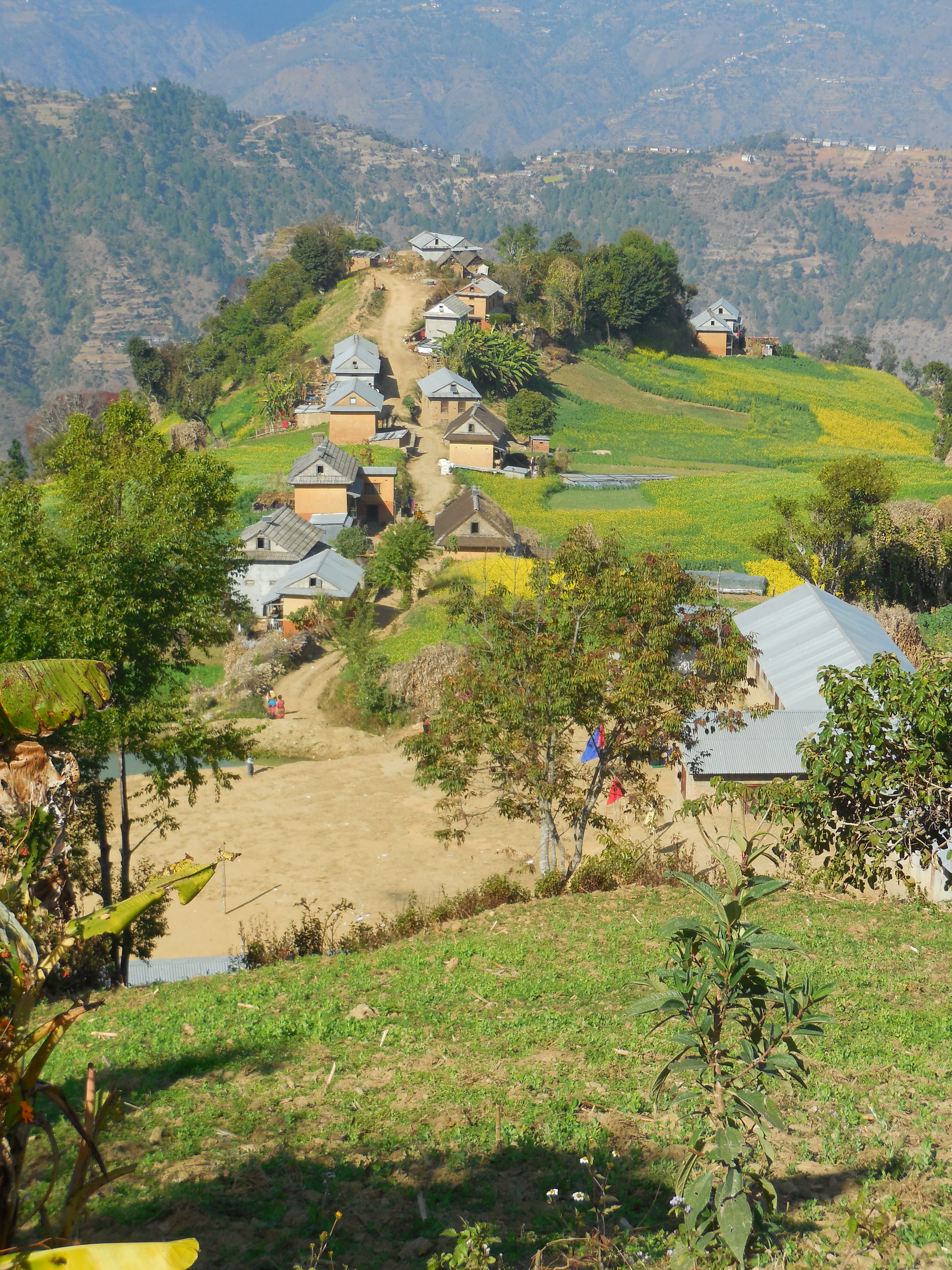
Almost 2.5 hours after we started our climb, we reach the village, left the kids at the school and made the final short climb up to Shankar’s home. As we approached the top of the road we were greeted by a welcoming party that had been eagerly awaiting our arrival. Two malas (garlands) of gold and maroon marigold flowers were placed around my neck and I was given some red flowers and some more marigolds as everyone said “namaste” to me in greeting. Everyone was extremely happy that we were there.
Shankar's village

Shankar’s village

Honoring a Mother

The particular puja Shankar and his brothers were performing is a means to offer devotion and respect for a relative, typically for a parent. Performed on the 15th, 30th, 45th and 60th day after the passing of the person and then monthly until the one year anniversary of the death, the ritual is seen as a way to alleviate any sufferings the person’s soul might be experiencing as it wanders the world for the year.

Cows are viewed as holy by the Hindus and therefore the dung is considered pure. Using a softball sized pile of dung, the ground where the puja is to be performed is purified. Shankar’s youngest brother mixed the cow dung with water and carefully spread a thin layer over the entire area. The selected area was where their mother’s body was placed when she was brought out of the house after she died. Once the area was purified, only Shankar, his brothers and the priest were allowed to step there. When the ground was dry, mats for the priest and the brothers were placed accordingly and the trays of banana leaf bowls containing rice, sugar, salt, turmeric and ghee were readied.

Amidst the flurry of ceremony preparation, food preparation, daily work and preparation for the larger fire puja set for the next day, I was introduced to the family and given the basic tour of who lives where. A tin cup containing hot milk was produced, followed by a plate of food. Everyone was very curious about me and wanted to know my history. After the 10th time and her sharp memory from Thursday evening, Swastika was very effective in providing the answers (my age, America, single, no children). And following the answers, while the men of the family chatted, I leaned over to Swastika and said “they are trying to find me a Nepali boyfriend, aren’t they?” With the Nepali side-to-side head shake, she smiled and said “yes.”

As time grew closer for the puja, the brothers readied themselves. Dressed only in a white cloth around their waist, the first step was to change the strings they wore across their chest. Following a specific pattern, the new yellow string was placed across the chest and the faded white one was removed. The old string had to be broken, because the spirit in the string is so strong that if another person tried to wear it they would have a burn left on their skin, and tossed somewhere. When they were ready, they took their places in front of the priest. Shankar sat in the middle with his younger brother to his right and his youngest brother to his left.

This puja was clearly for the sons to honor their mother and not a large family ordeal. A few of the family members gathered around for the ceremony, although most kept on with the work at hand. People were sent to gather missing items, extra small bowls and a container of water. Cell phones rang and were answered a couple of times. All while the priest continued with the ceremony I tried unobtrusively as possible to take a few pictures (with permission). Mostly I just sat and watched tying to make sense of what was transpiring and wishing I knew more about the symbolism of the ritual.

In the center of the area, three bowls made of banana leaves filled with rice were placed, the center one with a lit piece of special grass and a puri (fried bread), another with just a puri and the third with a copper bowl of turmeric. Mantras were spoken as offerings were made of the sugar, salt, turmeric and ghee. In synchronized movements, the strings around their chests were moved from the right shoulder to the left and back to the right. Tikka paste was prepared in a tin plate that looks like an artist’s paint tray.

Performing the puja to honor their mother.

Performing the puja to honor their mother.

At the end, everyone received a tikka blessing using the yellow tikka powder. The priest first gave Shankar and his brothers the tikka blessing. After all of them had their blessing, then Shankar gave the priest the blessing followed by the wives, the uncles, the sisters, and the children. When all the others had been blessed, Shankar came up to me and said that he thought it would be best for me to have one too. And with that, the ritual was done.

The brothers changed back into their all white clothing and covered their heads. Food was served in the house where the youngest brother lives. The metal plates were piled full with rice, curry, dal and pickle. The elder males had the place of respect on the slightly raised platform, a seemingly continuous flow as one would finish and another would come sit down in their place. Shankar’s youngest brother is a cook as well as my personal photographer, taking my camera and making sure there were pictures of myself and all the family eating. Shankar and his brothers were the last to eat, this meal being the first of the day because of the ritual.

Before heading in to eat, negotiations had started amongst the uncles and Shankar. Shankar’s uncle had organized a large puja for the next day, to which the whole village had been invited. A similar puja had been arranged after the passing of Shankar’s mother, which Shankar was unable to attend. His uncle wanted to know why he couldn’t attend this time. At every excuse Shankar provided, the uncles countered with some means to overcome that obstacle. First was Swastika’s school and missing two days in a row. (Uncles: Missing two days won’t make any difference on her exams.) Next was that I had already paid for my hotel in Dhulikhel. (Uncles: how much did she pay? (I’m pretty sure they would have taken up a collection if I told them).) After that was that we didn’t have enough bottled water for me to drink. (Uncles: we can have some brought up on a jeep.) Lastly was that where Shankar’s car was parked the owner of the shop was not going to be able to close his doors. (Uncles: A flurry of phone calls to confirm that there was no way to close the shop and what could be done. Resolution: Shankar could walk down the mountain, move the car, and come back up (either by foot or jeep).)

Doing the right thing and happiness is always more important than money. It was clear to me that Shankar staying would make everyone, including Shankar, happy. I told Shankar that I had no problem with staying in the village and that the cost of the hotel booking was truly unimportant. And with that, it was settled. Shankar, Swastika and I would be staying in the village. Shankar would make the trek down and back, to move the car and buy water (and an unnecesary roll of toilet paper/tissue) while he was there.

Shankar and his nephew headed down the mountain, while Swastika, one of the nieces, Shankar’s youngest brother and I headed up the mountain a little further. Swastika wanted to take me up to show me a couple of the temples in the village. The first temple was a small cobblestone wall surrounding a courtyard containing two bells and a colorful shrine. The next temple was down in a valley, bright with green crops and yellow mustard plants. After that we went to visit their other grandmother, a beautiful 81-year-old lady worn by sun and farming. She commanded that I sit, and sent the girls to go and fetch some sugar cane. The girls came back with two large stalks of sugar cane that were about three times as tall as they were. The cane was proficiently cut into smaller chunks and peeled so that we could chew on the fibrous mass to get it to release its sweet goodness. Before we left, we had to have a cup of warm and spicy tea flavored with a touch of black pepper to give it an additional bite.

Returning to the house, we joined in with the food preparation for the next day. The amount of food preparation that goes into feeding over 200 people is pretty impressive. The first job they let me help with was making the puri (round fried bread made using corn flour). My job was to help make balls of dough that the remaining 5 people were rolling out into flat perfectly round circles for cooking. At one point, Amrika asked me if I wanted to try rolling them out. To put it simply, I’m not very adept at rolling and flipping the dough in the right way so that it doesn’t stick to the rolling pin and ends up in a perfect circle. Being taunted with fresh hot cel roti (circles of dough like a doughnut but with the flavor of a funnel cake made using corn flour), I relinquished my rolling pin and block. After my snack, I went back to rolling the balls of dough.

As we worked, Amrika worked on learning a little English which actually involved a great deal of laughing. One of my habits that I picked up in Thailand is to say “ok, ok”. Amrika started mimicking me when I would say it. Through Swastika she was able to say a few other phrases by the end of the afternoon, including that she wanted to come to America with me. In between laughing, the kind old gentleman that looks a lot like Grandpa Walton from The Waltons, would smile his toothless grin and admonish her to work more and talk and laugh less.

While most of the family worked on food preparation, the rest tended to the evening chores. At one point, it was suggested that I try milking the cow or buffalo. While I would have been game for it, I opted not to. Which I think was a preferable choice for both myself and the buffalo.

As dusk started to settle, Shankar returned from his trek. Car was moved and I had two more bottles of water.

Life on the Mountain

As evening settled on the mountain and the temperatures began to drop, all the activity moved inside. The cheerful noise of people eating and talking resonated off the mud brick walls insulating us from the cold. The happiness of family and community apparent in the tenor of the talk and the smiles on the faces. Shankar was certain I was bored and many times offered that I was welcome to take a rest whenever I wanted to. Even though I couldn’t understand a single word, I was fascinated and warmed to be in the presence of such genuine love and didn’t want to miss any moment of this experience. After dinner, we moved to the other house where a wood fire was built in the cooking area and most the people went to work peeling and cutting the vast quantity of squash that was need for the curry the next day.

Finally it was time for sleep. Even though it was only probably 8 pm, I was exhausted from the long day of rising early, hiking up a mountain and meeting the family. My bed was in the youngest brother’s house. A solid Newari bed made of a wood platform and an inch thick mattress covered with the thickest blanket I’ve ever come in contact with. (Shankar’s youngest brother had brought it back from Saudi Arabia where he has been working.) I snuggled into my bed, head covered with a scarf that had I had been lent, and sank into a sound sleep in the pitch black room. The warm heavy blanket and the warmth and insulation provided by the mudbrick walls made for one of my most comfortable nights sleep of the whole time in Nepal.

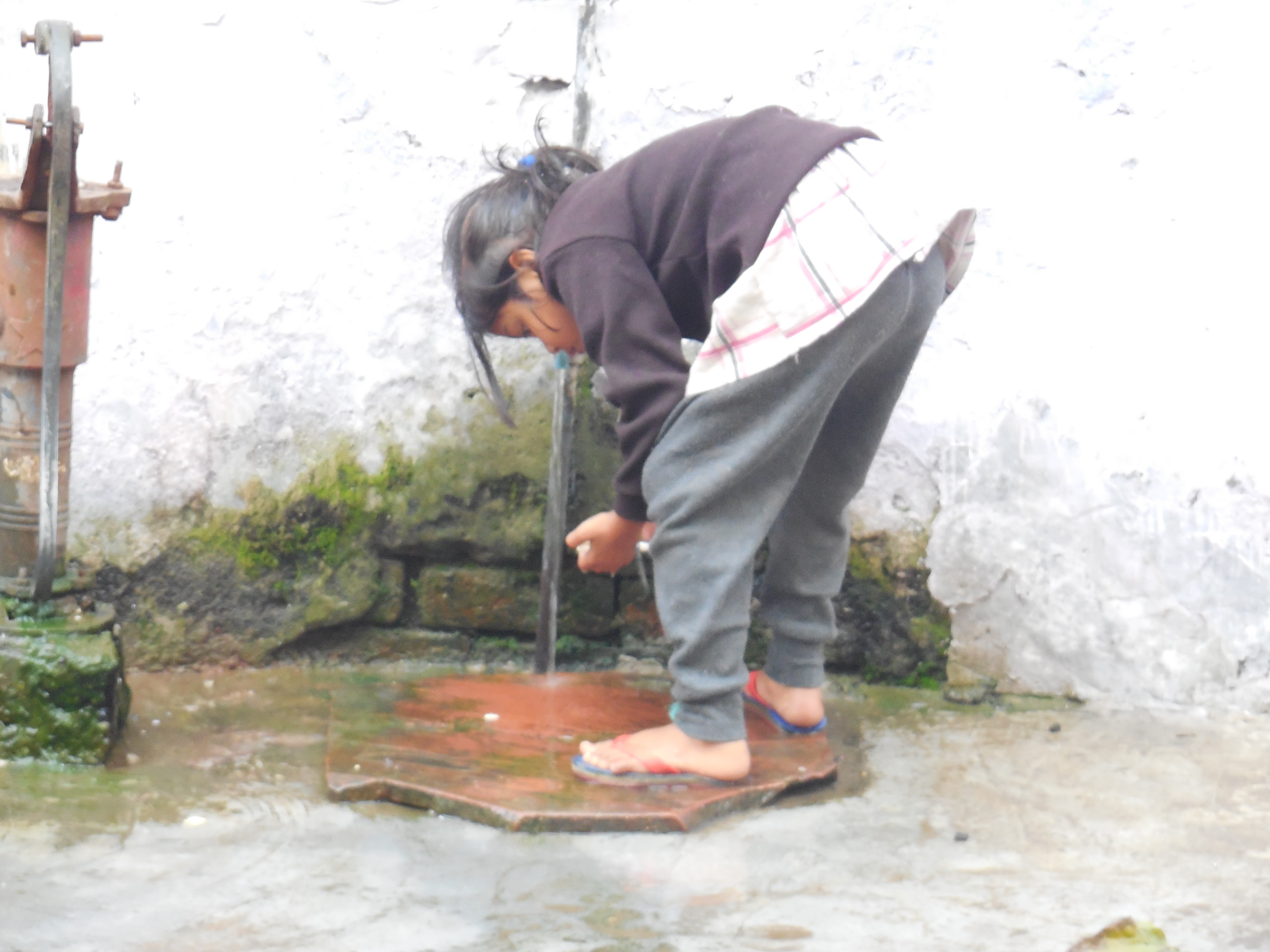
Without electricity, life rhythms definitely flow with the rising and setting of the sun. Once I could see a faint thread of light around the wooden shutters and was sufficiently sure that other people were stirring about, I decided it was time to get up. Watching the day get started filled me with a sense of contentment. Each person efficiently and happily performing their chores. Large pots of warm mush (flour and water) was made for the cattle. Cows and water buffalo were milked. Goats were brought out to their stakes and their bundles of food hung from the posts. The embers from one fire being used to start the other. People washing and brushing their teeth with the cold mountain water. Shankar said it must seem strange to me. Just because it is not my normal doesn’t make it strange. In fact, at the heart of it, watching the rituals just enforces how similar all humans are despite their culture or where they live.

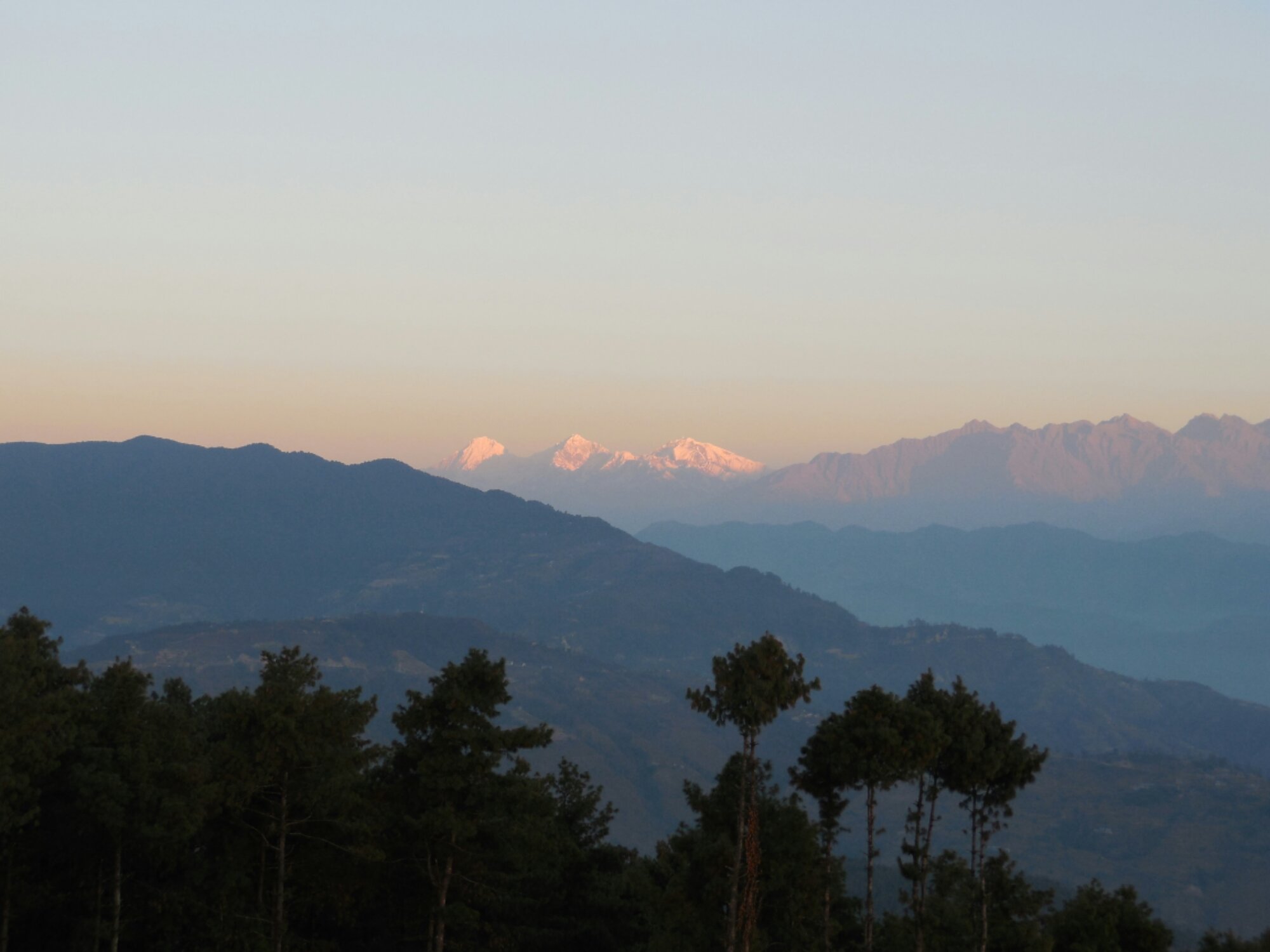
Of all the sunrises on the Himalaya that I saw during my week in Nepal, the sunrise from the village was by far the most beautiful. For the first time I was truly able to appreciate the height of Mt. Everest. Instead of being a small triangle on the horizon, its height a victim of perspective robbing it of the respect as the tallest mountain deserves, it appeared as a peak that truly stands above all the others.

Removing Obstacles

Preparation for the Fire Puja was a furry of activity, each person doing their part to make certain that everything was as it should be The main preparation was the area where the puja would be performed. The eldest uncle was in charge of building the altar, a 20″x20″x4″ two-tier square built out of cow dung. Once it was made, he proceeded to decorate it using white flour and red and yellow tikka powder. The white representing peace, the red action and the yellow perfection. At each corner were three flower petals. On the east side, was the name of god (Rama). On the south side, was a conch shell. On the north side, was the weapon of Rama. In the center was a wheel with spokes going to each corner. Along the sides was a scalloped pattern looking like a garland made out of powder.

Fire puja preparation.

Fire puja preparation.

The jovial priest with his effervescent personality arrived wearing a bright orange jacket with silver reflective strips and began his process of setting up the rest of the altar. Several people helped to find ways to string the cloth banners with Sanscrit writing on the wall as another altar was set up for Shankar’s mother and the images from the pantheon of Hindu gods. Music was playing on a loudspeaker, and every now and then at the appropriate moments, the priest would throw in a “hare Krishna” or just a “hare”. When I asked what I could do to help, he said to dance. In demonstration he put his hands in the area and spun around sounding a solid “hare”. My version was a much weaker attempt.

The blowing of the conch shell indicated that the ceremony was beginning. The recorded music that had been playing was replaced with a 3-piece band comprised of an accordion, a pair of drums and cymbals. Once the playing and singing began, it carried on continuously throughout the entire day. Listening to the music, it was easy to become mesmerized and start chanting Hare Krishna along with the music. The men of the village took turns filling in as one needed to go do something or just to give them a break. The constant mantras of hare Krishna filling the air, carrying the praises down into the valley and up into the heavens.

The Fire Puja is considered to be very powerful and has many benefits. For the living, the ceremony fulfills wishes, removes obstacles, improves health and increases merits. For the deceased, the ceremony is a method of purifying negative karma in order for the soul to attain a higher rebirth. During the elaborate ritual, the offering is made by tossing a large number of specific substances into the fire. Among the substances offered during the Fire Puja were barley, sugar, ghee, cel roti, and coconuts.

One of the more interesting offerings was the mound of cow dung covered with flowers. Shankar explained this to be a traditional offering to honor Krishna for saving the people from Indra’s wrath. A long time ago, the ancestors used to make offerings of their crops to Indra. Krishna came along and told them to not make the offering to Indra. This made Indra angry and so she ordered the god of rain to send furious and relentless rains and the god of wind to blow mighty winds. The ancestors went to Krishna and asked what they should do, so he told them they must lift the village to make it a mountain. All the ancestors worked together and with the help of Krishna’s little finger, they lifted the ground and were able to be protected from the wind and rain.

Offering to Krisha.

Offering to Krisha.

Shankar was absent for a good portion of the fire puja, as he isn’t allowed to celebrate through singing or clapping of hands for the year while he is honoring his mother. Mostly I again just watched and tried to take in all the detail, wishing I knew more about the symbolism. Prayers would be said by the uncle and the priest over a substance and it would be added to the fire by the priest. This pattern continued until all of the substances had been offered. The words of the prayers being overshadowed by the mesmerizing sounds of the band playing and chanting.

Finally it came time for everyone to participate. Each person was given a handful of barley and then came to stand behind the priest. I wasn’t going to participate until the priest handed me a handful of barley. Shankar was quickly summoned to explain the process to me. While chanting the name of god, offerings are thrown into the fire 3 times. The process was repeated with sugar and coconut. Lastly was a handful of marigold petals. The petals were thrown into the fire while walking around the altar. Coming back around to the starting point at the front of the altar, each person got down and bowed. This process marked the end of the first part of the ceremony.

After a short respite while the area in front of the other altar was finished being prepared for more ritual was performed. All the time the band continued to play the mesmerizing music. People from the village had begun arriving and finding places to sit on the ground in front of the house. The uncle’s oldest daughter was in charge of giving tikka blessings to the people as they arrived. Children that arrived looked at me with that blend of curiosity and suspicion. (Looking back at pictures, I would have looked at myself the same way given the state of my hair having not been brushed and my clothes having been slept in.)

Once ready, the next part of the ritual started up. The priest began by pouring a circle of water on the ground. Next he placed offerings of sugar, salt, grains and tikka powder around the circle at the six points of the star that represents knowledge. The fervor of the celebration picked up with a flurry of spinning, chanting, playing music, blowing conch shells and ringing the bell. The cacophony of sounds meant to ensure the gods hear the prayers and send their blessings.

As mid-day approached, we slipped away from the ceremony and took our last meal with the family before heading down the mountain. Once we finished our meal and bags had been loaded with fresh spinach, squash, garlic, ghee, and fresh cows milk to take back to the city with us, it was time to say goodbye. Shankar suggested that I go over to the group and say namaste to the village. When I did, the priest came over to me and insisted I first dance, indicating that I mimic him in turning with my hands held up in the air. He then placed a mala around my neck and insisted I spin again. Then he gave me an orange and insisted on one final spin. Laughing and happy, I bowed and said one last namaste. Then off we went, accompanied by his brother and one of the uncles for a short way down the road.

Going down a mountain is much faster, although not necessarily easier on the body. We avoided one of the particularly steep areas by taking the road for awhile. With great concern, Shankar kept reminding me to go slowly. I followed him, carefully placing my feet in his footsteps. Along the way, two gentlemen from the village caught up with us. They joined us, carrying Swastika’s backpack as she was struggling with the weight and had developed blisters on two of her toes. They reacted when great concern when I slipped and plopped down on my bottom and again when Shankar also slipped. An hour and a half after we left the village, we arrived at the car.

My final night in Nepal was spent in Shankar’s home. The long drive home was punctuated by stops to buy fresh butter and pick up my belongings from his brother’s house, taking time for a cup of tea and to show pictures of the ceremony. At home, I met his father, a lovely and happy old man and we had a delicious, filling meal after our long two-day journey. Shankar’s wife and everyone ensured that I was comfortable and warm. Covering myself with a fleece blanket and then the quilt, I slipped into peaceful sleep.

In the morning, after the flurry of getting the children off to school and eating some of the most delicious rice pudding I have ever had (Shankar’s wife promised to teach me how to make it the next time I visit), we took our breakfast and I loaded all my pictures from our two days onto Shankar’s computer. His father seemed so happy to see the pictures and spent the 45 minutes that I was gone to walk into Bhouda to buy a few more souvenirs looking at them continuously. Not many people have cameras in Nepal, so seeing pictures of relatives and of the village was particularly special for him.

Finally it was time to head to the airport. Shankar’s father insisted on going with us. At the doorway, his father standing outside the door and me just inside, I was given a tikka blessing, a mala and an orange. The blessing was to ensure a safe and successful journey.

The whole family is a truly kind and genuine group of people who I am so fortunate to have encountered.

A Touch of Nepali Culture

Throughout my blogs I have said very little about some of the customs that I have encountered since I felt they deserved their own special discussion.

Eating in Nepal was one of the most interesting cultural differences I encountered. Nepali eat their food using their right hand. All the food is mixed together on the plate using fingers and then eaten. My food was typically given to me with a spoon as no one expected me to follow suit. On the morning of our stay in the village, they made me a traditional meal of dhindo (thick corn porridge) and sag (cooked spinach). Several people were concerned that I would have difficulty eating this with a spoon. So, much to their amusement and surprise, I followed by example and ate using my fingers. Eating using fingers as the utensil actually makes great sense as it allows you to enjoy the texture as well as the taste of the food. At lunch, I also used my fingers, quietly and without fuss. Shankar noticed and just gave me a nod and a happy smile. Eventually someone else noticed, followed by a warm smile and a laughing comment.

Love is also shown through food. Plates are piled full of food. When the plate is nearing empty, more food is offered. Politely I would accept additional food saying torre (just a little) so as not to offend and to accept the hospitality. The idea of just a little seems to be lost on most people out of wanting to show love and caring. By the last meal in the village, Shankar’s youngest brother actually obliged by only giving me a true little bit more.

Another cultural practice that it took me some time to adjust to was Swastika and other children asking an elder person permission before doing something. The first evening that I ate with Shankar’s family, the kids asked me if they could eat prior to going into the kitchen to take their dinner. In the village, Swastika would ask permission to stand (leave after eating) and to go to the bathroom or off to spend times with the village kids. Such a simple act that shows how elders are honored in Nepali society.

The beautiful more intimate greeting between people was another cultural aspect that I found endearing. At one point during the puja on the second day there was a brief time where people took time to greet each other. The greeting is done only between people of the same gender (with the exception of the old man who greeted me following this ritual). For this traditional greeting, a pair of people say namaste with their hands in prayer position and a bow of the head, then two hugs are given with hands placed on shoulders and changing sides left to right with each hug, then fingers are placed with the thumbs at the third eye (just between the eyebrows) and with fingers touching a final bow is given while uttering namaste and the name of god (Rama). This manner of greeting is to show that you recognize and honor the god that is within each of us. As I was leaving, I honored Shankar’s wife this way.

Heading for the Himalaya

Standard

Getting Settled In

From the air, Kathmandu appears as a mishmash of colorful buildings crowded into a valley. The pinks, blues and greens of the buildings providing splashes color in the otherwise tan cityscape.  Tribhuvan International Airport is by far one of the smallest international airports I have ever landed at. Without jetways the passenger loading and unloading is done directly from the tarmac. On the way to immigration, signs telling interesting facts about Nepal hung from the ceiling. My favorite: Nepal is home to the tallest mountains and the shortest people in the world. After completing my visa application, waiting in line and paying my $25 for my visa on demand, I dove into my first experience of Nepal.

True to the guidebook’s promises, a barrage of taxi drivers were vying for my business. All I really wanted to do was find an ATM so that I would have Nepali Rupees. Not that having rupees was completely necessary, as most people in Nepal will take US Dollars instead. The first two people that approached me were less than helpful. A third guy, sitting along the windows, pointed me in the direction of the ATM. He too was a taxi driver, and since he was kind enough to help me out and was going to charge me $2 less than his competitors, I accepted his offer.

As the rickety white taxi car pulled up, I almost immediately began to doubt my choice. Still, I got in and off we went into the Kathmandu traffic. Kathmandu traffic was a whole new experience for me. Traffic fills the streets in a chaos of each car and motorbike attempting to find the least bumpy spot of the road, which often means the center or the opposite side of the road. Cars seemingly go every which way and there is a distinct lack of traffic lights. At some of the more major intersections, police are stationed to help provide some sense of order in traffic flow. Honking as communication is necessary, but far less pervasive than in India.

Between two calls to the Shechen Guest house for directions, the driver assured me that he knew where it was just couldn’t remember exactly. Those rea not very reassuring. Eventually, after a trip up a slightly paved street, asking yet another person where Shechen Guest House was, a U-turn, and a trip down a small alley, we arrived at Shechen Guest House.

From the outside, the guest house was picture perfect. The rooms looked out on a lush green courtyard and the brightly colored side of the temple from the attached monastery with strands of prayer flags fluttering in the light breeze. Inside, the drab room with paint that had seen better days and the musty smell was less appealing. The people were friendly, the location was very near the stupa and the proceeds go to the monastery, so that made the room tolerable.

Anxious to explore, I struck out in the direction of Bhoudanath to see one of the largest spherical stupas in Nepal. A short walk and I had my first sight of the white dome, topped with a gold square painted with Buddha eyes on each side, and a gold spire reaching into the clear blue sky. Prayer flags fluttering in long strands streaming from the spire to the four corners. Circling the stupa, spinning the prayer wheels and counting “om mani padme hums” on their malas, were dozens of devout Himalayan Buddhists. Some monks in their deep maroon robes, old women dressed in traditional Nepali fabrics, and people wearing every day clothes made up the worshipers. At the Hindu temple at the front, people were making offerings. An old woman in her maroon robe was stationed outside the shrine door. She called me over and gave me a blessing, for which I gave her my only small rupee bill (50 NPR). I climbed up on the stupa platform, spinning prayer wheels and taking pictures. Seeing the stupa was just what I had hoped it would be.

Bhoudanatha Stupa

Bhoudanatha Stupa

Bhouda is home to several monestaries and the energy of the area reflects their presence. Chanting, drumbs banging, cymbals crashing and horns blowing were omnipresent as each monestary had a different schedule for their prayer sessions. Around the stupa, recordings of “Om Mani Padme Hum” chants played continuously. Collectively it was actually quite soothing.

Kathmandu is a city that is too large for its britches. Approximately 3.5 million inhabitants live in this city with an infrastructure less than adequate to support that size of a population. Most streets are almost paved, at least in the centeral part of Kathmandu. Going out to the edges of the city, such as in Bhouda where I was staying, the roads are a combination of remnants of paving and dirt. Electricity supply is far greater than the demand, requiring rolling balckouts at least once if not twice a day. The rolling blackouts are a part of life, as evidenced by the schedule posted in the lobby of the guest house. Which, if you miss that sign, can lend to a bit of confusion upon returning to your room and finding that there is no power.

Touring Kathmandu

Nepal is just starting to tap into the tourist market. Almost a reflection of the city itself, the idea of providing quality service as part of tourism has not completely been realized. Instead, key tourism destinations generally charge a hefty price to all foreign (non SAARC (South Asian Agreement for Regional Cooperation)) tourists. In one day of sightseeing, the total entrance fees that I paid was 2600 NPR (or $26). The perception that all tourists have money is also clear in the phrase “150 rupee not big money to you” (or 200 or 300 rupee). By the end of my first day of sightseeing this attitude toward me as a foreign tourist had me feeling overwhelmed and frustrated.

My one day of sightseeing was full of the must see locations such as Pashupatinath, Swayanbunath Stupa, Patan Durbar Square and Kathmandu Durbar Square. I do belive that my trip would not have been complete without seeing these sites. The most effective way to see the sites is to hire a driver for the day. Hiring a driver was where fate smiled on me. Shankar, a man with a friendly face and demeanor to match, picked me up promptly at 8 am. Piling into his white taxi car, off I went to see Kathmandu.

On the way to our first destination, Pashupatinath, Shankar and I talked about Himalayan Buddhism and other topics of interest. He gave me history on the city and the area. About the three kingdoms, Kathmandu, Bhaktapur and Patan, that were joined together to form Nepal. He also explained how a long time ago the Kathmand valley was a lake that a king was told to drain so that the kingdom could be established there. Finally, he also gave me advice about the guides at the tourist locations. Because Shankar doesn’t have a tourism license, he is not allowed to walk around with me and explain the temples and the practices. He strongly advised to get a price from the guide. Advice I should have heeded more stringently.

Pashupatinath is a large Hindu complex known primarily for the cremation ghats. After Shankar showed me some of the smaller outlying temples, including one where I recieved a couple of blessings. One being a yellow many stranded string tied on to my right wrist while a prayer was being said. Another was a tikka on my forehead. The gentleman at the temple explained about the Shivalinga (primary symbol of Hindu worship) and the four faces on each side of the pillar in the center of the Shivalinga. Depending on your troubles, you would pray to the appropriate face.

After that small temple, we were approached by a guide. Later Shankar told me that the guide was being very beligerant about the fact that Shankar was telling me about the place and that he would report him if he didn’t stop. To my face the guide was friendly. And when I asked about a price he said to pay “whatever made me happy”. Herein lies the mistake that I made. Being a trusting person coming from a fixed price system that hates to barter, I was not insistent about a price. Off I went with the guide for my hour or so tour.

The guide provided a wealth of information about the rituals and the history of the place. The primary ritual he explained to me about was the beliefs around death and cremation in the Hindu faith. When a person dies, the body is cremated and the ashes are cast into the Bagmatti, the source of the Ganges river. The rituals go beyond just a cremation. The body is wrapped first in white cloth  (for purity) and then gold cloth. The sons carry the body to the river for purification on a bamboo platform. The body is blessed and the gold cloth is removed, because our bodies enter the world naked they should also leave the world naked. After the body is prepared, it is carried to the cremation platform and placed on the pyre of wood that is waiting. The eldest son is responsible for placing the fire in the mouth. What this means is that the eldest son circles the body three times with a lit offering and then places it in the mouth of their parent. Only sons are allowed to perform this part, if the person had no sons thenthe attendant for the platform would perform this duty. After the fire is placed in the mouth, the body is covered with straw and the cremation begins. With the body are gold placed in the mouth to wish the spirit wealth in the next life and bags of rice to wish that the spirit never gets hungry in the next life.

The rituals extend beyond the cremation. After the ceremony, the members of the family perform a ritual to be purified. The sons will shave their head and face, save one lock of hair, and will wear only white for the next year. Rituals to honor the parent are performed once every 15 days for the first 2 months, then once a month for the rest of the year. On the far bank of the Bagmati from the cremation platforms, people were performing these rituals. In addition, for the year the sons are only allowed to eat pure foods and are prohibited from eating items such as garlic or anything that has been dried.

Our tour continued to the far side of the river where many stupas and shrines had been built. Many of the shrines are home to holy men with their continual chanting, smoking of cannabis and offering tikkas to tourists. My guide lead me to one of the “official” group of holy men (which in retrospect I suspect is a group that is more for show) where I received another tikka blessing by three men with their faces painted and wild hair (at a cost of 300 NPR ($3)). My guide also showed me the reflecting shrines. A series of 11 shrines built in perfect alignment so as to appear like a reflecting mirror of shrines. The king built these shrines in the hope of finally bearing a child. 11 is a key number because the 11th incarnation of Rama is the one for fertility and child bearing. Also from the far side of the river, we were able to watch the whole cremation process from purification to lighting the pyre.

At the end of the tour came time to pay. Apparently whatever my guide felt would make me happy was 4000 NPR ($40). 4000 NPR is what Shankar was charging me for the whole day of taxi service. I told him that I could only afford to pay 1000 NPR ($10) (in reality I was thinking that it would only be 500 NPR) and even paying 1000 meant that I would not be able to pay entrance fees or buy souvineirs. Yes, my emotions got the best of me and tears flooded to my eyes. Clearly, I was not happy. He had told me before that if they make someone cry, then they will cry the rest of their life. When he offered me to take my money back so that I wouldn’t cry, I should have taken it. As I walked to the Shankar could read my face and knew what had happened.

Leaving Pashupatinath, we headed for Swayanbunath, one of the largest stupas in the world perched atop a hill overlooking Kathmandu. Swayanbunath is also known as Monkey Temple, so named for the many monkeys hanging about searching for food. Visitors need to be wary that they don’t hold their cameras or purses in a way that a monkey can snatch them thinking they are food. Shankar was able to walk around with me here and explain about the temple. We walked around the stupa admiring the white plaster, the gold square atop painted with Buddha eyes on each side and the spire reaching up into the blue sky. Prayer flags streamed from the top of the spire to all four corners, their red, yellow, blue, green and white flags representing the elements and blowing in the breeze to carry the prayers off into the heavens. Walking around Swaynbunath was a terrific respite from my experience at Pashupatinath and helped restore my spirit for more sightseeing.

In Nepal, Hinduism and Buddhism peacefully co-exist at many of the temple complexes. Some people believe that Buddha is an incarnation of Rama, facilitating the existence of the two religions hand in hand. At Swayanbunath, several Hindus were making offerings at their shrine while Buddhists circumambulated the stupa spinning the prayers wills and reciting “om mani padme hum.

For lunch we headed to Patan Durbar. Durbar is the term for a square where the royal palace is located. On our way in, we stopped at a fruit stand for Shankar to purchase some fruit, a nice assortment of oranges, apples and bananas. Fruits are sold by weight, as measured by a balance scale with a basket on one side and weights on the other. The restaurant was hidden away in a courtyard just off of the main square. While waiting for my food, Shankar shared his fruit and explained that he can’t take food that isn’t pure while he is respecting his mother’s spirit since she had passed away 40 days prior. Outside of the home the only guarantee for pure food is fruit.

Patan Durbar square is filled with a variety of temples adorned with intricate wood carvings. Again, being a tourist location, Shankar was technically not able to tell me about the temples, so I carried my tour guide book with me and read some of the information at each temple. Wandering away from the square, we visited a variety of smaller temples tucked away down narrow alleys in small courtyard areas. Looking at the amazing brick and wood architecture was as interesting as seeing the temples. The cobblestone alleys were flanked on both sides with mud brick buildings that look as though they have been standing there for centuries. The ornate carvings on the window sills and eaves of the roof mimicking the carvings of the temples.

The last stop for the day was Kathmandu Durbar Square and an ATM as I was quickly going through my rupees. On our way there I made the comment that if I couldn’t find an ATM then I would not have enough money to pay the entrance fee and to eat. He told me that if I couldn’t find money, then I could come eat with him and his family in his home. I happily agreed to that prospect. When we arrived at Durbar Square, he dropped me off since no parking was available and pointed to the entrance and where the ATMs were on the other side of the street. Agreeing to meet at 5 PM, I wearily headed off for my last sight of the day.

I’ve decided that whoever designed the game Frogger had clearly experienced trying to cross the road in Kathmandu. The key is to hold your hand out as cars and motorbikes approach, kindly asking that they stop for you. Sometimes they do, sometimes they don’t. Using the protection of some locals to cross the street, I made it across and back successfully.

Almost immediately after paying my entrance fee, I was approached by a person wanting to be my guide. I told him that I had my guidebook and that I would be fine. He blithely replied that the book was written by foreigner and wouldn’t tell me all I needed to know. I simply walked on. A little further on, another want-to-be guide approached me. He told me that the Kumari Bahal (House) was open and did I want a guide. Again I declined and headed for the house. Kumari Devi is a living goddess. A young girl is selected  based on 32 stringent criteria to serve as the goddess until she reaches puberty and becomes impure. At the appointed time, the Kumari Devi approaches the second floor window of her house and looks down at the chowk (courtyard) full of visitors hoping to catch a glance of the living goddess. Pictures are not allowed and she will not make an appearance until is confirmed that all visitors have put away their cameras.

Filing out of the courtyard with the throng of visitors and being accosted by women trying to sell postcards, I headed for the main square. At this point of the day all the temples I had seen blended together in my mind. I stood and looked in my guide book for details and another man struck up a conversation with me as he pointed out the big bell used to call people together for important announcements, the dancing platform and the hippie temple. His initial statement of wanting to just talk for free was after a time followed with an offer for tea and to talk more. Out of a combination of wariness and only having a limited amount of time, I declined and walked away.

Attempting to escape the continual offers for guides and to buy souvenirs, I climbed the stairs to the top of one of the temples. Unfortunately, at the top was a gentleman who I was hoping was also just there to look down on the sights of the square. I was wrong. He too wanted to be a guide and it had been a very unlucky day for him as far as helping tourists. He too struck up a conversation, offering to be my guide. During this conversation I adamantly explained to him how tired I was of being treated like I had money just because I was a tourist and that $1.50 or $2 or $3 adds up to be big money. I told him that for them to look at tourists like they have money is the same for me to look at all Nepali like they are not kind and just want to take advantage of foreigners. He persisted in spoiling my attempt at some respite from the crowds so I climbed down the stairs and headed toward where I was supposed to meet Shankar, hoping that he would be there earlier than our appointed time.

The best and most special part of my day was the very last. Shankar repeated his offer for me to join him in his home for dinner and to meet his family. I gratefully accepted this generous offer. His simple home is on the third story of a typically narrow Nepali building, tucked off the main road. Only his wife was home when we arrived, as his daughter and nephew were off collecting his son from school. His wife handled the surprise gracefully and then insisted on making a second curry because I was there, despite my insistence to not do anything special. When the children arrived, they were definitely surprised. The boys were quiet and shy, hiding behind Shankar or his daughter as much as possible and whispering the questions they wanted to ask. Swastika, his daughter, is learning English in school and is quite proficient in it. While she was shy at first, as the evening wore on she began asking questions about my likes “do you like pets?”, “do you like birds?”, “do you like to camp?” among other questions. While she and I chatted, Shankar, his cousin (who had arrived while we were eating) and wife tried to make sense of my life since as a single, 43-year-old, traveling and living alone, I don’t fit into any Nepalese paradigm. I couldn’t have asked for a better way to end a very long day.

Some Really Tall Mountains

The key when flying into Kathmandu is to get a seat on the right-hand side of the airplane. As the plane approaches Kathmandu, passengers on the right side of the plane get the best view of the Himalaya. Coming from a place with mountains, the height of the Himalaya is truly impressive.

No trip to Nepal would be complete without seeing Mt. Everest. Since I didn’t have the time, training or inclination to even trek to the base camp, I opted for the easier approach of taking a Mountain Flight. Most of the small Nepali airlines offer 2 or 3 Mountain Flights each day. Departing early in the morning, when the skies are the clearest and the views are the best, the planes fly down the mountain range toward Mt. Everest and make a turn and come back up to Kathmandu. Six- to 20-seater planes are used so that all the passengers have a window seat.

My flight was on Simrik Airlines. Nothing instills confidence like the manager of the airline giving a small talk before we boarded about how Nepali airlines have been banned from flying into the European Union citing their poor safety record. With that in mind, the 18 of us boarded the vintage 1900C Airliner. I’m sure not everyone appreciated the low cabin height, vintage upholstery, seat belt buckles that required lifting the metal buckle to actually insert the tab into the buckle or the 3 air sickness bags in the seat pocket; however, I thought it was awesome.

Rattling down the runway we lifted into the clear blue skies. Heading down the Himalayan range, the stewardess would walk down the plane and point out key mountains as we went by. As we neared the turn, everyone had a chance to walk up to the cockpit to see Mt. Everest head on and take pictures. Karma, the agent that had booked my flight, ensured that I was on the best side of the plane. While I didn’t have great views on the way out, I was lucky to be on the side closest to the Himalaya on the return trip, offering much better views of all the peaks on the way back to Kathmandu.

Mount Everest from the air.

Mount Everest from the air.

To be honest, as mountains go, Sagarmatha (Mt. Everest) really isn’t that interesting. Seeing the tallest mountain in the world is impressive; however, its 29,028 feet (8848 meters) is really hard to perceive from the air or from a distance. Looking at the mountain it is merely a granite pyramid covered in alpine glaciers. Several other much more interesting mountains live in the limelight of their big brother.

The most interesting mountains to me are ones that have different faces and contours that catch the light giving the mountain a character of its own. Ganesh Himal (24,350 feet (7422 meters) is one of the Himalaya peaks actually visible from Kathmandu on a clear day. The broad face with three points like a circus tent and covered in snow catch the sunlight like a cloud with sharp edges floating above the Kathmandu valley. Gauri Shankar (23,405 feet (7134 meters)), the holy mountain, has double peaks and a deep bowl that give the mountain depth. The mountain is considered the dwelling place of Shiva and no one is given permission to climb the mountain (either by the authorities or by Shiva). Melungtse (20,660 feet (6297 meters)) looks like a mountain that was never finished, leaving a snow-covered curve of granite in place of a point.

Escaping It All

After my one day in Kathmandu, I was ready to escape the overwhelmingly big city and find something that would hopefully match the image of high snow covered mountains and friendly people that I had in my mind of Nepal. On the advice of my friend that had served in the Peace Corps in Nepal, I headed to Nagarkot. A small hill station higher (7,201 feet (2195 meters)) in the mountains about 1.5 hours from Kathmandu purported to have great views of the Himalaya and provide the ultimate location to just relax and enjoy life.

Leaving the city behind, the drive to Nagarkot took me past tan mud brick houses with wood trim painted bright purple or blue, and up narrow winding roads. By narrow, I mean so narrow that two cars couldn’t pass each other easily, let alone trying to get around the occasional bus or truck. Potholes added another feature to the journey up the mountain.

My destination was Peaceful Cottage Hotel. The minute I arrived at Peaceful Cottage I knew I had definitely made the right choice. Perched near the top of the hill overlooking valleys on both sides and a view of the Himalaya stretching across the horizon, the snow capped peaks reaching into the blue skies, I instantly felt better. The air was crisp and clear and felt amazing on my lungs that had been growing ever more clogged with smog and pollution. Even the people seemed to be more genuine and friendly than most of the people I had encountered in the city.

My room was a room fit for a princess. Located in the new building (so new that it was still under construction), the room with its tile floor and wall decorated in rock was a breath of fresh air from the mustiness of the Shechen Guest House. Two of the walls occupied by near floor to ceiling windows offered an amazing view of the valley and the mountains. One wall decorated in rocks ranging from small pebbles to stones, creating swirling patterns. The heavy wood headboard reminiscent of the temple carvings I had seen so many of the day before.

The most spectacular moments of the day at Peaceful Cottage are sunset and sunrise. At sunset, the red glowing sun slowly sinks into the mists of Kathamandu valley giving everything a mystical quality and taking the heat of the day with it. Sunrise is a must see event, especially from the rooftop. Around 6:30 the first blush of light touches the top of the highest peaks of the Himalaya making them glow like diamonds. As the sun continues to rise, the peaks are painted a blushing shade of pink, the light emphasizing the various faces of the mountains. The beauty of the mist filled valleys, dark foothills and the gentle pink of the snow capped Himalaya is breathtaking. Sunrise is also when Mt. Everest is the most visible, although it is merely a small triangle on the distant horizon.

Sunrise from Nagarkot

Sunrise from Nagarkot

My time in Nagarkot was dedicated primarily to relaxing, writing and just enjoying the view. During the day, I chased the sunbeams across the patio, moving every so often as the shade of the building overtook where I was sitting. In the evening, I staked out my spot at one of the tables in the dining room. Every so often I would take a break from my writing to enjoy the view of the Himalaya and the falcons circling over the valley or to visit with other guests or the staff.

I quickly became friends with Laxman, one of the staff with a vivacious personality, sparkling eyes and genuine heart. He would come over to chat often and made sure I had a thermos of hot water and the occasional cup of tea. The afternoon of my first day he took me on a motorbike ride to visit his village. As I watched him get his bike, I noticed the ritual that he did prior to moving or starting the bike. Three times he passed his hand over the engine then touched his head and chest with his fingers three times. As I never asked, I can only assume that this was asking the gods for a safe journey, which given the state of the roads around Nagarkot was probably a good thing. Laxman’s village is maybe 2 km from the hotel nestled into the side of the mountain. The village’s population of 200 people lives in clusters of homes for each family group. Laxman’s family members have three houses there belonging to brothers and sisters. I met the water buffalo and goats and most of his family. His brother’s sister made us tea. Sitting and drinking the tea I really wished that I knew more Nepali so that I could understand what his sister was saying. Laxman was not exactly the most helpful translator, his jokester personality often making me question if what he was translating was true or not.

After we left his village, we headed up toward an area that is a typical gathering spot for locals on their day off (Saturday). Several buses and large groups of people were playing music, dancing and cooking. We looked at the view for a little bit, then the group of women from Bhaktapur noticed me. One of the kids hooked up some music to the speaker they had brought and the dancing began. Surrounded by women in their bright fuschia and red and turquoise saris, I tried to follow along and have fun. At every turn, I would find a cell phone being used as a camera pointed toward me. One of the women showed me how to do their local dance, which hopefully I didn’t mess up too badly. After 30 minutes of laughing and dancing, we headed back to the hotel. Getting to experience the true spirit of the people makes my heart the most happy. These type of experiences are the ones I treasure most when traveling.

When in Nepal, Do as the Nepali Do

I’ve always found it the best approach to do as the locals do. This axiom applies to everything from eating to dressing appropriately.

While it almost never snows in Kathmandu, it does get very cold. Most buildings have no heat. The first night in my room at Shechen Guest House, I had trouble sleeping because I was so cold despite being dressed in long pajama pants and a thermal shirt and was buried under a thick blanket. After having dinner with Shankar and his family, I realized the importance of keeping my head covered. That night (and for all nights after that) I slept with a bandana on my head. Amazing how just a thin piece of cloth can make such a difference. The second night I was actually sweating.

Shawls or blankets are a key feature of almost every Nepali’s daily outfit. When I made my decision to head to Nagarkot, I knew I would need this extra layer if I had any chance of actually staying warm. My $5 investment in a green woolen wrap was well worth it in the chilly air of Nagarkot.

Ever since I was a child traveling with my dad, I have made it a point to try and learn at least a few words in the native language. Nepal is no different. On my first taxi ride I asked how to say “no” and “thank you”.  Slowly I added to my vocabulary, especially with the help of Laxman and Shankar. By the end of my time in Nepal I now have an 18 word vocabulary where I can say: hello (namaste, nameskar), thank you (thanyibar), a little (torre), hot (tatu), pani (water), cold (tishue), my name is MJ (meru namu MJ ho), what is your name (Que namu ho), no in 3 different ways depending on context (huay naa, huay dai naa, chay naa) and I love you (maa tameli maya gatzu).

Two Full Days

Standard

Monument to a Queen

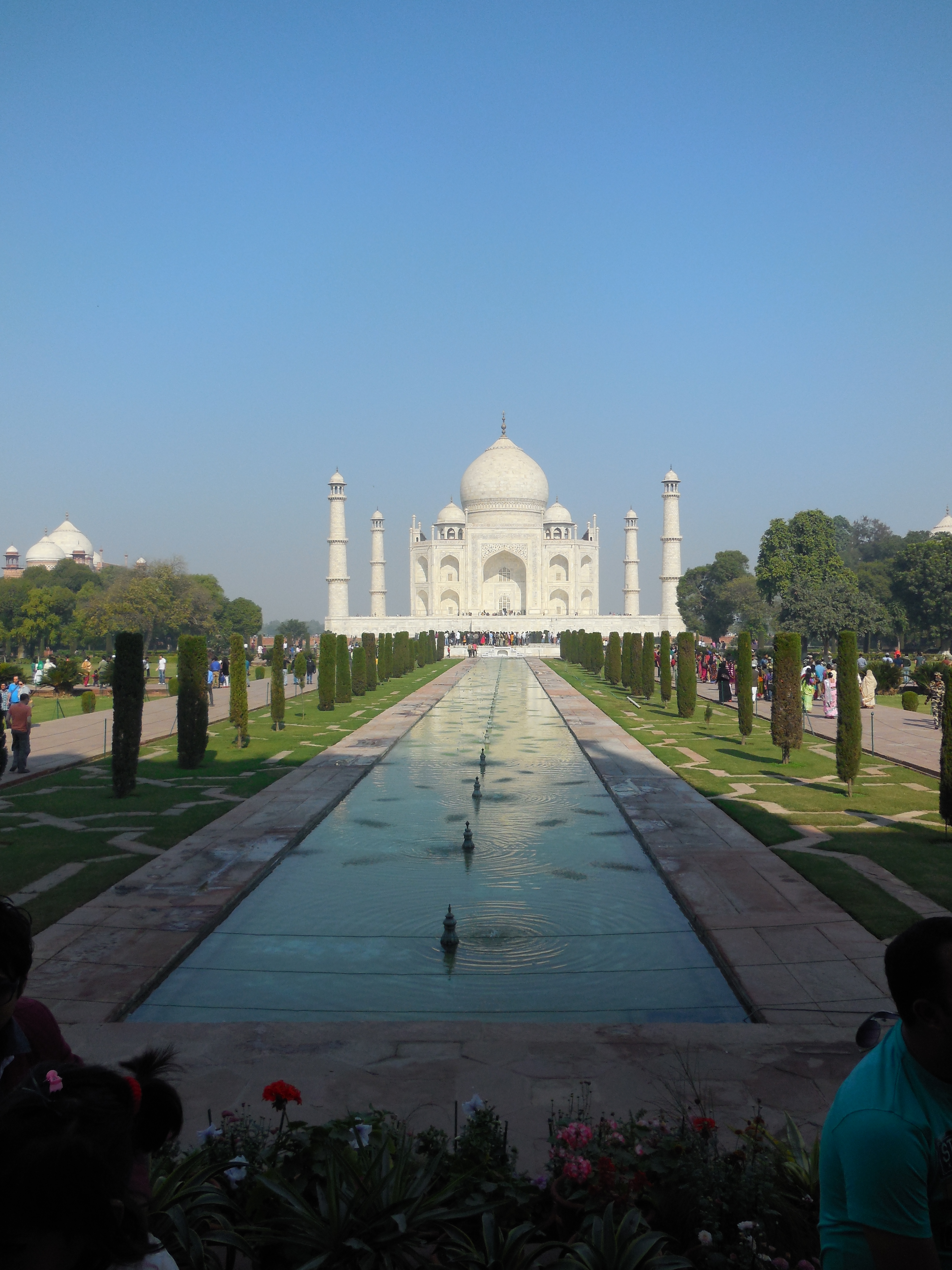
“Wow!” Not one of my more articulate moments but that is all I could say at the very moment I walked through the red sandstone gate and took in my first view of the Taj Mahal. My jaw literally dropped at the splendor of the white marble against the clear blue sky. The delicate carvings appear like lace in a beauty befitting a queen and the shallow pools leading up to the building reflecting the beauty up into the heavens.

First view of the Taj Mahal

That sight alone was worth every minute of the drive there, which was actually quite pleasant. My expectations for an arduous journey had been set well before I went to India by a friend that had traveled there a few years prior. Other than the traffic getting out of Delhi and getting into Agra, the trip was a peaceful journey using the Yamuna Expressway across flat green-brown fields punctuated by yellow mustard fields and the chimneys of brick furnaces rising up through the morning haze. A mere 3 hours after leaving the house, we made it to Agra. Agra has not yet figured out the necessary infrastructure to support a monument of such magnitude with the average 20,000 people who visit this New Seventh Wonder of the World daily. A mad chaos of cars, trucks, motorbikes, rickshaws, bicycles, and cows sluggishly made their way through the town, across the river, around a sharp U-turn along the river and finally into the streets around the Taj Mahal. I think the only people not really bothered by it all were the cows.

Once parked, the car was instantly assaulted by people wanting to sell books, post cards, magnets and I have no idea what else. Narrowly escaping them and the many touts offering rickshaw rides to the gate and the people offering to be a guide, we bought our tickets. Entering a big attraction like this is when being a woman in India is a benefit. Separate entry lines are designated for Gents, Gents with High Value Ticket (i.e., foreigners that have to pay 750 rupees instead of the 20 rupees Indian and SAARC people do), Ladies and Ladies with High Value Ticket. We had the shortest line possible, Ladies with High Value Ticket.

Other than being a “guide”, locals make money by offering to take pictures of people in all the classic poses (on the bench, standing, making it look like you are holding the Taj Mahal by the top spire). The fee is about 50 rupees per shot, and it is actually worth it. So after going through the photography session, which I can’t complain because our guy took the same pictures with my camera that he was also taking with his, I was able to really take in the beauty of the place.

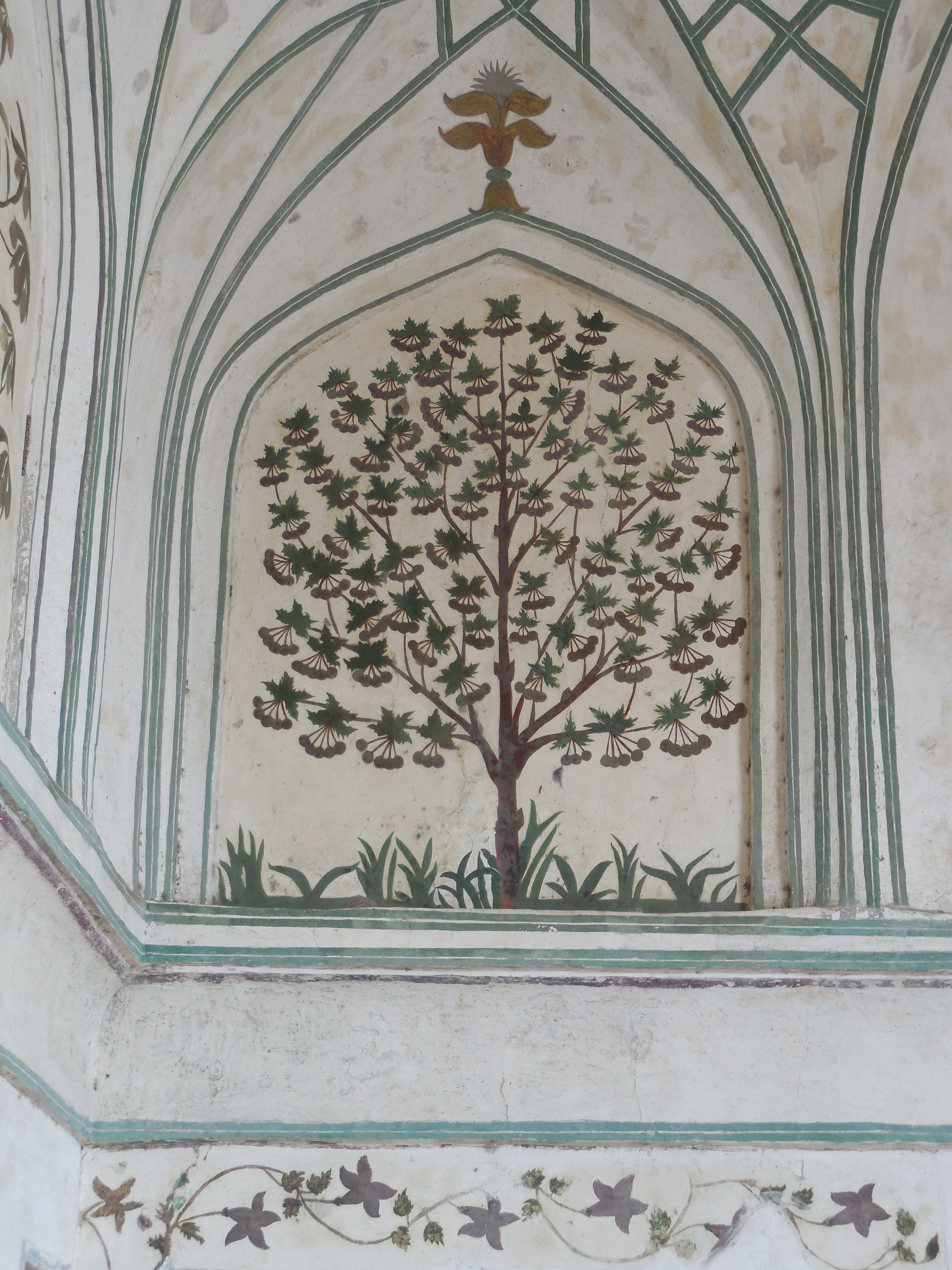
The Taj Mahal is built with perfect symmetry, with Shah Jahan’s beloved wife’s sarcophagus at the center of it all. (The only exception is the sarcophagus of Shah Jahan which was erected beside her sarcophagus.) Looking at the large white dome, flanked by two smaller domes to each side and accompanied by four white minarets reaching into the clear blue sky, the symmetry of it all is subconsciously taken in while marveling at the beauty. Entering the mausoleum, the awe continues. The marble screen surrounding her tomb is carved into a detailed latticework, each panel being carved from a single piece of marble. The walls are bejeweled with flowers and borders made from rubies, lapis lazuli, and malachite. The intricate beauty of the place can scarcely be elaborated by mere words.

Example of the intricate stone work

Example of the intricate stone work

As a person that generally travels alone, I know how nice it is to actually have pictures of yourself at the places you visit. I also think that it is nice to offer to take pictures of couples instead of them taking a picture and trading places. The first couple I offered to take their picture, had apparently heeded the advice to not let anyone offer to take your picture for fear they will run off with your camera. Being an honest person, I felt a little sad by their reaction. The next couple I offered to take their photo also appeared hesitant, so I offered to let them hold my camera while I took their picture. That made them relax. And after I took their picture, they insisted on a picture with us in it.

After lunch and collecting my photos, we headed to a park on the opposite side of the river from the Taj Mahal. Working our way back through the Agra traffic was again a bit of a challenge, taking longer than you would expect in a small town. The near deserted park provided a peaceful view of the Taj Mahal and a chance to take pictures that are void of other tourists.

Getting into the Thick of It

After easing into India culture the first part of my trip, I finally took the plunge and dove into it head first like it was an ocean of cold water. Delhi By Cycle offers bicycle tours around Old Delhi. Instead of just looking at the chaos that is Delhi, you actually get to experience that chaos first hand by riding a bicycle through it. Meeting at 6:30 AM, we climbed on our bright orange bikes and off we went. Flanked by our guides in their bright orange jackets, we rode through alleys that were barely wide enough for our bikes and a person to pass, past people starting their day around fires of burning trash, through slightly wider alleys, and along busy streets. Going on the tour was a truly incredibly way to experience Delhi.

Along the way, we stopped at particular points of interest for our guides to explain various landmarks and to snap the occasional picture. We made stops to look at the old British architecture of buildings long since empty but still owned by families and to gain some history bout the city. We stopped to see places such as the Red Fort, St. James Church, and the Jama Masjid mosque. In some places, local people would gather to see the tourists and maybe to listen. On a couple of occasions people begging for food or trying to sell trinkets approached the group and were quickly shooed away through the sternly spoken Hindi words by one of our guides. Most of the time, the people along the way would just say “Good Morning” or “Hello” as we passed by and the kids would stare at us wide-eyed and a little shy.

Looking around at the people gathered around small piles of burning trash or that are washing at the community water pump, the initial gut reaction was a bit on the side of “what a terrible existence this must be.” Going beyond that paradigm, I started realizing that this is just their life. Homes do not have running water or central heating. And these activities are their morning rituals, no different from anyone waking up anywhere in the world.

DSCN1605

The olfactory assault was a little harder to get over. The combined smells of urine and burning trash resulted in a pungent combination. Women sweeping the area in front of their homes continually stirred the urine scent as it mixed with the dust and was catapulted into the air. The smell of trash burning was layered onto pf the already pungent smell. In particular the man burning a large plastic tarp, the odor of melting plastic permeating the air. All of this combined with the exhaust from the cars, trucks and motorbikes and the general smog that hangs over Delhi left an acidic taste in my mouth and throat.

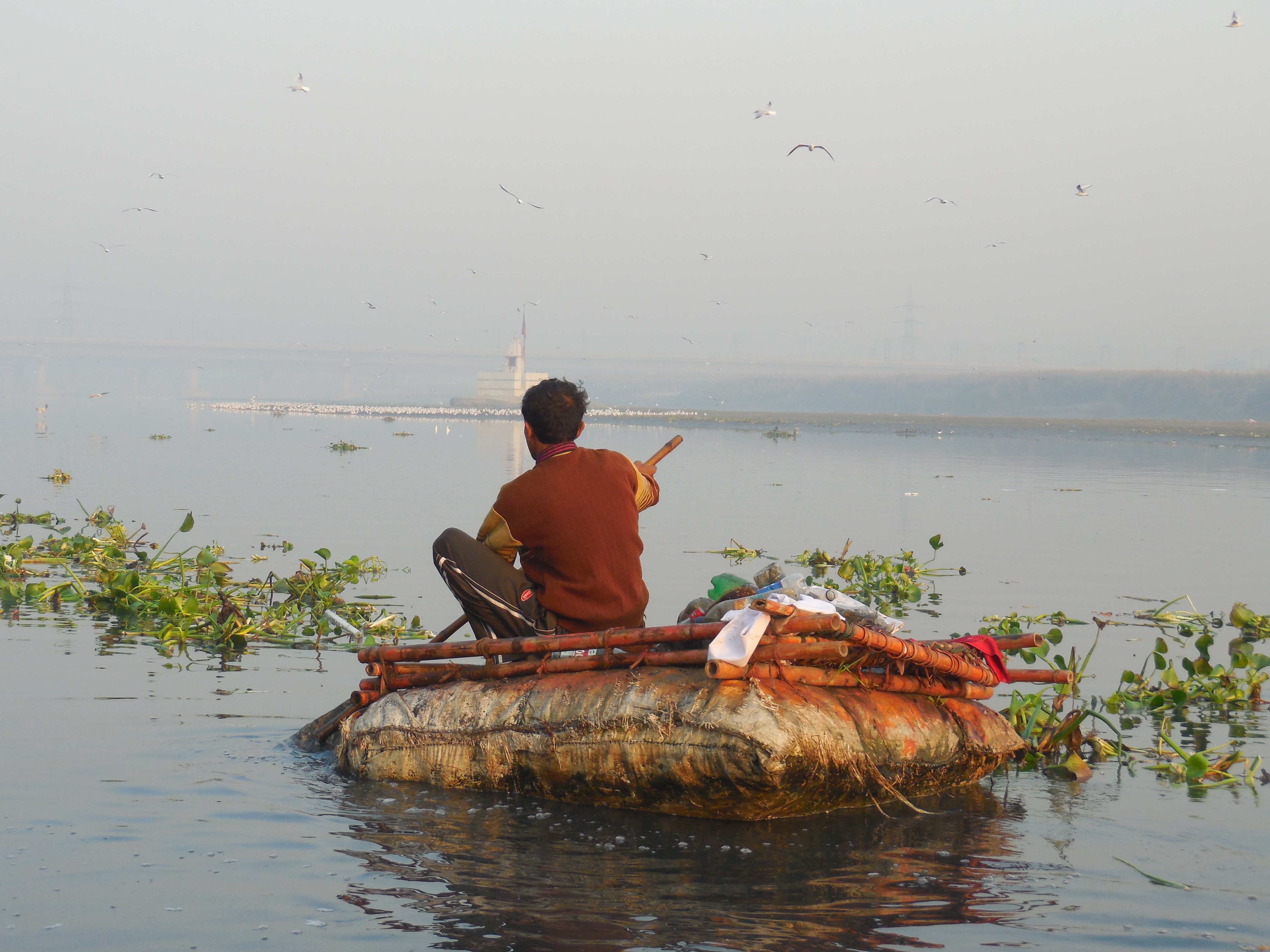
The highlight of the Yamuna Tour was a short boat ride on the Yamuna river. Leaving our orange bikes under the watchful eye of one of our guides we made our way over the flood barrier wall to a home situated on the bank of the Yamuna river. Donning life jackets we climbed into the small boat that was rowed downstream while our guides explained various facts about the river, such as 18 sewage/rain drains dump directly into the river and the lotus like plants on the river are merely remnants from cremation ceremonies. We passed by a person on his barely buoyant makeshift raft collecting trash from the river to sell. We finished our river tour with a viewing of the cremation grounds (Nigambodh Ghat) where the last vestiges of one of the morning’s cremations was still burning and the ashes from another ceremony were being cast onto the river.

DSCN1577

After a chai break, we hopped back on our bikes for more of the city life. We passed by the large group of men gathered in the hopes of finding some work for the day. Another large group was waiting in line for polio vaccinations. The morning ablutions had given way to the start of commerce. Food cooking provided an olfactory respite. Fruit stands and stores were starting to open up. During this stretch of the ride it was imperative to start making friends with the bell on the bike and how to use it, as the number of people, bicycles and motorbikes in the alleys had increased significantly. By the last bit of the ride, I felt like a true participant in the conversation of honking and bell ringing. Short rings to let people know that you are there, longer more insistent rings to try to urge people to get out of your way.

At the end of the tour, Mr. Joseph came to collect me and continue on with my day of sight-seeing. First stop was at the Red Fort, the primary landmark that I wanted to see. The impressive red sandstone walls are another testament to the incredible appreciation Shah Jahan had for architecture. Many of the inner building are made from white marble, with inlaid stones and carving similar to the Taj Mahal. The smooth white marble providing a lovely contrast to the rough red sandstone.

DSCN1618

It was only noon and I was on stimulation overload between the sights and smells of the bicycle ride and the hordes of school children at the Red Fort who wanted to take their picture with me. To add to the over stimulation, I ended up going out the main entrance of the Red Fort and walking along the street for some distance. Immediately after exiting the compound, I was flooded with taxi drivers and rickshaw drivers and tuk tuk drivers all asking if I needed a ride. In retrospect, it might have actually been worth 20 rupees to have them take me the short distance to the parking area.

The night before I had discovered that the charging cord for my tablet had died. Our main objective for the afternoon was to find a replacement cord. It is at times like this where I wish I didn’t have a tablet that uses proprietary adapters for their power supply. First we went to Kahn Market, an area with several electronics stores. Mr. Joseph and I went from store to store asking them about a cord, several of them trying to say that it was the same as an iPhone 4 cord, and others just looking at it, shaking their head and saying to try the next one. The consensus was that, if there was an ASUS tablet cable to be found in the city of Delhi we were going to need to go to Nehru Place.

After a lunch break, a pleasant place recommended by Mr. Joseph, we headed into the Delhi traffic to Nehru Place, which is most of the way across Delhi. At this point, let me just say that Mr. Joseph is a saint. Nehru Place is a morass of electronics vendors and people offering software and laptop laminating. I didn’t think it was possible to actually hock that much software. Mr. Joseph persistently guided me through the place, again stopping at several stores. Strangely, the ASUS store didn’t have a cord but sent us to 107-A in another building. 107-A is a small niche in the wall where we found a young man who apparently had all the necessary connections and minions to carry out his bidding. He was able to produce not only a charging cable but also a converter plug so that I can still use the charger when I get back to the States. And if the charger should have problems, it has a 3 month guarantee.

The last stop was the Lotus Temple. A Bahai temple designed to look like a lotus flower, the bud of the lotus formed by the white architecture and the opening petals pools of blue edged in white stone. Having seen the temple from the air, it gave me a whole new appreciation to how far across the city we actually were. Partly out of not wanting to keep Mr. Joseph waiting too long and partly out of exhaustion and overload, I stayed just long enough at the temple to take my shoes off, walk around the temple, read a little about the Bahai philosophy and reclaim my shoes. The temple is really beautiful and a very unique piece of architecture.

Driving (Riding) in India

Driving in India is truly an art to be appreciated. With all manner of vehicles vying for their spot in what first appears to be a discombobulated mess, it is possible to eventually discern a vague pattern to it all. Traffic lanes are quickly abandoned. Details like turning from the furthest lane left or right is a convention that is also mostly abandoned. Vehicles insistently make their way into lanes or across traffic, usually resulting in a cacophony of honking.

The horn (or bell for bicycles) is the primary means of communication. Long and insistent honking to indicate the desire to pass or the irritation that you are in their way. Short honking to say I’m here so watch what you are doing or that I am going to make my way through this traffic no matter what. Painting on the back of trucks remind other drivers to “Blow Horn” so that they are aware you are behind them and want to get around. Honking becomes so insistent that it is easy to believe that drivers must honk their horn every 20 seconds or they will go into withdrawal. Some horns are solid and strong commanding attention. Other horns make you laugh at the weak attempt to demonstrate their presence. The high-pitched tweedle-tweedle-tweedle-tweedle of the large trucks almost laughable for the oxymoron the sound creates.

Just navigating the tangled mass of roads is an impressive skill. Being a former part of the British empire, the layout of streets in Delhi make pervasive use of traffic circles. Each traffic circle looking almost identical to the one before, just differing in the number of spokes coming off the circle. The center most often green and occasionally boasting a statue, the curbs painted yellow and black. Adding the traffic with cars going every which way requires adept driving and amazing knowledge of quickly knowing where you are going lest you get caught going around the traffic circle again and again.

My admiration for Mr. Joseph grew with each successive time we headed off into traffic. This quiet man had such a solid approach to driving that seemed to be in direct contrast with his outward demeanor. Rarely did he ever get riled by the traffic. He simply played his part in the dance, honking when necessary and being insistent in getting to the front of lines at stop lights and crossing across traffic (either perpendicularly to or in line with the traffic) always ensuring the safety of his passengers. Not only did he navigate the traffic expertly he always seemed to know exactly how to get to where he was going efficiently.

Keeping Things Safe

India takes public safety very seriously. Perhaps if this level of attention was upheld locally, we wouldn’t have some of the problems that we do. The security is consistent across airports and tourist monuments.

All the bags, whatever you happen to be carrying, are scanned. Then you queue up in the appropriate line, ladies in one, gents in the other. After walking through the metal detector, you step into a small screened off area where you receive a pat down by the same gender official, often including the use of a wand to check again for metal. At first this whole process feels a little invasive from a western perspective, that is until you gain the appreciation for the seriousness at which security is taken.

At airports, once your security scan is complete, your boarding pass is stamped by the official. Your airline provided carry-on tags are also stamped, indicating that they have been screened. The tags are checked at the gate prior to boarding the plane. Not sure what happens if you somehow made it through without the stamps

The importance of security checks extends beyond the scanning of bags and people. During my shopping expedition to Nehru Place, we had to park in the garage. Prior to entering, we were required to stop so that an offical can scan the undercarriage of the car using a mirror. I’m sure a visual scan of the interior is made as the official walks around the car with the mirror.

Life in Chiang Mai

Standard

Tourist Season in Chiang Mai

High season in Chiang Mai brings a whole different feel to the otherwise lazy and laid back atmosphere the rest of the year. The traffic on the roads is more ubiquitous, changing the ratio of motorbikes to cars. Parades of tuk tuks filled with tourists like clown cars sputter down the streets. Large lumbering tour buses attempt to navigate the sometimes narrow streets and blocking traffic as they make the u-turns from the inside moat road to the outside moat road. The Thai that work the shops and markets in this area have taken on an air of exasperation with the constant stream of foreigners. Rare is the greeting of a genuine smile and heartfelt “sawad dee ka” in this area of the old town, especially from the workers the 7-11 at the heart of the backpacker area.

Taking detours down small sois (alleys) to avoid the hordes of tourists and the exhaust from the traffic reminds me that the area around CM Blue House is more than just a collection of coffee shops, massage shops and guest houses. Well before this area become the hot destination for so many young people backpacking their way across Southeast Asia, this neighborhood was and is home to many Thai people. Even on the more popular sois, looking closely you can see the homes. Some of the inhabitants have used the boom in tourism to their advantage turning part of their homes into restaurants, laundry shops, bicycle rental places and other types of shops. The rest come and go, carrying on with their daily lives. I often wonder what they think of all these farang (foreigners) roaming about the sois.

Shopping, Football and Herbal Steams

One of the advantages of being on my ninth journey to Thailand is that I can pick and choose what I want to do with my days without having to feel like I need to fill every available moment with tourist activities. Almost every day involved a trip to Fitness Thailand for a workout and venturing out for food, usually to the Chiang Mai Gate night market. Also managed a trip to Worowot Market for some shopping, a couple of Monday morning Denver Broncos games and an herbal steam.

Worowot market is a bustling hive of shops, generally consisting of two buildings and a plethora of additional shops. The streets around Worowot market are crammed with cars, motorbikes, songtheaws and people. Both buildings offer opportunities to purchase pretty much anything you might need. The only real difference is that building 2 feels like you are trapped in an MC Escher painting. Staircases leading to ramps and more ramps leading to stairs that lead to ramps, all of them lined with stalls selling everything from clothing to housewares to food. I bought a couple of shirts and some peanut yummy goodness (a sticky mixture of puffed rice, dried coconut and peanuts) and decided to save my energy for being in a crowd until the Sunday Night Walking Street.

My Monday mornings were spent at Thai 1 On Bar and Grill eating breakfast and watching the Denver Broncos play their Sunday Night Football games. The first Monday I was pretty much by myself, other than Tony (the owner) and Chien (his right hand man). Felt a little funny to be the only one yelling at the TV about bad plays and cheering for touchdowns, and I’m pretty sure Chien thinks I’m a crazy farang (as did the group of young European tourists that had arrived to eat and play pool). When the broadcast would show views of Denver on the return from commercial, I would show Chien and tell him that is where I am from. Made him very excited to see it and he doesn’t believe that Denver and Chiang Mai are the same size.

The next Monday, Tony had the game on the TV before I even got there. That Monday I was joined by 3 guys from Chicago who were just rooting for a good football game, and 2 guys from Boston that were rooting for the wrong team. Definitely a fun way to watch the game. Guess I should have actually packed my jersey (although I’m not sure I would have had room for it in my already near full suitcase).

After two days of intense training, Jo (the other student) and I headed to Spa Mantra for an herbal steam to detoxify everything that had been stirred up by the massage work. Spa Mantra is a beautiful spa located just outside of the old town. The warm and soothing interior is dressed in lush fabrics and plenty of places to relax. Upon arrival, an ice-cold, slightly sweet tea garnished with rose petals to prepare the body for the steam is served in traditional metal cups that look like small bowls. After drinking our tea and checking in, we were led up the stairs where we were given lockers for our purses and a tray containing a sarong and a hair cover. After changing, it was time for the steam.

The 8′ x 8′ room was filled with luscious smelling steam infused with beneficial herbs so thick you could barely see across the room. After awhile, maybe 15 minutes, the helper opened the door and told us it was time to come out for a few minutes. During our break we were served a room temperature brown tea with a delicious taste that I couldn’t quite recognize. The tea helps to bring the impurities out of the body. After giving our bodies a few minutes to cool, it was back into the steam. We repeated this process two more times, each time the cool tile benches became a more welcoming contrast to the hot steam. Once we could take the heat no longer, we emerged from the steam room slightly light-headed and sweat oozing from every pore combined with the moisture from the steam. A cool shower finished the process. The treatment was rounded out with hot Butterfly Pea Tea, a delicious blue hot tea that helps to improve circulation and cleanse the blood, and a plate of watermelon.

Of Keys and Motorbikes

Keys and I have a real issue in Thailand. Last trip, I blamed the number of times I left my keys in my motorbike or my guesthouse room door on the wrong dosage of a medicine I was on. This trip, I’m lacking that excuse. And while the frequency of leaving the keys in my motorbike has decreased, I’m still finding it to be a problem. Especially when I leave the ignition in the “On” position, which is a new twist to this habit. Even more problematic is when I leave it that way for 2.5 hours, as that tends to drain the battery. Fortunately, the automatic motorbikes have a kick-starter for just such instances, so long as they are on the big kickstand. The tricky part is getting the motorbike up on that stand when you only weigh half as much as the motorbike. The unfortunate part is that I actually got good at it after I left the keys in the ignition and on for another 45 minutes the next day, again draining the battery, just not as completely.

Riding a motorbike in Chiang Mai is still an experience that I relish. The weaving amongst the cars to the head of the line at traffic lights, the crosswalk taking its role as a motorbike waiting zone. The surge forward as the light turns green. Or actually, just slightly before the light turns green in that pause after the opposing traffic light turns red. The happy smiles from other motorbike drivers. The wide-eyed stares by young children squished between parents or riding standing in front of the driver. The school girls piled 3 to a motorbike with their matching uniforms of navy blue pants, orange shirts and navy blue bows tied in their thick black hair.

Of course, the opportunity to have a small mishap is always present. Fortunately, my second incident in 9 trips to Thailand was just a minor one. I was heading home after a 35 minute ride around Chiang Mai to charge the battery in the motorbike and was turning onto the moat road. Following the motorbike in front of me, I attempted to squish by the line of cars waiting to turn. By squish, I mean that there was just a very narrow strip of asphalt to precariously steer along without scraping the car next to me. Unfortunately, my motorbike skills are not quite good enough to do that, and I ended up tumbling off the pavement. The kind gentleman on the bike behind me helped to right my bike, get it back on the asphalt and generally put the mirrors back in their more appropriate positions. The motorbike and my body both sustained a few scratches but generally stayed in fine working order.

Long Road to India

About 2 years ago, I was invited to India to visit a family that I had met at the Elephant Nature Park (2 years in a row). Each time since then that I would send one of my email blogs, I would get a short message reminding me that Delhi is only a short flight from Bangkok. So this year, I decided to go visit. While it may be a short flight, the process for getting a visa to get in the country has been long, long road for me.

Shortly after booking my flights for India in September, I started the rather confusing India visa application process through the designated visa provider in the US, BLS International. Starting mid-October I began worrying about the fact that I had not heard any word on the status of my visa. As my November 14 departure date drew ever closer, my anxiety and panic rose. My attempts to contact the helpline proved futile. Finally, 6 days (3 business days) before my departure, without a visa or my passport, I had no other option but to report my passport as stolen and procure a new one so I could at least get to Thailand.

Once in Chiang Mai, I started the visa application process again. At the same time, my initial application was approved and a multi-entry visa was issued to my now invalid passport. Apparently, invalidating the old visa and just assigning a new one to my new passport is not an option. The in-person visa application requires an interview with the Consul General, an abrupt man who uses his power to make applicants feel insignificant and seems to lack any sense of compassion. After a 30-minute berating that left me in tears about the concerns of reporting a passport as stolen (yes, I know that a terrorist could steal my identity), how I was accusing India of this situation (I wasn’t, I accused BLS International), that obviously my passport wasn’t stolen (since I had a picture of my visa) and how there was no room for emotion in this situation (once I lost any sense of composure I was trying to maintain), I was sent away to get additional proof he required for the application. I found myself thinking that it was hard to believe that a country that honors Gandhi, one of the most compassionate men ever to have lived, would choose this person to represent their country.

On November 20th, I finally managed to get my application submitted, and at that time I was informed that it would take a week to get the visa processed. My flight to India was mid-day on the 27th and I still needed to fly to Bangkok to catch my flight. The cloud of anxiety still loomed over me as I began to formulate back up plans for getting to India.

After trying to not obsessively check the India visa website (the 8 times I did between the 25th and 26th, all it said was that my application was in process), I decided to make a trip in person to the consulate on the morning of the 26th. I am still convinced that the Visa Processor gentleman is the only person with compassion at the Chiang Mai India Consulate (with the exception of the door sentry, who on the second day of attempting to submit my application said “happy, happy, no tears” on my way in.) His kind smile and gentle demeanor was a welcome contrast to the Consul General. When the processor gentleman saw me, he went to get my file, and asked me when I was planning to fly. When I responded with that evening, he asked me to come back that afternoon.

Thanks to his kindness and compassion, at 2 PM (well outside the designated hours for picking up a passport) I am now in possession of a single-entry visa and will make my flight for India. And thankfully airlines do not charge extra for same-day flight arrangements.

Festival Time in Chiang Mai

Standard

Festival of Lights

Since starting my adventures to Thailand in 2008, the Loy Krathong Festival has been on my bucket list of Thai experiences I needed to have. The amazing beauty of postcard images of hundreds of sky lanterns glowing orange floating up into the dark night sky was something I wanted to see with my own eyes.

Held on the full moon of the 12th month of the Thai lunar calendar, this festival is celebrated by lighting and releasing khom loy (paper sky lanters) into the sky, hanging colorful fabric or paper lanterns and setting krathong (offerings made of banana leaves, flowers, incense and a candle (krathong has no actual translation)) off down the river. The paper sky lanterns that are launched into the sky and the krathongs that are floated down the rivers are meant to symbolise the drifting away of bad luck and misfortune and provide the opportunity to say prayers asking that wishes and hopes for the future be fulfilled.

Northern Thailand combines the Yee Peng Festival with Loy Krathong. Yee Peng is the Lanna festival of lights. And in true Thai fashion, the whole festival lasts for 3 days and is filled with events and people lighting off fireworks and firecrackers. Hotels and guest houses fill up early. In fact, having forgot to make my reservations when I booked my trip in September, I actually found myself staying at a new place for the first two days of my trip. The Western House Hotel was pleasant, but not the same as coming home to the CM Blue House.

The highlight of the celebration for me was going with my friend Lek to the mass launch of khom loy at Mae Jo University. Designed primarily as a photographic event, thousands of people turn out to participate. Many are tourists and all the anouncements are made in Thai, English and Chinese. Lek picked me up around 4 PM to give us ample time to wind our way through the heavy traffic in the hopes of claiming some piece of turf before the whole massive expanse of green was covered in people, lighting torches and khom loy. Definitely glad Lek was driving the 13 kilometers to Mae Jo. As she expertly wove her way through the heavy traffic, I was able to truly appreciate the variety of smells and sounds of the city and countryside. The sweet smell of flowers wafting on the light breeze competing with the sour smell of exhaust from the cars.

Entering the compound, we were given plastic sheeting to sit on and greeted by the chorouses of young Thai girls welcoming us to the festival. The field was layed out with rows and rows of torches containing candles that would be lit at the right moment in the ceremony and used for lighting the khom loy, most of them surrounded by early comers. We staked out a spot, I by a torch, Lek in a spot not too far from me where she would hopefully have a good vantage point for snapping photographs. After claiming my spot, off I went in search of a khom loy to purchase. A never ending monologue (in all three languages) was broadcast over the loud speakers, explaining the purpose and meaning behind the ceremony. The grey skies threatened rain. While it didn’t actually rain, it did provide a dramatic backdrop for the first early khom loy that were released while waiting for the event to begin.

The ceremony began around 6:30 PM with a demonstration how to properly light and let the khom loy fill with warm air to carry it off into the heavens. Following was a demonstration on how to pray and bow according to Thai tradition, including a couple of practice bows by the entire audience. Finally, a very long sermon was given, the gist of which was about stilling the heart and allowing for inner peace and happiness in your heart, your friend’s hearts and the hearts of all people everywhere. Maintaining focus on a long sermon given all in Thai is not easy and it was often that I would find my attention drifting to the steady stream of khom loy that were being launched into the dark sky.

After the sermon and the circumambulating with candles, it was time for the big moment. The spotlights lighting the field were turned off. People were instructed to light the torches and their khom loy and then to wait for the cue to release the lanterns.

Lighting a khom loy is definitely a two or more person process. A girl from Australlia helped me with mine. Once the parafin ring is lit, the lantern fills with hot air and slowly begins to rise. The heat from all of the khom loy becomes a bit intense with that many people so close together. The orange glow is truly magnificent. While holding the lantern, prayers and wishes are said in preparation of relase. On cue, all the lanterns are relased, floating up into the night sky carrying wishes and prayers and honoring Buddha. As the lanterns reach altidue and are caught by the wind they make a road of wishes drifting off into the distance.

Just like the postcards and images I had seen, it was truly a beautiful and amazing spectical to behold!

Holistic Navigation

Usually one of my first orders of business upon arrival in Chiang Mai is to get a motorbike. The freedom a motorbike provides is unparalleled. I’m not tied to finding a tuk tuk or a songtheaw (shared taxi) to get to where I want to go, especially when I have a whim to go to Tesco Lotus (department store) for this or that or need to actually get to somewhere specific since street pronunciations are not among my strength in speaking Thai yet.

The trade off though is that it is easy to miss out on the details of being in Chiang Mai. Or the chance encounters that can occur. Since I figured traffic would be miserable with the festival, I opted to not get a motorbike right away. Which made for a lot of time in my shoes, with many benefits. The biggest benefit has been running into people that I would have otherwised missed if I was zipping here and there.

So after two days on the back of a motorbike or on foot, I got my motorbike. And for the first trip since 2008, I have found myself without my trusty Nancy Chandler’s Map of Chiang Mai with its cheerful, colorful maps and tips for things to see and do. Being without my trusty friend feels a little sad. We have been together through many Chiang Mai (and surrounding areas) motorbike adventures. To be fair, my map is being held together by a lot of tape and doesn’t fold very well anymore. Perhaps it is time for a new map. In the meantime, I am making due with the free tourist maps that are definitely lacking in detail (like streets and a consistent scale).

After so many kilometers on a motorbike during my past trips, I have a pretty good feel for most of the roads around Chiang Mai. Still don’t know them quite as well as the back of my hand, but I’m working on that. The combination of no map and a vague sense of the streets makes for a bit of what I call holistic navigation. Using holistic navigation methods, I follow the other motorbikes and cars that generally look like they know where they are going and hope I end up where I want to be. For the most part this type of navigation has been successful. When it fails, I find myself exploring parts of Chiang Mai that I haven’t seen before, which is not a bad thing.

Being a Non-tourist

One of my aims for this trip is to just exist in Chiang Mai. To not fill my time to the brim with tourist activities and motorcycle adventures. Some days are dedicated to training. Outside of those days, I have no set schedule. So far this approach has been fruitful, both mentally and in having experiences I might have otherwised missed.

On Sunday night, as I was making my way along the inside moat road admiring the little candles being placed along the sidewalk as part of the Loy Krathong festival, I ran into two of my friends Aek and Mix. They were on their way to meet friends to go to Amooga, a Thai barbeque restaurant, for dinner and invited me along. And by invited, I mean they told me I was coming along. I never made it to where the main festival activities were taking place. Instead, I had a much more satisfying evening spent with friends and experiencing a meal I wouldn’t have had the chance to experience otherwise.

Thai barbeque is a type of hot pot meal, although instead of boiling the food in the water, the steam and heat are used to grill the food on the top of the plate. The cooking plate is placed over a burner on the table and the trough around the edge is filled with water. To start, everyone fills a plate (or two or three) with whatever types of meats and vegetables they want to eat. The meat options ranged from steak and chicken to squid, and everything in between. Still not sure what half of the options were. Then the cooking and eating begins. My eyes were definitely bigger than my stomach. Not to worry though, the boys took care of finishing all the food on the table (much to my astonishment) and two bottles of SangSom The whole meal, including non-alcoholic beverages and coconut ice cream for dessert, cost 199 baht (or just under $7).

On the way back to the old town, we stopped to launch a krathong. My krathong had banana leaves folded into intricate points, giant yellow marigolds and purple orchids. I lit my joss stick (incense) and the candle. Keeping the candle lit proved to be a futile task in the light breeze that had started blowing. Placing a few strands of hair on the krathong, I made my wish and let it go in the Mae Ping (river). Sadly, I don’t think my krathong made it very far as it had trouble catching the current and ended up bunched against a branch with several other krathong. Still, just maybe my misfortunes will be floated away and my wish will be granted.

Rain, Rain Go Away…

November is a transition from rainy season to cool season in Chiang Mai. The warm daily rains of the wet season are replaced with sporatic cooler evening storms. Many days the clouds just threaten. The last two nights though we have been graced with torrential rains. The first night I was caught on the other side of the old town with my motorbike. I had forgot how cold riding a motorbike in the rain can truly be. Even on the short journet back to the Blue House, I found myself trying to take as much advantage of the heat of the other cars as possible.

One of the Loy Krathong events is a parade showcasing brightly lit, highly ornate floats bearing the winners and contestants in the Noppamas Queen beauty contest. All of the floats and participants were staging when the rain started falling. All the beautiful women, dressed in their finest were rescued from their floats as fast as possible and all the parade participants went scurrying for cover. I headed home as quickly as possible, lacking either a rain poncho or an umbrella, assuming the parade was cancelled given the torrential rain that we had all night.

The other downside to the rains is the number of mosquitoes. The voracious mosquitoes take any opportunity to grab a drink of blood. Finally resorted to buying some mosquito repellent. I think the mosquitoes are just laughing at it though as I’ve managed to continue to amass welts from bites.

I am also now the proud owner of an adorable blue umbrella with a polka dot trim. Hopefully I don’t have to use it too much, especially while riding my motorbike.

Stepping off…

Standard

Welcome to the Adventures of Gypsy Gal!

The Gypsy Gal (me) likes to travel and likes to write, so this blog site is a melding of those two passions. Here you will find the tales of the Gypsy Gal on her travels throughout the world.

I have posted some of my tales from previous trips and look forward to posting more very soon.

Read, imagine the sights and smells, and enjoy!

More Elephant Time

Standard

The Little Ones

The park has two new darlings that everyone is fawning over. Naavan is about 6 months old and is a cheeky little fellow. His birth was a complete surprise as Sri Prae, one of the landmine victim elephants, never showed any signs of being pregnant. This 300 kg little toddler is curious about everyone and everything.

On the first day the volunteers experienced Naavan’s curiosity first hand. The group of volunteers had just got out of the river after bathing the elephants and the ensuing water fight. Around the corner came Naavan, rushing ahead of his auntie and mom to the river for bath time. He decided to check out our group, which collectively sent us scurrying up volunteer hill (no longer called that, but that’s what I know it as.) One of the volunteers just couldn’t seem to get out of Naavan’s way whichever way he went and ended up getting chased almost to the river. Watching the chase gave us all a good laugh.

After bath time, Pom let us have a photo opportunity with the new family. Pom asked me to help her with the bananas by putting them out for the adult elephants. Naavan hasn’t quite figured out how to eat bananas, making them more of an object of curiosity to be played with than eat. What was even more curious to him was the bag of bananas I was holding. Instead of playing Tug-of-War with Naavan, I opted for Keep Away. Not that I had a chance of winning either, my odds were better with Keep Away. A few nudges from him and a bit of scrambling on my part I successfully got all the bananas out of the bag. That little guy is really strong!

The other new darling of the park is Dok Mai. She was just 16 days old when I got to the park. The cute furry little elephant is so sweet to watch as she figures out her trunk and feet, like a new baby figuring out their hands. Dok Mai is the second baby Dok Ngern has given birth to at the park.

Dok Mai and her mother are currently secluded in a shelter until Dok Mai is a little older. At around 4 to 5 weeks Dok Mai will be old enough to be around other elephants and the two will be able to rejoin the family group. In the meantime Chiang Yim, Dok Mai’s older brother, is not handling the arrival of his baby sister very well. His behavior is erratic like a child trying to get the attention he was used to. Unfortunately, when a 4 year old elephant decides to have a tantrum things can get a little crazy.

Spending Time with the Elephants

Having been to the park so many times, I definitely have my favorite elephants that I like to spend some time with. Volunteer elephant bathing time was at the end of the day. Generally this was when I got to see two of my favorites, Mae Do and Mae Lanna. Mae Do has a broken pelvis from a forced breeding program and is one of the most immediately recognizable elephants at the park. She and Mae Lanna are never far apart.

My time with Mae Do was considerably less this trip. She and Mae Lanna have a new shelter that we didn’t visit on our elephant walk, which is typically when I would spend the most time massaging her hips. (Yes, you can massage an elephant, it’s all about providing healing touch.) Additionally, with 49 volunteers it his hard to find that time where she isn’t surrounded. On the last day I had a little alone time with Mae Do and her mahout. Mae Do’s mahout always recognizes me. His english continues to improve, at least at a faster rate than my thai.

Another favorite elephant pair is Jokia and Mae Perm, the superstars of the park. Mae Perm is the first elephant rescued by the park and holds the status of reigning matriarch. She is amazingly compassionate and serves as guide for Jokia who is blind in both eyes from abuse. During our elephant walk we spent the most time with this pair. Because Jokia is blind, you have to touch her trunk first when feeding her. If you touch the underside of her trunk, she will put her trunk up and allow you to put the food directly in her mouth. The important part is to not throw the food into her mouth. Technically, feeding the elephants directly in their mouth is against the safety rules, but then all rules have an exception.

Not All Fun and Games

The volunteers at the park help offset the operating costs. Which means doing some of the work. Each day we had a morning chore and typically had an afternoon project. The typical morning chores include elephant poo to clean up the shelters, elephant kitchen to clean and help prepare the food for the day, cutting corn for the elephants’ overnight eating and mud put to make sure the elephants have sufficient mud to apply as sunscreen. My favorite morning chore is still cutting corn, followed closely by cleaning up elephant poo.

Corn cutting typically takes up the whole morning and into the afternoon. The fields are about an hour from the park and 300 bundles are needed to feed the growing herd. Cutting corn involves the opportunity to use a machete. Which is probably why I like this task so much. (Yes, I still have all my toes and fingers. Only injury to report is a blister.) Using a machete to cut corn in the middle of the Thai countryside surrounded by bright green rice fields is actually quite cathartic. It’s also a point of pride for me if I can keep pace with the Thai workers that are there to help us. I am getting faster bit still not quite as fast as they are. Maybe next time.

Elephant poo is fun because it often provides unexpected encounters with the elephants. One of the shelters we clean is the area around where Dok Ngern and Dok Mai are currently staying. Straying from his typical mantra of “more work, less talk”, at this shelter it was “more pictures, less work”. At least for a little while.

Blessings for Long Life

Lek, the founder of the park, has been rescuing and caring for elephants since the late 90’s. In 2003, through a very generous donation she was able to buy the property that currently comprises the majority of the park. Last week marked 10 years of the park operating as an ecotourism organization in this location.

On Tuesday, a ceremony was held to commemorate the 10 years. As we came up the stairs to the upstairs platform room we were greeted by a common room transformed into a sacred space. At just about head level, blessed white string made a grid. Above each cushion on the floor was a piece of string tied in a loose knot. At the front of the room a large tripod of sticks had been erected, a different offering at the base of each stick. The string from the grid wrapped around the tripod and to a Buddha image on a little shrine. The string connects us all and the tripod represents the way we support each other.

Sitting at the front of the room were six monks, one in deep red robe providing contrast to the traditional saffron robes associated with monks in Thailand. The ceremony was performed by the monks and the shaman from the village. Very little was explained about the actual content of the ceremony, so I can only interpret based on what I have seen at other ceremonies. Candles were lit, offerings were made and blessings were said. During a long bit of chanting, that even the monks seemed to tire of, a large tray of small candles were lit. At another point in the ceremony, following the lead of the shaman wrapping the string from above Lek and Derrik’s head around their head, we pulled the strings down so that they were either touching our heads or holding it in our hands while they were in a wai (hands together like a payer position.)

At the end of the ceremony we were told to keep the string as it represents long life. Some people tied the string around their wrist in several bands. Alternatively, the monk in the deep red colored robe was willing to say a blessing and tie it on your wrist. In total breach of Thai culture, I performed my wai with my hands at my heart instead at my forehead. Then in an effort to not make contact with the monk since I am a female, I managed to drop the string on the floor. While he was wrapping the string around my wrist 3 times and saying the blessing, the first loop around my wrist slipped out of his fingers so he had to very carefully, without actually touching my skin, pick it up. Hopefully the blessing is still valid despite the several gaffs that occurred. I’m sure it is.

OK, Some Fun

Doing the mud pit requires some people getting in the muddy water and breaking up the dirt around the edge with a hoe to make mud while other people bring more water up from the river. Often this chore is touted as a free spa trip, since some people pay good money to be slathered in mud. Eve and I decided to go all out and rub mud on our cheeks, nose and chin. In reality it was putting on war paint.

Rule #1: wear your oldest possible clothes. People with water and mud make for a enticing combination. Every person in the mud pit was waiting for who would be the first to start the mud flying. It begins innocently, using your hoe to splash the backs of the people on the opposite side. From there it escalates to grabbing a bucket to pour or splash mud on each other. Another tactic is to just tackle the person into the mud.

Rule #2: not even bystanders are safe. Once the people in the pit are sufficiently mud covered, the mud fight expands outward. The first casualties are the ones bringing water up from the river. The next casualties are the onlookers that have decided to actually come down to ground level.

Rule #3: do not wear your contacts. I only discovered this rule after the fact. After several buckets of mud to the face, I actually had someone with river water help rinse out my eyes. Not sure how sanitary that was, but it was better than the mud.

Once everyone was sufficiently coated in mud and exhausted from laughing and playing, we headed to the river to get the first couple of layers of mud off. As we paraded by a group of day visitors, I’m sure they thought we were crazy. But what better way to show how much fun being a volunteer can be. Three days later I think I finally have all the mud out of my eyes and ears.

Special Moments

My most favorite elephant at the park is an old trekking elephant named Jarunee. Jarunee’s back is rippled from years of carrying a saddle and tourists and she is blind from old age. For all my previous visits, Jarunee was part of an elephant pair. Last year her best friend passed away. With the arrival of Naavan, she has become one of his aunts. This lovely old lady has a new chance to get the social support and love she needs from being part of a family group.

Because Naavan’s family group doesn’t yet come to the platform for feeding, I was lucky enough to have the opportunity to spend some very special time observing Jarunee and her new family. Naavan was initially interested in us. He checked us out and then his attention quickly turned to a log that was there.

Watching him puzzle out moving the log was sweet. While using his trunk to check it out, it moved much to his surprise. Again a little nudging with his trunk and again it moved. So he gave it a try using his leg, this time suspecting it might move. After that he rolled it a few more times using either his trunk or his foot. And then he was distracted by some other new thought.

One Night in Hong Kong

The first stretch of my long journey took me to Hong Kong for an overnight stay. Since I was only in the city for a little over 12 hours, I opted to stay in the Kowloon area where lodging is typically cheaper. Leaving my luggage at the Left Luggage in the airport and armed with my Octopus card and 380 HKD, I headed into the city.

Conveniently located about 3 steps away from the B1 exit of the Jordan MTR station, the New Lucky House is a rather dodgy looking building. Readying myself for an adventure, in I went. The Hoi Shing Hotel occupies two flats on the first floor in the New Lucky House building. The rickety elevator took me to the first floor where I was faced with a barrage of signs pointing to the variety of “hotels” on this floor and eventually located my hotel. $52 does not provide for especially luxurious accommodations in Hong Kong. My 8′ x 10′ room offered two beds that comply with the Asian standard of firm, and a bathroom that is smaller than a standard size bathtub. But it was clean and had air conditioning and an adapter power strip for people travelling with US plugs.

Kowloon by night is a crazy mix of neon lights and traffic. For a few minutes I stood there with my mouth agape taking it all in. Running low on cash and the ATM’s unwilling to give me more, I wandered over to the Temple Street night market to see if I could find something cheap to eat. Fortunately, the food on my two flights was good and I decided that I didn’t really need to eat.

Hong Kong at 6 am is much different than Hong Kong during the day. The streets are virtually empty, the neon lights are sleeping and the MTR stations deserted. The whole city felt as if it was pressing the collective snooze button to delay waking up.

Until Next Time

Leaving Thailand is always a little emotional, even though I know I will return. My journey back involved 5 airports and 4 airlines. Sadly, with each progressive flight taking me further away from Thailand, the standards of food quality and amenities decreased. At least I had interesting people to talk to and an empty middle seat on the long flight from Tokyo to Seattle.

Family Time

Standard

Getting there is Half the Fun

Trains in Thailand are not especially known for their punctuality or reliability. One advantage of taking a train from a terminus is that the train generally leaves on time. Any station after that it can, and usually is, a bit behind schedule. Or a lot behind schedule depending on the reliability of the train. If you are up for an adventure, take the train. Otherwise, take the bus.

The Special Express train costs a little more with the advantage of not stopping at every little station along the tracks. The first impression of the inside of the train is that they have been in service since some time in the 60’s, or about the same time commercial air travel became possible. Vinyl seats and linoleum floors adorn the interior and fans on the ceiling aid the circulation of gently air conditioned air. Even the stewardess was dressed like she had been transported in time. Complete with metal drink and food carts offering a limited supply of drinks and food that smelled terrible and tasted worse.

Taking the train, despite the punctuality and reliability issues, is actually quite pleasant. The gentle sound off the train rolling through the countryside is soothing. The bright green rice fields giving way to the mountains surrounding the valley in which Chiang Mai is situated the further south we went.

7 Hours into my 6 hour trip to Pichit there was a sudden horrible sound and the train came to a screeching halt. Or as screeching of a halt that a train can come to. Many of the crossings are not controlled with barriers and rely on drivers to check for oncoming trains. Unfortunately, one car was not so lucky. We stayed stopped for awhile while things were sorted out and the train was checked for damage. The front end of the car was totaled and the train had a large piece of metal torn off the front carriage. We ended up returning to the previous station for repairs.

Celebrating Family Love

The second day of Songkran is Family Day. Family Day celebrates family love and togetherness. Value of family is one of the three major values in the Thai way of life. Songkran is the time when family members come together to show appreciation, love and respect as well as making merit and paying homage to their ancestors. This celebration was my main purpose for making the trip to Pichit.

The religious part of the celebration was a merit making ceremony in dedication to the late ancestors. This year was especially important as Nat’s grandmother had passed away last July. The ceremony was hosted at Lung (uncle) Bhum and Paa (aunt) Song’s house, where as much of the family as possible gathered.

Before the monks arrive at the house, food is prepared, a list of relatives that have passed away is written, offering envelopes are filled with money and wishes, the Buddha image is set up and the chedi (memorial statue where ashes are kept) is cleaned. White string is wrapped around the Buddha image and strung over to the chedi and back. The idea of the string is to pass on the blessings to all that are connected to it, either human or Buddha image or other inanimate object. All the accoutrements of the ceremony are set in place. Then Lung Buhm was given the microphone…

While waiting for the monks to arrive, Lung Buhm provided a jovial and entertaining monologue. Without understanding more than two words of his monologue, I surmised that he was talking about family and the happiness of having the family there. The two words that I understood were “MJ” and “Colorado”. His words were genuine and heartfelt.

The ceremony began with six monks from the temple arriving and taking their place on the platform that had been set up in the courtyard of the house. The beginning of the ceremony focused on honoring the late ancestors and the gathering of family. A series of blessings and prayers were said, candles were lit to honor all of our late ancestors, and water was blessed. During the middle of the ceremony, the monks took their meal. At the same time, meal offerings were placed in front of the Buddha image and the chedi. The remainder of the ceremony involved merit making and blessing the family members. The offering envelopes were given to the monks and a special offering was given to the head monk for performing the ceremony. The ceremony ended with a symbolic purification of pouring water while a blessing is being said and being sprinkled with water by the head monk.

After our meal, the bingo began. Ante was 5 baht per card for each round. We spent most of the afternoon playing. At one point I think it became important to them that I won at least one round. In the end I managed to win enough rounds that I think I actually finished ahead 100 baht. Which I lost at least 50 baht of in the evening games.

Playing bingo was an excellent way for me to practice my Thai numbers. Most the time I was able to quickly recognize the number and see if I had it on my card. The rest off the time Mea, Paa Salee or Nat would say “MJ” after the number if I had it on my card. Eventually I know I will clearly be able to distinguish yi-sip (20) from see-sip (40). For a couple of the rounds they patiently even let me call the numbers.

Songkran – Part Two

While in Pichit, my experience of the festival part of Songkran continued. This time I was part of the group standing by the road throwing buckets of water on passing cars and the occasional motorbike. This experience was much more fun than being the one in the back of the truck on the receiving end of buckets of cold water. The real fun was when trucks would pull over and an all out water fight ensued.

As the sun began to set behind a bank of clouds, we all piled into the back of a truck and made a lap of town. As we would slow for another group, Nat would say “MJ, MJ…this is you.” By the end of the lap, I was soaked and happy.

Pichit doesn’t see many farang (foreigners) visitors. Accordingly, I became a source of interest to any group that stopped or that we met in town. I was offered beers and was on the receiving end of many extra buckets of water. Several people told me they loved me and shook or kissed my hand. Many asked where I was from and welcomed me to Thailand.

Khab Lob Di Moung (We are the Same Family)

Belonging to a Thai family is an enduring connection, especially with the emphasis placed on family within the culture. Nat has a truly warm and welcoming family. Many of his extended family remembered me from his monk ceremony, and instantly made me feel at home. Even Nat says I am now his oldest sister.

While many families have communication issues, ours was more of a communication challenge given the language barrier. In all my trips, I think this is the most I used my Thai phrase book. At first, just as I was hesitant to speak the little Thai that I know, they were equally hesitant to speak the English that they know. Most of the time Nat or his cousin Neung translated for me or helped me learn the words so I could almost communicate on some level. By the end of the three days, most people figured out that if they talked to me slowly and used simple words, much like you would talk to a small child, we could manage some basic conversation.

One lesson I learned is: never worry your Thai mom by feeling sick in the middle of the night. Especially when your Thai dad works at the hospital and you live in the hospital housing. This only results in a trip to the hospital at 1 AM. The words to convince her that if I just could vomit (and even after I finally did) I would be fine and that no, I didn’t need to go to the hospital were lost in translation. Diagnosis: food poisoning. Treatment: anti-nausea pills and electrolytes should I continue to be sick.

Taking me to the bus station in Pitsanulok was even a family affair. I rode with Mea (mom) and Poe (dad). Along the way, dad wanted to make sure I saw the highlights of Pichit. Mainly this meant a drive-by of the temple of the white elephant, a stop at the large crocodile for a photo opportunity, and a visit to the crocodile museum. Using simple words, accompanied by mom’s basic English and my phrase book with it’s limited dictionary, we were able to carry on a short dialogue. Mostly I think dad wanted to make sure I was happy and that I enjoyed my time there. Toward the end of the trip, he said that he believes we are the same family. Kahb lob di moung.

Hills and Valleys

Situated in the Mae Ping river valley, the city of Chiang Mai is pretty much flat. Immediately west of the city, the Doi Inthanon range of mountains rise almost 1400 meters (4500 feet) out of the river valley. On a clear day the mountains provide a lovely backdrop to the buildings of Chiang Mai. The nearby mountains also make for a nice escape from the heat of the city.

Only when getting out of the city am I reminded of just how big Chiang Mai is. At each intersection, I weave my way to the front of the traffic as is the custom in Thailand. Just before the light turns green, a revving of motorbike engines grows. As the light changes, all the bikes are off in a collective roar. The sound and knowing that I am a part of it makes me smile.

The destination for this motorbike adventure was the Mae Sae – Samoeng loop. The 90 kilometer (56 mile) route heads north from Chiang Mai, west through the Mae Sae valley, south to Samoeng, and back east to Chiang Mai. After getting out of the city and past the plethora of tourist attractions such as the Monkey Centre and snake show along the first part of the highway leading to the Mae Sae valley, the traffic was almost nonexistent.

The loop was definitely a test of my motorbike skills as I went up and down the mountains and around curves. Driving in the mountains of Thailand, three types of signs designate the types of curves coming up. The s-curve sign with its gently waving lines indicates casual turns. The angle curve sign, with the arrow containing two 90 degree angles, indicates tighter turns ahead. The Sharp Curve sign isn’t kidding. Some of the curves following this sign had the road practically doubling back on itself.

The cool mountain air was in a constant battle with the heat from the sun and pavement. Occasionally, nearer the top of a mountain, a cool bit of breeze would win. Descending down into the valley, the heat generally had the upper hand. Especially the last descent back into Chiang Mai.

The distant mountains looked picturesque, softened by a gentle haze. While a postcard would have you believe it is a mist that gives the mountains their mystical quality, the reality is that it is smoke from forest fires. Most of these fires are intentionally set to clear the land for farming. Looking at the nearer hillsides and seeing the terraced farms is a testament to this practice that is slowly destroying the forests and the habitats for the animals that dwell in them. To think that once the hills had lush jungles and were home to elephants and monkeys made my heart ache a bit.

Along the way I came across four cattle grazing on the side of the road, a small girl that smiled and waved, and the obligatory random dogs that generally believe they have the right of way on roads. The highway was lined with quaint little villages, many having only a few buildings. (I am assuming the villages had more than what was along the roadside.) I knew I was close to Chiang Mai when the villages became larger and the houses were mud brick instead of bamboo.

Time Out

Chiang Mai truly is my home away from home. With each trip I feel less compelled to rush around seeing and doing as much as possible. Several days this week I found myself doing the types of things that I would do at home. Granted, making ribbon flowers for a friend’s upcoming monk ceremony isn’t something I typically do at home. I will say that I’m getting better at making the coin offerings, although many of them still have a special farang quality to them that make them special.

On Saturday, swimming sounded like a great way to escape the 102 F (39 C) degree heat and to change up my exercise regime. Municipal swimming pools are rare in Chiang Mai. Many of the guest houses and hotels open their pools to the public with fees ranging from 100 to 200 baht ($3.5 to $6.5). The lesser known Chiang Mai Land Pool was one of the few that I found not attached to a hotel and only charged a 60 baht ($2) entrance fee. Not terribly crowded, I was able to swim several short laps and only heard one or two farang comments, mostly from kids splashing in the water near me.

New Year Festivities

Standard

Home Sweet Home

Surin in the southeast of Thailand to Chiang Mai in the north covers a great expanse of the country. After an hour drive to Buriram through a countryside of dry, brown rice fields, I boarded the overnight bus headed for Chiang Mai. Generally, I filled the 12 hour journey with a movie and writing on my tablet until my battery went low and an attempt to sleep. Despite the comfort of the bus seats, I struggled to sleep. The cold blast of air from the air conditioning didn’t help either. At least as dawn broke I was able to look out the window at the lush green scenery in the hills outside of Chiang Mai. Weary, yet happy to be in Chiang Mai, I was greeted at CM Blue House with a warm and jovial greeting.

Being in Chiang Mai is truly like being home. After a few awkward moments where my motorbike and I were getting to know each other, I was off and running. Just in case you were wondering, black motorbike seats tend to heat up quickly which tends to feel like you are searing a little more skin off each time you sit on the bike. Chiang Mai traffic was worse than I have ever seen it, with everyone arriving for Songkran. For once it seemed like cars outnumbered the motorbikes. Even with the increased traffic, motorbikes still enjoy their high standing in the traffic pecking order.

My first few days were mostly spent seeing my friends, which mostly involved eating food. The first night was a hot pot meal with Chet and Mix. Chet and Mix were in charge of ordering since everything was in Thai. Two types of broth to cook meat and vegetables in as well as a hot plate to grill food. The funniest item was the Angry Bird sausage. The one that got stuck to the side of the pot, halfway in the broth, really looked angry! An incredible amount of food combined with wonderful conversation made for a terrific evening. The next day was lunch with Yaweav at a hip place that is popular with the college students. After lunch we went to a wonderful ice cream place that had some fun art. The next day was dinner with Lek followed by a trip to her favorite place for dessert, dao tuung. Dao tuung is an interesting mix of jellies, fruit, beans and corn, covered with a scoop of ice with longan juice played on top. It was really quite yummy!

The rest of my time has been filled with typical day-to-day events. Shopping for necessities, getting bit by some type of bug, trip to the pharmacy for ointment for said bite, working out and some massage training. Despite a lack of a true itinerary, my days have seemed to pass quickly and I somehow have reached the end of another week according to the calendar.

Stopping to Smell the Flowers

Ratchaphruek park, also known as the Royal Flora garden, was established to host the 2006 Chiang Mai floral exhibition. The exhibition featured 30 international gardens and several corporate sponsored gardens displaying flora specific to the countries. Granted, dry season on the hottest day my entire week in Chiang Mai might have not been the ideal day to go to a flower garden. But still I went since I had never been and I needed something to do. Plus it gave me a chance to get out and ride around.

The orchid display was beautiful. So many different colors and shapes of orchids, plus shade and cool. The international gardens were interesting. Despite the lack of actual flowers, each garden contained statuary representative of that country that made it worth walking around. I’m sure it would even be better in cool season.

Finding relief from the hot sun during my 3 hour visit posed a bit of a challenge. Some respite from the heat was found in the mist from the sprinklers watering the landscape. Bug World and the Lanna style house also offered some shade. The greatest relief from the heat was found in the appropriately named Shaded Paradise. Filled with plants and flowers found under the canopy of the rainforests mixed with interesting statuary made it easy to spend a great deal of time walking around.

As one of the few, if not the only, caucasian farang (foreigner) in the park, I ended up being the subject of a couple of photo opportunities. As I was looking at the Buddha images, including one for Songkran, a hospitality employee encouraged me to pour water on the image for good luck. He took a picture of me pouring the water. Then I ran onto him again along with the group of performers dressed in traditional Thai outfits looking utterly gorgeous with their red dresses, matching umbrellas, and beautiful hair and makeup. He insisted that I have my picture taken with the group, which involved about 3 people taking pictures with an assortment of cameras.

Let the Water Festival (Fight) Begin

Songkran is the traditional Thai New Year, also known as the Water Festival. The name Songkran comes from the Sanskrit word “sangkranata” which means to move or change. At the root, Songkran is a religious holiday although today the religious origins are largely overlooked. Water is poured on Buddha images for cleansing and good luck. Sand is brought to the temples, as a way to return all the sand that is taken on your shoes from each visit throughout the year. The sand is made into giant chedi shaped sand castles and decorated with colorful flags. And many Thai use this time to clean their homes and make resolutions to do good deeds during the coming year. Water is poured on friends and family to represent cleansing and baby powder is smeared on faces to represent the fresh and good smell after a cleansing.

Chiang Mai has become one of the prominent locations to celebrate Songkran for Thai and tourists. If you don’t want to be completely drenched by buckets of water and super soaker squirt guns, do not leave your guest house or hotel! Monks are pretty much the only people exempt from soaking. While there are some “rules” followed by Thais, these rules are unfortunately widely disregarded by tourists. Some of the rules include not hitting people in the eyes with water, motorbikes are generally exempt or only the lower body or passenger are targeted, young babies or small children should only have watered sprinkled on them, and after sundown is understood to be a general ceasefire. Songkran lasts several days, and according to locals it seems to last longer each year. This year Songkran started on the 12th.

The 13th was my main day for experiencing Songkran. Navigating the city by motorbike took some special skills and was a solid test of my knowledge of Chiang Mai streets. My friend Alison and I ventured out to some temples in the morning before the craziness really started. Even on back roads it was impossible to not get drenched. On one street, a mischievous official walked out into the road and signaled us to slow down so he could pour water down our backs. Kids with their large buckets of water or hoses meant a lot of splashing. And every time we got splashed or sprayed, Alison would giggle. Trying to get back to our guest house took some serious motorbike skills to negotiate the near standstill traffic and also completed our drenching.

Armed with squirt guns, we dove into the full festivities by walking around the south and west sides of the moat where there were significantly less tourists. Watching water fly everywhere and kids swimming in the moat (either willingly or having been pushed), listening to the booming music being played by cars and on stages that had been constructed overnight, enjoying the brightly colored shirts, and shrieking every time ice water was used made it a truly wonderful afternoon.

Truly I enjoyed being part of such a crazy and wonderful all out celebration. All around the moat people were filled with happiness and carefree frivolity. Young children giggling as they squirted you with their squirt guns that were occasionally bigger than them. Teens pouring water on your shoulder or down your back. Adults encouraging children to spray people or helping with the drenching. Trucks full of families and large buckets of water circulating through the traffic finding as many people as possible to drench. The warm water was fine, the ice water was always a shock.

In the same way it is hard to not be drawn to the images of a natural disaster, we decided to head toward Thae Pae gate to see the carnage there. Thae Pae gate is where the main concentration of foreigners celebrate. We never made it there (thankfully).

One of the key events of Songkran is the parade of the Buddha images from each of the temples. On our way toward Thae Pae gate, we found the parade. Hundreds of people lining the street armed with water infused with tamarind, other spices and flower pedals or bags of pedals to throw. Each image was preceded by a procession of women and men dressed in traditional Thai outfits carrying offerings and flags, and a band. Everyone in the parade was drenched with water. As each image came by, water would fly from every direction. Despite the religious nature of the parade, it was not without festivity in any way. One woman came up and poured us each a shot of Hong Thong, a blended spirits drink. Another woman grabbed my hand and danced me away for a bit.

From Hot to Cold

One of the ways to escape the craziness of Songkran, is to go have a picnic and go bamboo rafting in the hills outside of the city. Lek invited Alison and I to go with her and some friends to Mae Wang, a small river about 40 km from town. Driving up, each little town had at least one or two groups armed with buckets. Alison and I were happy to be inside the truck, as all the people in the people in the back were drenched by the time we reached Mae Wang and our picnic site.

All along the river are bamboo salas, open bamboo platforms with a roof to block the sun, right over the river. The river is shallow (or as the Thai would say, not deep), coming up to maybe my thighs. After eating, most of the younger folks (Lek, App, Alison, Nee and I) got in the river for some fun splashing and playing. Not sure how long we played in the river, apparently it was long enough for me to start getting hypothermia, or at least for my skin to start turning pale even though I only felt a little chilled.

Bamboo rafting was fun. The bamboo rafts are constructed of 8 – 20 foot long, 4 inch diameter stalks of bamboo, lashed together with a length of rubber (a piece of an old tire) and a thin bamboo cross bar. Two people steer (or attempt to steer) the raft down the river using bamboo poles. Traffic jams of other rafts and rocks posed the greatest obstacles. Some of the collisions were quite jarring.

Most the “rapids” we went through were class 1, more just a spot of extra stones and a faster current. Calling these areas rapids is like calling a speed bump a hill. One of the more challenging spots was a narrow rapid that required precise navigation to get through. Felt like being in a large truck negotiating a narrow alley. App and Lek did great getting us through. And then we collided with another raft at the end of it.

The most fun was all the splashing between rafts and greetings of happy new year. As we approached, you would hear “farang, farang”, which usually elicited extra splashing. Not sure if there is some significance of splashing a foreigner for Songkran or if it was just a fun way to welcome us to Thailand.

Not wanting to get the seats all wet inside the truck, Alison and I joined the group in the back of the truck for the ride back. I was already cold and the wind and being drenched with more water didn’t help. By the time we got back to Lek’s friends place, I am pretty sure I was close to having full on hypothermia. Never was I so grateful for the heat of the city, a warm shower and a hot bowl of noodle soup.